



June 1MONROVIA, Liberia — A growing political controversy is raising questions about the relationship between the Liberian government and its international partners following reports of concerns allegedly expressed by the European Union’s Ambassador to Liberia regarding governance, transparency, and the country’s investment climate.
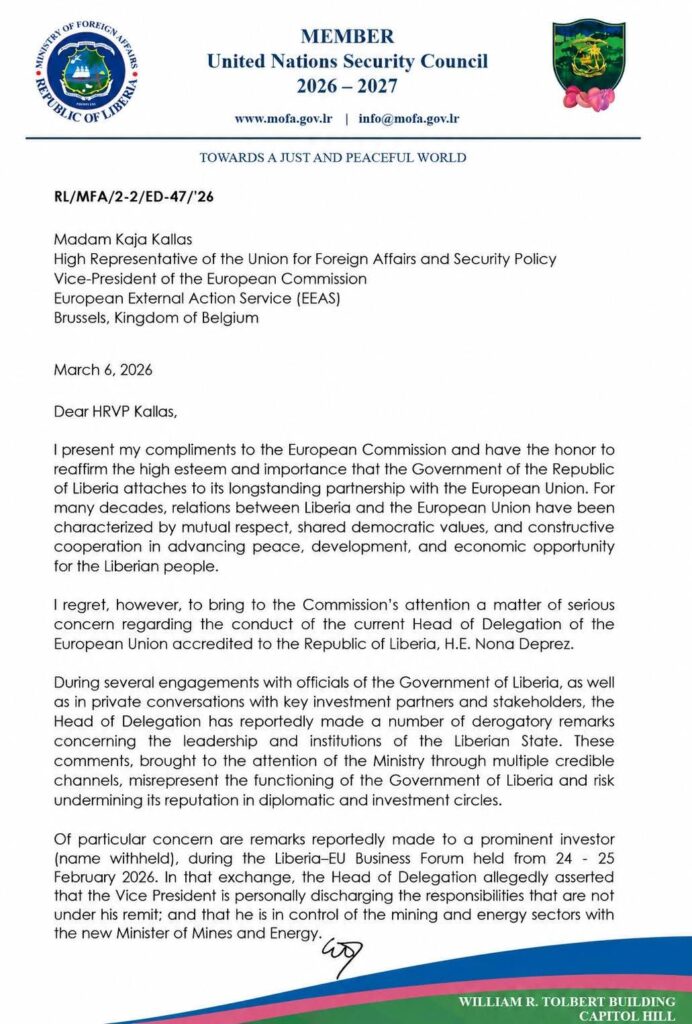
At the center of the debate are claims that EU Ambassador Nona Deprez raised concerns about aspects of the Boakai administration’s governance approach, including issues related to transparency, accountability, and the management of key sectors of the economy. The reported remarks have generated significant public discussion and prompted fresh scrutiny of the government’s relationship with development partners and foreign investors.
According to reports circulating in political circles, Ambassador Deprez allegedly questioned the level of transparency surrounding certain government activities and expressed concerns about the flow of information provided to the public regarding major national projects.
Among the issues reportedly highlighted were developments within Liberia’s energy sector and questions surrounding government disclosures relating to infrastructure and development initiatives. The reports further suggest that concerns were raised regarding information presented to the public about various government achievements and ongoing projects.
The reported comments have become a major talking point among political observers, civil society actors, and members of the opposition, many of whom argue that the controversy extends beyond any individual statement and instead touches on broader questions of governance, public accountability, and investor confidence.
Particularly noteworthy are reports that Ambassador Deprez allegedly described the recent Liberia-European Union Business Forum as potentially being the “first and last” event of its kind. While the context and exact meaning of the statement remain subject to interpretation, political observers say such remarks, if accurately reported, could be viewed as reflecting concerns about the country’s business environment and the confidence of international partners.
The Liberia-EU Business Forum was widely regarded as an important platform for strengthening economic ties, attracting investment, and promoting trade opportunities between Liberia and European investors. As a result, any suggestion of declining enthusiasm among international stakeholders is likely to attract considerable attention from policymakers and the business community alike.
The controversy has intensified amid allegations from critics that some within the government are more focused on responding to the messenger than addressing the concerns reportedly raised.
Government critics argue that public officials should focus on clarifying disputed issues and providing factual responses to questions regarding governance, transparency, and economic management. They contend that addressing substantive concerns directly would be more productive than engaging in public disputes over the statements themselves.
Supporters of the administration, however, maintain that the government remains committed to transparency, accountability, and the implementation of its development agenda. They argue that Liberia continues to make progress in infrastructure development, energy expansion, and economic reforms despite numerous challenges.
The unfolding debate has also revived discussions about political consistency and the role of international actors in assessing governance standards.
Opposition figures point out that during previous administrations, many of today’s governing politicians frequently welcomed criticism and assessments from international partners when those observations were directed at governments they opposed. They argue that the same standards should apply regardless of which political party occupies the Executive Mansion.
According to these critics, concerns expressed by development partners should be viewed as opportunities for dialogue and institutional improvement rather than as hostile interventions.
The broader issue now facing policymakers is how Liberia balances national sovereignty with constructive engagement from international partners whose financial, technical, and diplomatic support remains important to the country’s development goals.
Political analysts note that strong relationships with development partners such as the European Union are often built on mutual trust, transparency, and open communication. They argue that disagreements are not unusual in diplomatic relations but are generally best managed through dialogue and factual engagement.
The European Union has long been one of Liberia’s most significant development partners, providing support in areas including governance, infrastructure, education, health, electoral processes, and private-sector development. Consequently, any public controversy involving senior EU representatives is likely to attract both domestic and international attention.
As public discussion continues, many observers say the central issue is no longer simply about reported comments attributed to a foreign diplomat. Instead, the debate has evolved into a larger conversation about accountability, transparency, investor confidence, and how governments respond when faced with criticism from influential international partners.
Whether the controversy ultimately strengthens dialogue or deepens political divisions remains to be seen. What is certain is that the issue has reignited important national discussions about governance, diplomatic engagement, and the expectations Liberians have for both their leaders and the country’s international allies.
For now, the questions remain: Were legitimate concerns raised that deserve answers? Has the reaction to those concerns overshadowed the substance of the issues being discussed? And how will the government and its international partners navigate a controversy that has quickly become one of the most talked-about political developments in recent weeks?


