


NEW YORK — As the countdown to the 2026 FIFA World Cup accelerates, world football leaders are increasingly focusing on what they hope will be the tournament’s most enduring legacy: expanding opportunities for young people through grassroots football development.
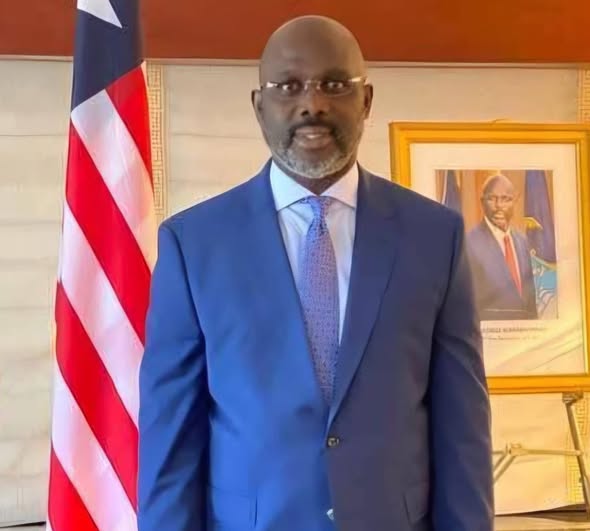
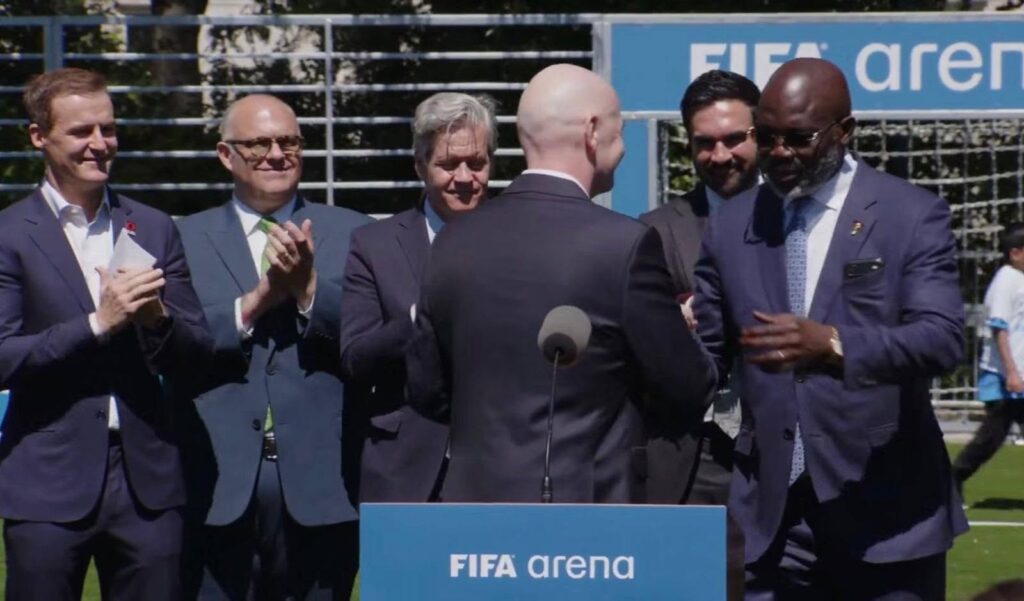
That vision took center stage in New York City as former Liberian President and football legend George Weah joined FIFA President Gianni Infantino, New York Governor Kathy Hochul, and New York City Mayor Zohran Mamdani for the official inauguration of a new FIFA Arena street soccer facility in Manhattan.
The ribbon-cutting ceremony, held near the historic Tavern on the Green in Central Park, brought together football administrators, government officials, community leaders, youth athletes, and sports advocates to celebrate the opening of a modern football venue designed to increase access to the game for young people, particularly those in underserved urban communities.
The new facility forms part of FIFA’s expanding FIFA Arena initiative, a global program aimed at developing community-based football infrastructure ahead of the 2026 FIFA World Cup, which will be jointly hosted by the United States, Canada, and Mexico.
The initiative reflects FIFA’s broader commitment to ensuring that the benefits of hosting the world’s biggest sporting event extend beyond stadiums and tournament venues to neighborhoods where young people can develop their skills, pursue their dreams, and engage in positive community activities through sport.
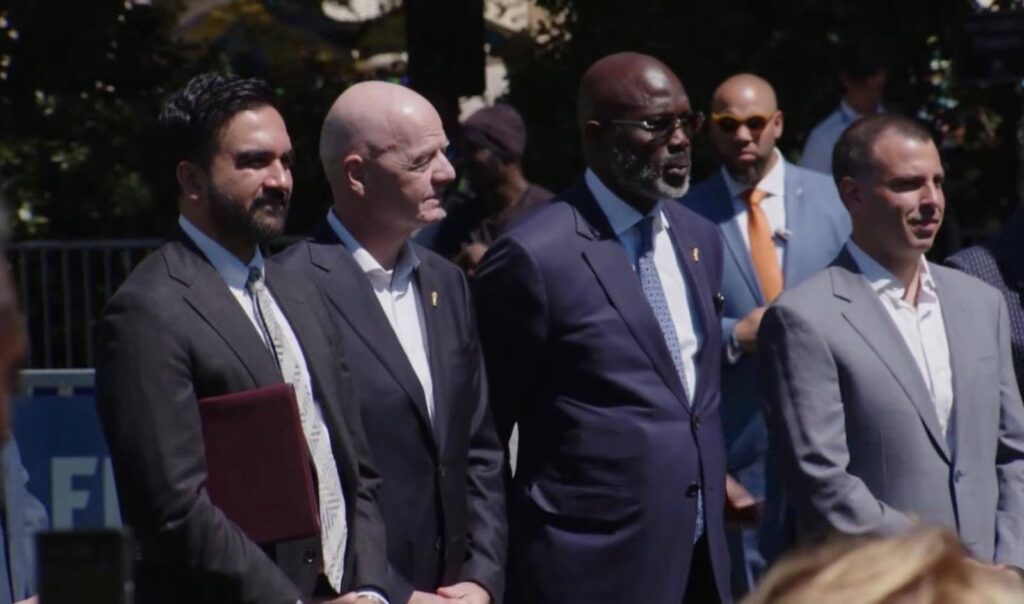
Speaking during the ceremony, FIFA President Gianni Infantino highlighted the importance of investing in facilities that provide safe and accessible environments for young people to play football and develop valuable life skills.
According to FIFA officials, the newly opened arena is expected to serve thousands of young players annually, offering opportunities for training, recreation, community engagement, and organized competition.
The governing body has increasingly embraced urban football projects around the world, recognizing street football as one of the most effective pathways for discovering talent and encouraging youth participation in sports.
The presence of George Weah at the event added significant symbolism to the occasion.
Widely regarded as one of the greatest footballers in history and Africa’s most decorated player, Weah’s own journey embodies the transformative power of football. Rising from humble beginnings in Monrovia, Liberia, he became one of the sport’s most celebrated figures, earning global recognition through a career that inspired millions across Africa and beyond.
In 1995, Weah achieved a feat that remains unmatched by any African footballer. While playing for Italian powerhouse AC Milan, he won the Ballon d’Or, FIFA World Player of the Year, and European Footballer of the Year awards in the same year, cementing his place among football’s all-time greats.
His professional career spanned some of Europe’s most prestigious clubs, including teams in France, Italy, and England, where his speed, skill, and goal-scoring ability made him a global icon.
Beyond football, Weah later transitioned into politics and served as President of Liberia from 2018 to 2024, becoming one of the few athletes in modern history to successfully make the leap from international sports stardom to national leadership.
His participation in the FIFA Arena launch served as a reminder of how access to football can create opportunities that extend far beyond the playing field.
The New York facility arrives at a time when anticipation for the 2026 FIFA World Cup continues to grow worldwide.
The tournament is expected to be the largest in football history, featuring an expanded format of 48 national teams, up from the previous 32-team structure. The expansion is expected to provide additional opportunities for countries from Africa, Asia, and other regions to compete on football’s biggest stage.
FIFA projects that the competition will attract billions of viewers globally and generate substantial economic activity across North America.
The organization also believes the expanded tournament presents a unique opportunity to invest in football development at the grassroots level and create long-term social benefits in host communities.
Football remains the world’s most popular sport, with FIFA estimating that more than five billion people engaged with the 2022 FIFA World Cup in Qatar through television, digital media, and other platforms.
As a result, FIFA has increasingly prioritized programs that make the game more accessible, particularly in communities where sports infrastructure has traditionally been limited.
For New York City, which will play a major role in the 2026 World Cup celebrations, the FIFA Arena represents more than just another sports facility.
Local officials say it is an investment in youth empowerment, community development, public health, and social inclusion. By creating safe spaces for recreation and competition, the facility is expected to help strengthen neighborhoods while providing young people with constructive opportunities for growth and engagement.
Moments after the ribbon-cutting ceremony concluded, children quickly filled the pitch, turning the newly opened arena into exactly what organizers envisioned—a vibrant community space where football can inspire ambition, teamwork, and personal development.
For FIFA, that image captures the true purpose of the initiative.
While the 2026 World Cup will undoubtedly be remembered for its matches, star players, and global spectacle, FIFA officials say the ultimate goal is to leave behind a lasting legacy that extends well beyond the final whistle.
Through projects such as the FIFA Arena initiative, the organization hopes to empower future generations, encourage healthy lifestyles, strengthen communities, and create pathways for young athletes who may one day follow in the footsteps of legends like George Weah.
As preparations for the historic tournament continue, the opening of the New York FIFA Arena stands as another reminder that the future of football is being built not only in world-class stadiums but also in the neighborhoods where tomorrow’s stars first learn to play the game.


