


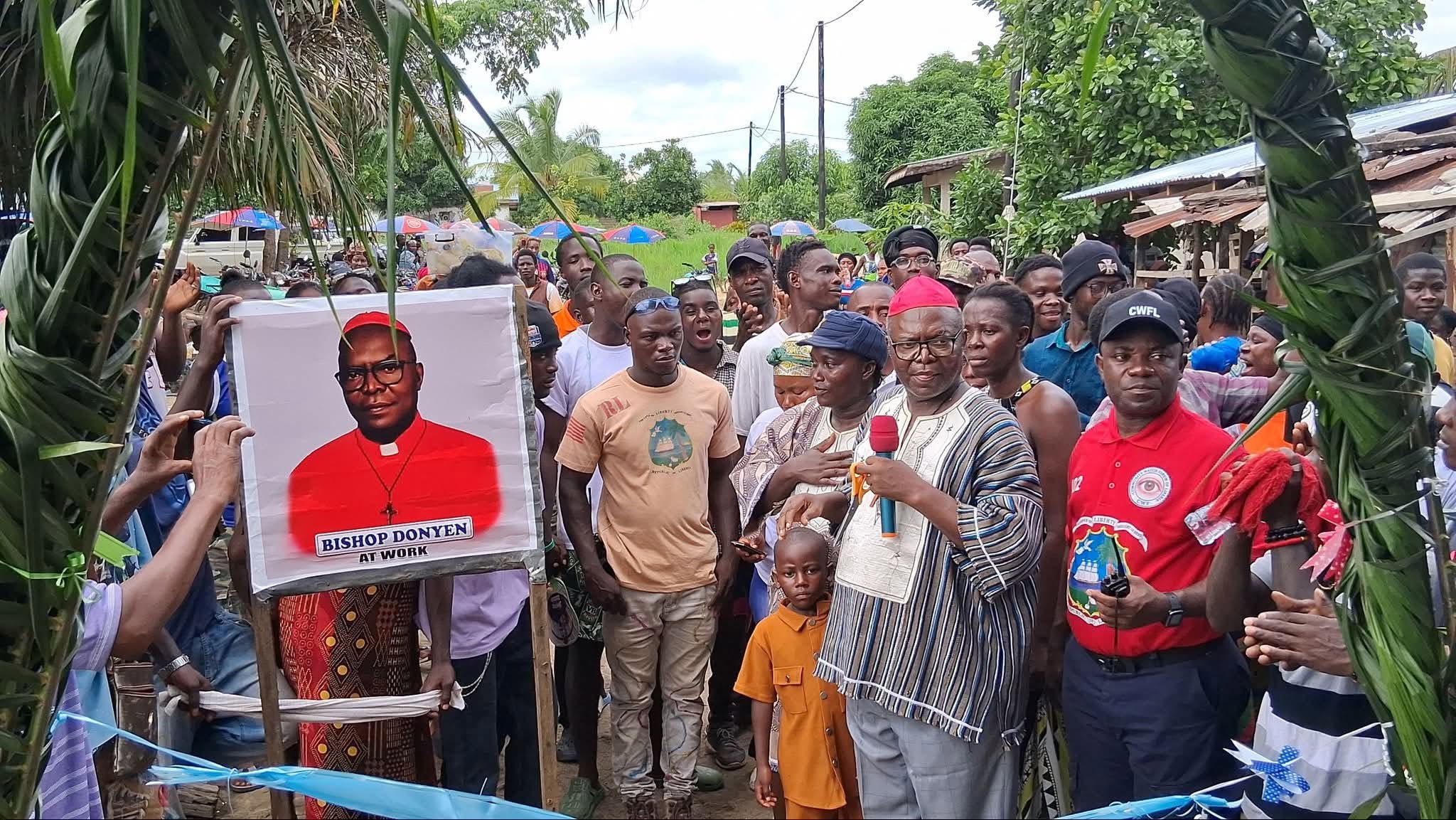
JOHNSONVILLE, Montserrado County – What began as a target of criticism on social media has become a symbol of relief and community impact for thousands of residents in two Johnsonville communities who now enjoy safer and easier access to schools, markets, healthcare facilities, and neighboring neighborhoods.
A newly constructed 1,400-foot wooden footbridge linking the Kpanwin and New Life communities is drawing praise from residents who say the structure has solved a longstanding transportation challenge that affected daily life for years.
The bridge, built at a cost of more than LRD 800,000, was fully financed by former Montserrado County District #2 Representative candidate and Independent Catholic Church of Liberia Bishop, Nimely Donyen.
While photographs of the bridge recently sparked debate and criticism online, residents and community leaders say the true measure of the project lies not in social media commentary but in the practical benefits it is delivering to thousands of people every day.
Speaking during the dedication ceremony, Bishop Donyen defended the initiative and challenged critics to contribute positively to their communities rather than focusing solely on criticism.
“To those who are there just to find something to criticize, I say to you: find something to do for our people. Do what you can to bring relief to our people,” Donyen declared.
According to him, the project was undertaken to address years of hardship experienced by residents who relied on a deteriorating crossing point that often posed serious risks to pedestrians.
He explained that despite limited resources, the bridge was constructed as a humanitarian intervention aimed at improving mobility and safety for residents.
“In our poverty, in our weakness, we were able to bring this kind of relief to you,” Donyen told community members. “I believe that with this job that has been done here, the attention of government and other people will be turned to this area.”
Residents Describe Major Improvement
For residents of Kpanwin and New Life, the bridge has become more than just a structure; it represents a solution to years of inconvenience and danger.
Many residents say the previous crossing was unstable and hazardous, particularly during the rainy season, making it difficult for schoolchildren, traders, pregnant women, and elderly residents to move safely between communities.
Market woman Mercy Wallace-Johnson recounted the challenges residents endured before the construction of the new bridge.
“We used to fall down on the bridge carrying our market goods from Red Light,” she said. “But now we can cross freely without fear. This bridge means a lot to us.”
According to Wallace-Johnson, the bridge serves as the shortest and most convenient route to the bustling Red Light commercial area, making transportation easier and reducing travel time for residents engaged in business and other daily activities.
Community Leaders Applaud Initiative
Local leaders have also voiced support for the project, arguing that its usefulness outweighs criticism circulating on social media platforms.
New Life Community Block Leader Pastor Jacob Allison described the bridge as a practical development that is improving the lives of thousands of people.
“As long as the bridge is serving its intended purpose, it must be commended,” Allison said.
He estimated that approximately 10,000 residents from both communities directly benefit from the crossing.
“Pregnant women can now access the other side of the community. People can move safely. That alone shows the importance of this bridge,” he noted.
Allison also praised Donyen for funding the project personally rather than relying on public funds.
“This was not built with government money or community taxes,” he emphasized. “It was a personal humanitarian gesture, and for that, we must commend Bishop Nimely Donyen.”
Calls for Larger Infrastructure Investment
Although residents are celebrating the immediate benefits of the bridge, many hope the project will attract greater government attention to the area’s infrastructure needs.
Donyen himself used the occasion to renew calls for a permanent concrete bridge capable of accommodating vehicles and boosting economic activities within the communities.
He expressed optimism that future investments could transform the area even further.
“If government cannot do it before 2029, by July 26, 2030, there will be a concrete bridge here that cars can pass on,” he pledged.
His remarks were met with applause from residents who believe improved infrastructure could unlock new economic opportunities and improve access to essential services.
Beyond Social Media Debate
While discussion about the bridge continues online, residents say the conversation on the ground is very different.
For the thousands of people who now cross safely each day, the structure has become an important lifeline connecting families, businesses, schools, and healthcare services.
Community members argue that the bridge demonstrates how local initiatives can provide immediate solutions to pressing challenges, even in the absence of large-scale government projects.
For Kpanwin and New Life residents, the bridge may be constructed from wood, but its impact is being measured in safer journeys, improved mobility, and renewed hope for future development.


