


BUCHANAN, Grand Bassa County May 1, 2026— What began as a church groundbreaking in Buchanan quickly evolved into something far larger: a rare public display of civic unity in a country where collective purpose is often promised, but seldom performed.
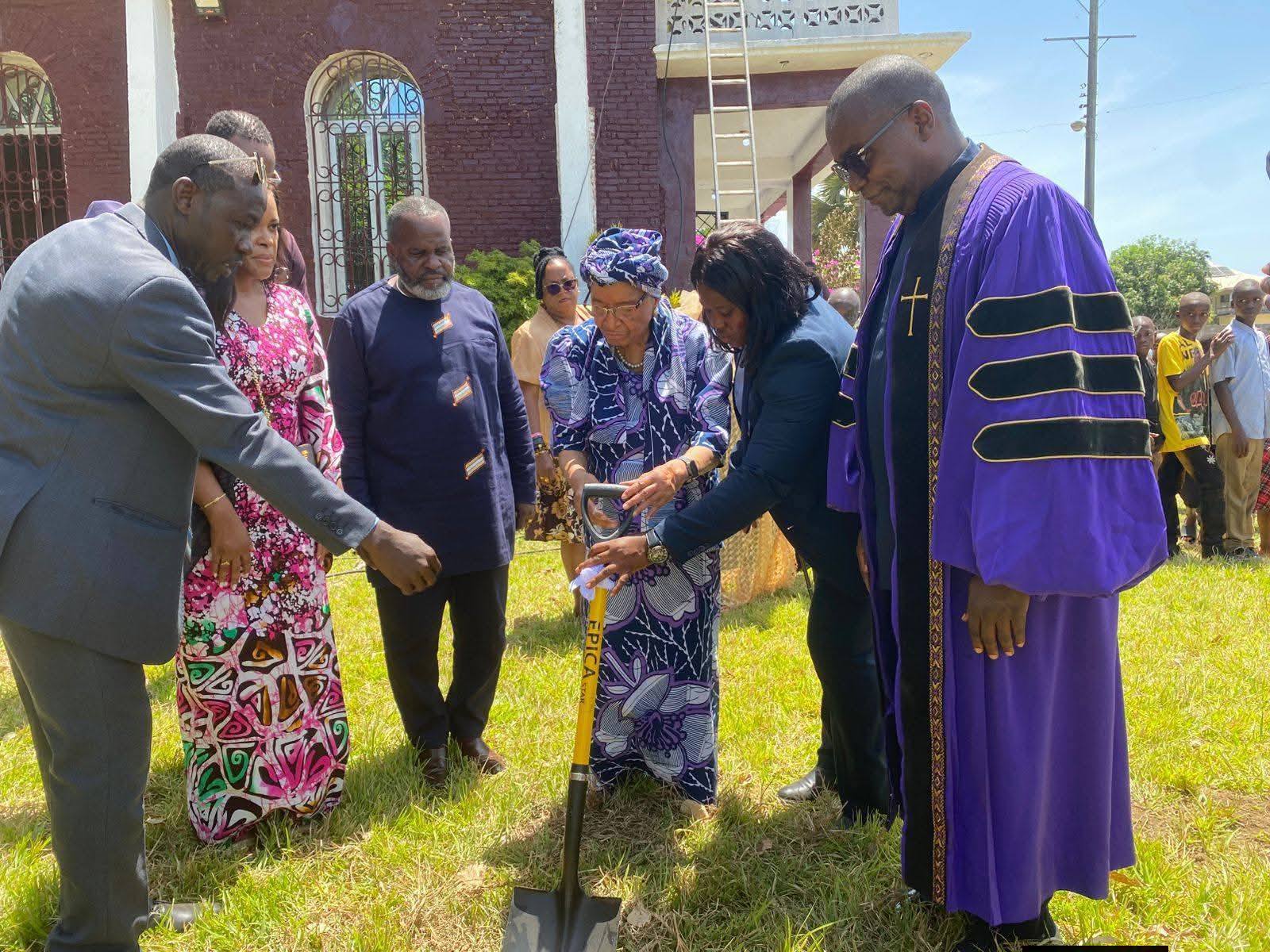
On Sunday, the Charles Aaron White Memorial United Methodist Church—one of Liberia’s oldest and most historically significant congregations—broke ground on a new US$80,000 church building, marking more than the start of a construction project. It marked a public demonstration of what coordinated local leadership, shared faith, and civic responsibility can still produce in Liberia.
Founded in 1842, the church has stood for 182 years as one of the country’s oldest surviving religious institutions, enduring civil conflict, political upheaval, and generational transition. But the significance of Sunday’s ceremony was not rooted in the age of the congregation alone.
It was rooted in what the event revealed: that in a national climate often defined by institutional weakness and fragmented public trust, local communities still retain the capacity to organize, mobilize, and build. That was the deeper significance of the groundbreaking.
What took place in Buchanan was not simply a ceremonial launch for a church structure. It was a public case study in how religious institutions continue to function as some of Liberia’s most durable organizing centers—capable of convening leadership, mobilizing resources, and translating symbolism into visible action.
The project, led by Head Pastor Dr. Lawrence Larry Bropleh, was framed not as a fundraising exercise, but as a moral and communal obligation. In a sermon delivered before the groundbreaking, Bropleh recast the occasion as a call to rebuild not only a church, but a civic ethic.
Preaching on what he described as “the construction of the mindset to value each other,” Bropleh argued that the true foundation being laid was not concrete, but social responsibility. His message was simple but strategically powerful: institutions endure when communities decide they matter.
That framing transformed the ceremony from a church event into a broader reflection on Liberia’s civic condition, where many public institutions remain fragile, but faith-based institutions continue to command legitimacy, trust, and mobilizing power. Former President Ellen Johnson Sirleaf’s presence reinforced that message.
Serving as chief launcher, Sirleaf elevated the event from a local religious gathering to a broader statement about nation-building. Her remarks were less about the church itself than about the national principle the moment represented.
“To benefit from anything, everyone must play their part,” Sirleaf told the gathering, offering a pointed reminder that Liberia’s most persistent development failures have often stemmed not from a lack of vision, but from a deficit of shared responsibility.
Her intervention gave the event its political weight. “The problem of this country no one person can solve. Rather, everyone must play their part,” she said, drawing a direct line between community participation and national progress.
The message was unmistakable: Buchanan’s church groundbreaking was being cast not only as a local religious milestone, but as a working model of collective responsibility in practice. That interpretation was reinforced by the turnout.
The event drew prominent sons and daughters of Grand Bassa, local leaders, church members, and residents whose financial pledges and public participation transformed the groundbreaking into a broader civic exercise. The significance of the gathering was not simply that people attended, but that they showed up prepared to contribute.
In practical terms, the project is modest: an $80,000 church building in a coastal county capital. In political and social terms, however, its symbolism is outsized.
At a time when national discourse is often dominated by political division, public distrust, and institutional underperformance, the Charles Aaron White Memorial United Methodist Church project offered a counter-image: a functioning example of communal coordination, local ownership, and shared investment.
That may be what made the moment consequential. After 182 years, the church is not merely expanding its physical footprint.
It is reaffirming an older and increasingly scarce Liberian idea—that institutions survive not because they are old, but because people continue to build them together.


