


MONROVIA, LIBERIA – May 1, 2026 – The Boakai administration has stepped up efforts to recalibrate Liberia’s domestic commerce structure, with a renewed focus on enforcing existing investment laws designed to expand Liberian participation in key segments of the economy.
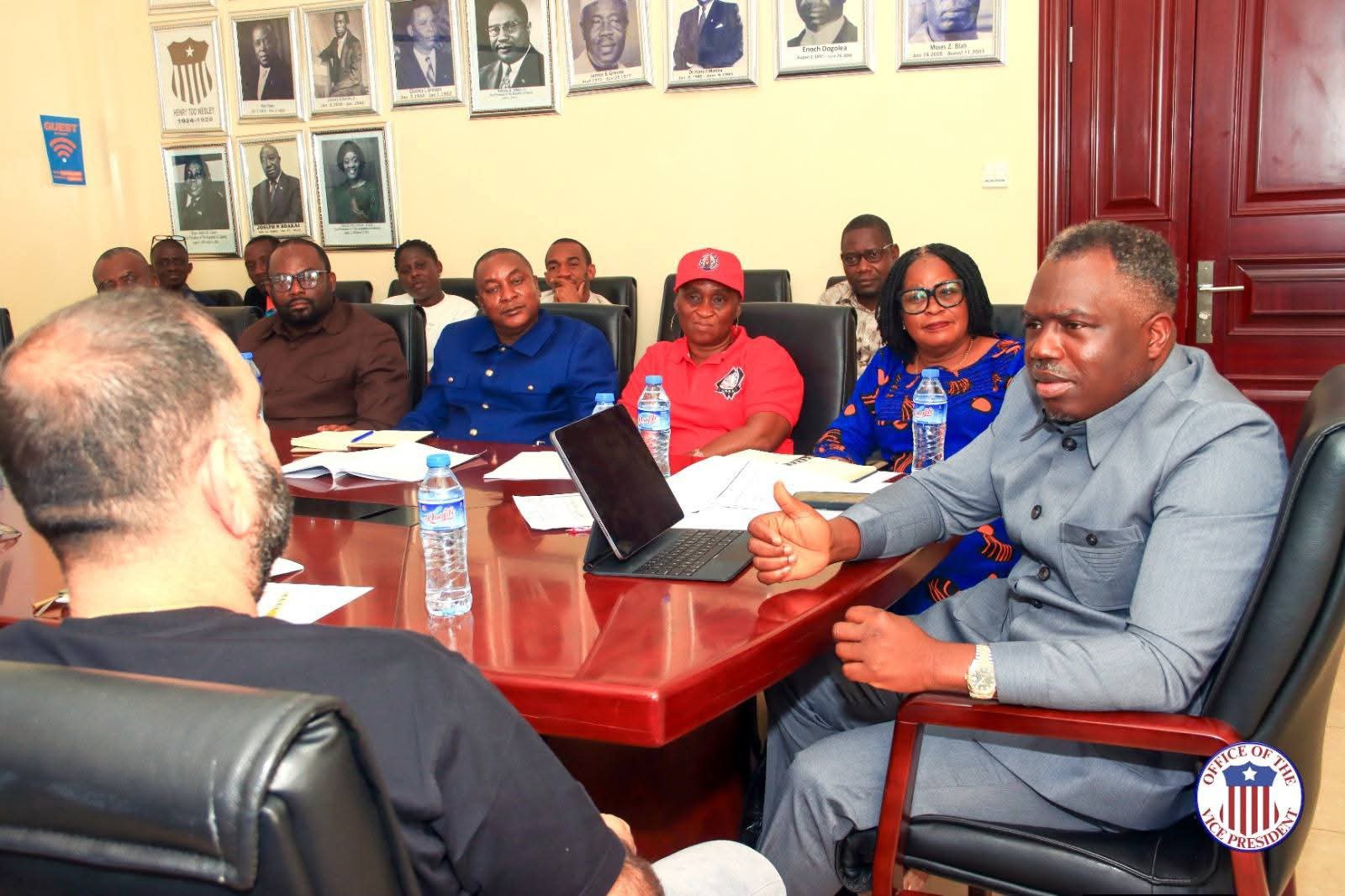
At the center of this policy push is Vice President Jeremiah Kpan Koung, Sr., who on Friday convened a high-level engagement with manufacturers and private sector stakeholders in Monrovia to discuss the practical enforcement of the 2010 Investment Act. The law reserves specific distribution and retail sectors exclusively for Liberian-owned businesses, but implementation challenges have long been cited as a barrier to its full effectiveness.
From Policy to Practice: Closing the Enforcement Gap
The meeting reflected a broader government concern: while Liberia’s legal framework clearly defines protected business categories for citizens, enforcement and compliance gaps have allowed mixed participation models—particularly in distribution chains where foreign operators remain active.
Speaking during the engagement and earlier on the state broadcaster ELBC, Vice President Koung reaffirmed the government’s political commitment to ensuring that Liberians are not only legally protected on paper but are also actively positioned to benefit from those protections in practice.
He emphasized that strengthening Liberian ownership in distribution and retail is not a symbolic policy objective, but a structural economic priority aimed at expanding domestic participation in value chains.
The G5 Case: A Test of Distribution Reform
A major focus of the discussion was the distribution structure of G5, formerly associated with Coca-Cola bottling operations in Liberia. The company currently operates a hybrid distribution system involving both Liberian and foreign distributors.
However, stakeholders highlighted significant structural barriers that limit broader Liberian entry into the system, including high entry thresholds such as approximately US$150,000 in bank guarantees, established logistics requirements, and the need for strong pre-existing market networks capable of sustaining cash-based operations.
These constraints, according to participants, have unintentionally narrowed the pool of eligible Liberian distributors despite the legal intent of the Investment Act.
A policy proposal now under consideration suggests a phased restructuring approach that would gradually reduce foreign participation in distribution channels while identifying between five and ten qualified Liberian-owned firms to serve as official distributors.
The Ministry of Commerce and Industry is expected to issue formal guidelines to facilitate the selection and onboarding of eligible Liberian enterprises.
Expanding Formal Distribution Systems Beyond Manufacturing
The discussion also extended to companies such as NICOM Distilleries and RITCO, both of which currently rely on direct-to-consumer sales models rather than structured third-party distribution systems.
Stakeholders proposed transitioning these companies toward formalized distribution frameworks that would similarly incorporate five to ten Liberian-owned distributors per entity.
This model, officials argue, would improve market efficiency, broaden access for local entrepreneurs, and align commercial operations more closely with national economic inclusion goals.
Revisiting Liberia’s Investment Architecture
Beyond individual company structures, the broader policy conversation centered on strengthening compliance with the 2010 Investment Act, which reserves approximately 16 to 20 categories of business activity exclusively for Liberian citizens.
Recent assessments have raised concerns about increasing foreign participation in sectors legally designated for Liberian ownership, prompting renewed scrutiny of enforcement mechanisms across regulatory institutions.
At one stage, policymakers considered introducing additional legislative measures modeled on foreign ownership restrictions used in other jurisdictions. However, after review by the Ministry of Commerce and key stakeholders, consensus emerged that the existing legal framework is sufficient—if properly enforced.
The challenge, therefore, has shifted from legislation to implementation.
Economic Nationalism and Market Structure Realignment
The Vice President’s engagement reflects a broader shift toward what government officials describe as “economic rebalancing”—a policy direction aimed at increasing Liberian control over domestic distribution networks while maintaining investor confidence in manufacturing and production sectors.
Supporters of the initiative argue that strengthening local participation in distribution is essential for expanding entrepreneurship, improving income retention within the domestic economy, and reducing structural dependence on foreign intermediaries in retail supply chains.
However, the transition is expected to require careful calibration to avoid disruptions in supply chains, pricing stability, and investor confidence.
A Policy Test of Enforcement Capacity
As Liberia moves toward deeper implementation of its Liberianization framework, the central policy question is no longer the absence of legal instruments, but the state’s capacity to enforce them consistently across sectors.
Vice President Koung’s engagement with manufacturers signals an attempt to bridge that gap by aligning government policy, private sector operations, and regulatory enforcement under a more coordinated national framework.
Whether this effort translates into measurable increases in Liberian ownership within distribution networks will depend largely on institutional follow-through, regulatory discipline, and the willingness of market actors to adjust long-standing operational models.
For now, the initiative marks one of the most direct efforts in recent years to translate Liberia’s economic nationalism policy into concrete commercial restructuring.


