


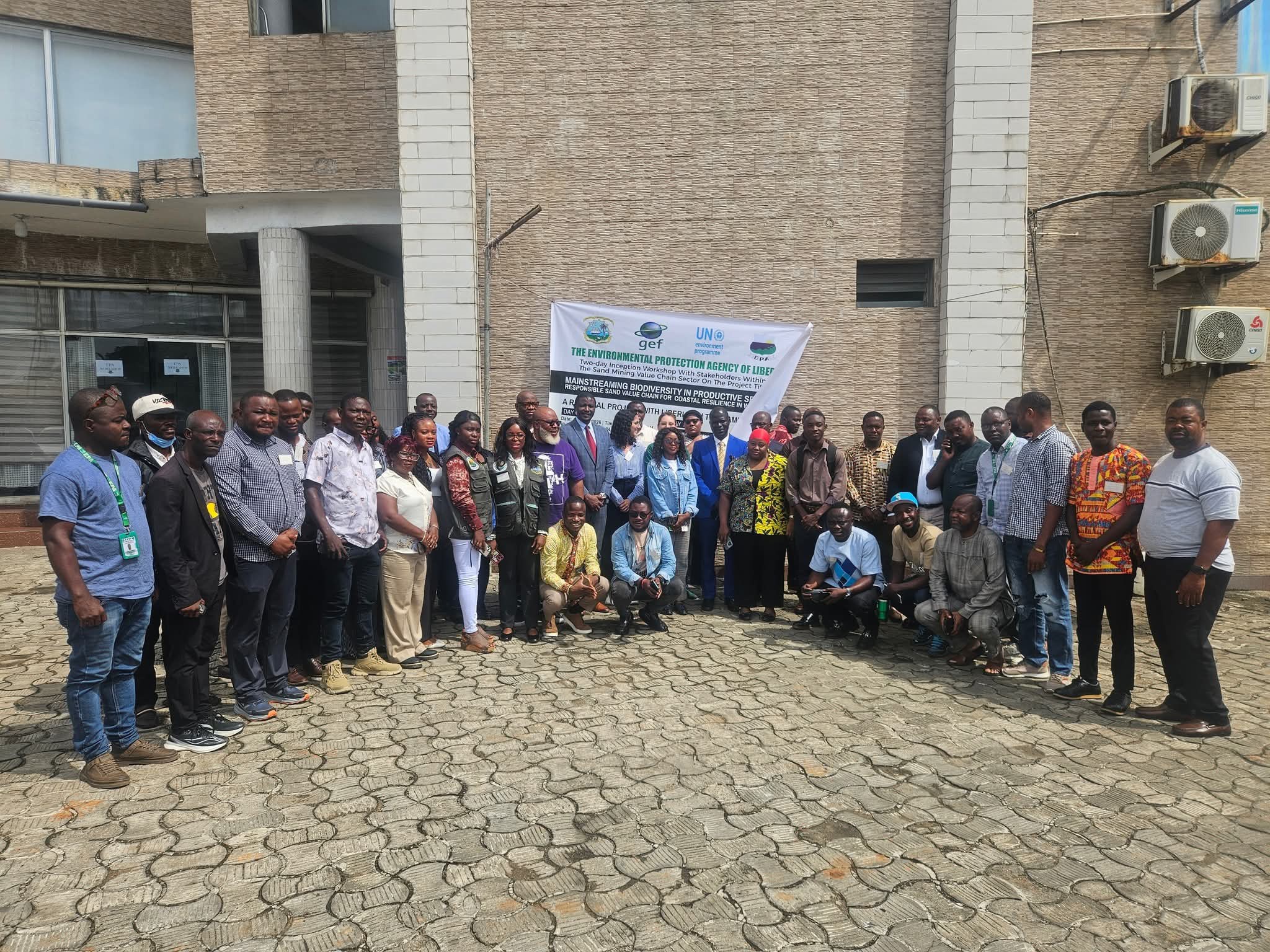
MONROVIA, LIBERIA – April 30, 2026 – As Liberia’s construction boom continues to accelerate demand for natural resources, government institutions and international partners are now confronting a growing environmental cost: the rapid depletion and degradation of the country’s sand ecosystems.
In response, the Government of Liberia, through the Environmental Protection Agency (EPA), has convened a high-level two-day inception workshop in Monrovia aimed at reshaping how sand is extracted, regulated, and integrated into national development planning.
Held at the Corina Hotel, the workshop is anchored on the theme: “Mainstreaming Biodiversity in Productive Sectors: Responsible Sand Value Chain for Coastal Resilience in West Africa.”
The gathering brings together a wide spectrum of actors, including the Ministry of Mines and Energy, Forestry Development Authority, Liberia National Tourism Authority, National Disaster Management Agency, Food and Agriculture Organization (FAO), Civil Society Network of Liberia, and development partners.
The breadth of participation reflects a growing recognition that sand mining is no longer a narrow industrial concern, but a cross-sectoral challenge with direct implications for environmental stability, infrastructure resilience, and community livelihoods.
Rising Environmental Pressure Behind Economic Growth
Opening the workshop, EPA Executive Director Dr. Emmanuel K. Urey Yarkpawolo delivered a stark assessment of the country’s environmental trajectory, warning that Liberia’s coastal zones and river systems are increasingly under pressure from unregulated and unsustainable sand extraction.
He noted that the rising demand for sand—driven largely by infrastructure development and urban expansion—is accelerating coastal erosion, destroying critical habitats, and weakening natural defenses against climate change.
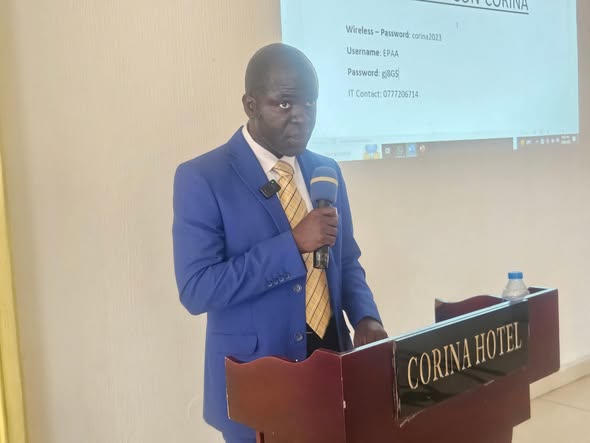
“In some parts of the country, we are witnessing visible retreat of the coastline. This is not simply an environmental concern; it is a structural threat to communities, infrastructure, and national resilience,” Dr. Yarkpawolo stated.
He emphasized that without urgent intervention, Liberia risks deepening environmental degradation that could undermine long-term development gains.
To address this, he outlined a multi-pronged approach focusing on improved environmental data collection, stronger regulatory enforcement, and policy harmonization across relevant institutions. He also highlighted the need to promote alternative construction materials, including compressed earth blocks, to reduce dependence on natural sand.
Global and Regional Support for Sustainable Reform
Reinforcing the international dimension of the initiative, Natalie K. L. Harms, representing the United Nations Environment Programme (UNEP), underscored Liberia’s ecological significance, particularly its coastal ecosystems and wetlands.
She acknowledged the dual reality facing developing economies: sand remains essential for infrastructure development, yet its extraction must be carefully managed to avoid long-term ecological damage.
Harms reaffirmed UNEP’s commitment to supporting Liberia through the Global Biodiversity Framework Fund, aimed at strengthening sustainable resource governance and protecting biodiversity across productive sectors.
Governance and Community Inclusion at the Center
From the perspective of local governance, Montserrado County Superintendent Whroway Bryant stressed that communities living in sand mining zones are among the most affected by environmental degradation and must therefore be actively included in decision-making processes.
He called for stronger institutional coordination and urged government agencies to move beyond fragmented regulation toward a unified enforcement framework.
Bryant’s remarks highlighted a persistent governance gap in natural resource management—where policy formulation often outpaces community-level implementation and oversight.
Strategic Resource or Environmental Risk?
Providing a technical perspective, Emmanuel Vaye, Assistant Minister for Planning, Research and Development at the Ministry of Mines and Energy, described sand as a strategic input for national development, particularly in road construction, housing, and infrastructure expansion.
However, he warned that the absence of structured planning and regulation has turned what should be a managed resource into an environmental liability.
He advocated for treating sand as a finite strategic commodity, requiring coordinated planning, controlled extraction, and long-term sustainability frameworks.
Building a Shared Governance Framework
Summarizing the purpose of the workshop, Desmond T. Thompson, Project Liaison Officer in the office of the EPA Executive Director, said the initiative is designed to align stakeholders around a common understanding of the sand value chain.
He explained that the sessions will focus on biodiversity protection, governance reforms, regulatory challenges, and livelihood considerations, while also identifying gaps between national policy and implementation.
According to Thompson, the workshop is intended to serve as a foundation for a more integrated and enforceable sand mining governance system that balances economic development with environmental protection.
A Turning Point for Resource Governance
The Monrovia workshop signals an emerging policy shift in Liberia’s approach to natural resource management—moving from reactive regulation toward coordinated, evidence-based governance.
At its core, the initiative reflects a broader national tension: how to sustain economic growth driven by infrastructure development while safeguarding fragile ecosystems that underpin long-term resilience.
As discussions continue, stakeholders are increasingly aligned on one point—sand, once viewed as an abundant and informal commodity, is now a strategic environmental and economic resource requiring urgent national attention.


