


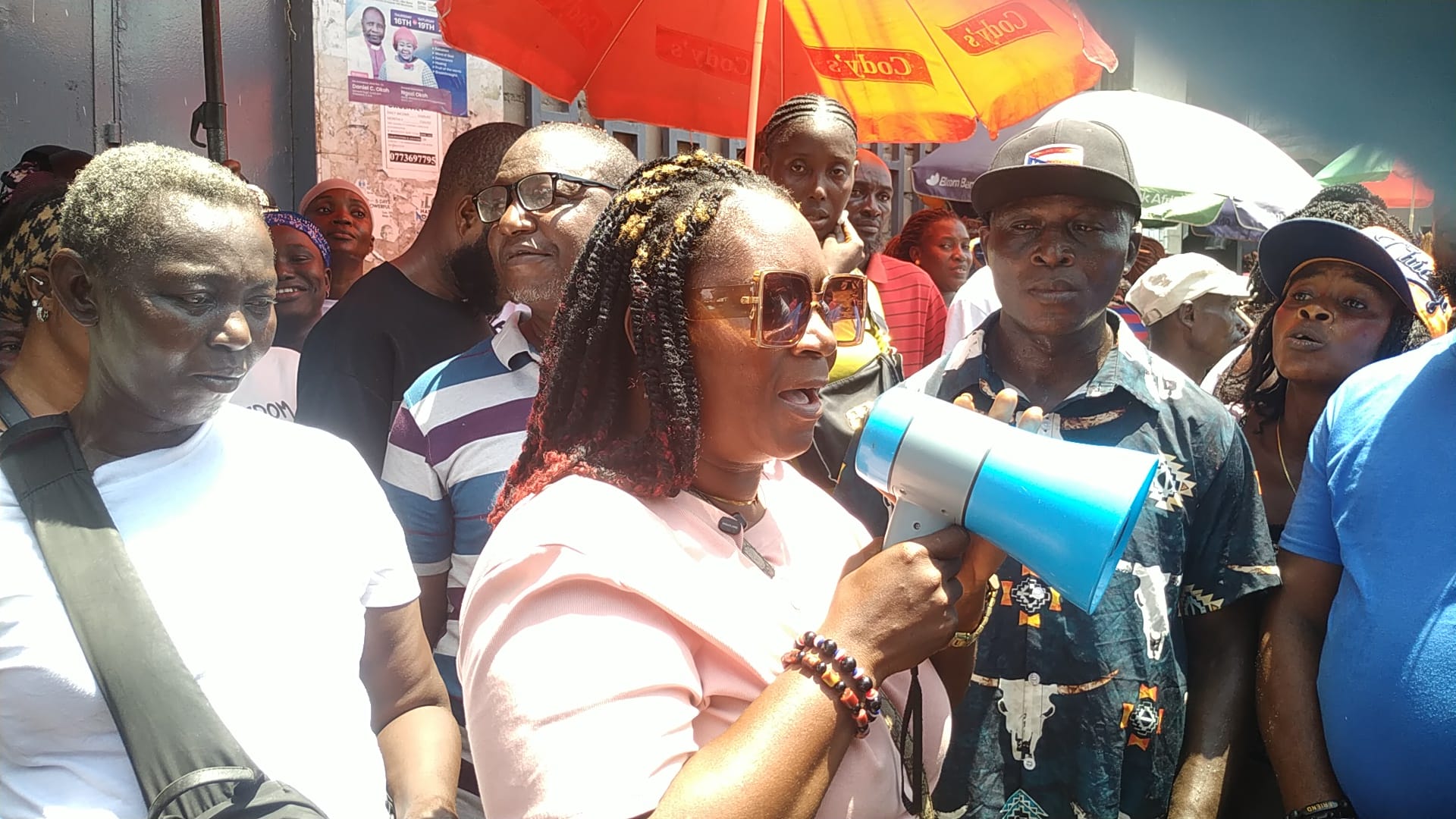
MONROVIA, Liberia — Liberia’s latest attempt to regulate street commerce is drawing sharp resistance from informal traders, who argue that the government’s enforcement-first approach risks deepening economic hardship for thousands of low-income families already operating on the margins of survival.
The dispute follows a recent announcement by the Ministry of Commerce and Industry directing that, effective May 1, 2026, all commercial activities and transactions must be conducted strictly within stores and shops. The ministry said the measure is intended to restore order in commercial corridors, improve public safety, and ease pedestrian movement in congested parts of the capital.
But for Liberia’s petite traders—many of whom rely on roadside vending as their primary source of income—the directive is being viewed less as a regulatory reform and more as a direct threat to household survival.
In a strong response to the ministry’s statement, the Federation of Petite Traders and Informal Workers Union of Liberia criticized the government’s decision as unilateral and disconnected from the economic realities facing informal workers. The group argued that the policy, while framed as an urban management measure, overlooks the central role informal street trading plays in sustaining livelihoods across Monrovia.
Speaking on behalf of traders in central Monrovia, Victoria Sawah, Chairlady of Bloc B Community on Ashmun Street, called on the government to suspend enforcement and pursue dialogue instead. She urged authorities to engage the traders and the Monrovia City Corporation before implementing restrictions that could displace hundreds of small-scale vendors.
Her appeal reflects a broader concern shared by informal workers across the city: that street vending in Liberia is not simply an issue of public disorder, but one of economic necessity.
For many traders, roadside commerce is the most accessible form of participation in the economy, requiring little start-up capital, limited infrastructure, and no formal business entry barriers. In a country where formal employment remains scarce and household incomes remain fragile, informal trading functions as both an economic buffer and a social safety net.
That reality complicates the government’s effort to impose order on commercial spaces.
While the Ministry of Commerce has justified the directive on grounds of sanitation, safety, and urban mobility, traders argue that the state is treating informality as a nuisance to be removed rather than an economic system to be managed and supported.
Sawah emphasized that traders are not opposed to regulation, but to what they describe as exclusion without consultation.
She noted that traders in her community have maintained cooperation with city authorities and regularly participate in local sanitation efforts, particularly along Ashmun Street, which she said is cleaned every first Saturday of the month. She added that traders remain committed to keeping the area clean and orderly, including this weekend’s scheduled cleanup.
That position suggests the dispute is not over whether regulation is necessary, but over how it is designed and enforced.
At the center of the disagreement is a familiar policy tension in many African cities: the conflict between urban modernization and informal survival economies.
Governments often frame street-clearing campaigns as necessary for order, beautification, and public safety. But without viable alternatives—such as affordable market stalls, designated vending zones, or phased transition plans—such policies can function less as reform and more as economic displacement.
In Liberia’s case, the stakes are especially high.
Petite traders form a visible and essential part of the country’s urban informal economy, supplying low-cost goods to working-class consumers while supporting families through daily cash-based commerce. Restricting their access to public trading space without a negotiated alternative risks disrupting both income generation and neighbourhood market access.
The federation’s response therefore raises a deeper policy question: can Liberia reform its urban commercial spaces without undermining the fragile economic systems that sustain its poorest citizens?
That question now sits at the heart of the dispute. What the Ministry of Commerce sees as an effort to restore order, petite traders see as a test of whether economic governance in Liberia can balance regulation with inclusion.
For now, the traders’ message is clear: urban order cannot come at the expense of economic survival.


