


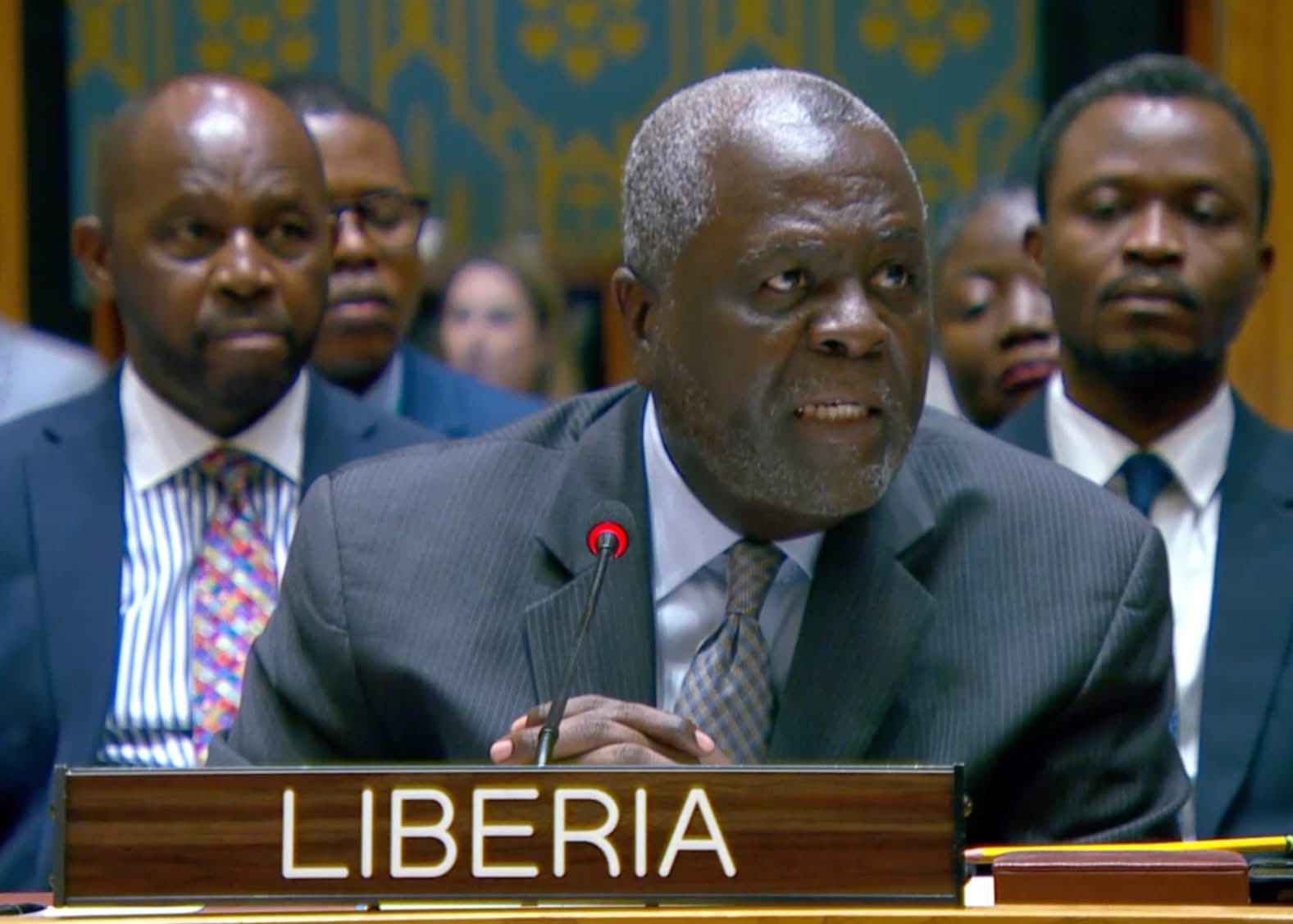
UNITED NATIONS — Liberia used the United Nations Security Council’s 10,145th meeting to shift the maritime security debate from abstract diplomacy to immediate economic risk, warning that the recent seizure of a Liberian-flagged vessel by Iranian forces demonstrates how fragile global shipping routes have become—and how quickly regional conflict can spill into world commerce.
Addressing the Council on Friday during a high-level debate on the safety and protection of waterways, Liberia’s Permanent Representative to the United Nations, Ambassador Lewis G. Brown II, argued that maritime insecurity is no longer a peripheral security concern. It is now a central threat to global economic stability, energy flows, and supply chains.
“The map of global insecurity is being increasingly drawn at sea,” Brown told the Council, framing Liberia’s intervention not as a theoretical policy statement but as the position of a directly affected state. His remarks came just days after Iranian forces seized the Liberia-flagged Epaminondas in the Strait of Hormuz on April 22, one of two commercial vessels detained in an incident that escalated tensions in one of the world’s most strategically vital maritime corridors.
For Liberia, the incident was not merely diplomatic. It was structural.
As one of the world’s largest ship registry states, Liberia occupies a uniquely exposed position in global maritime trade. While it is geographically distant from the Strait of Hormuz, its flag is carried by thousands of vessels moving through the world’s most contested shipping lanes. That makes maritime instability in the Gulf not just a regional security issue for Liberia, but a direct national economic and legal concern.
Brown’s intervention made that point with precision: Liberia was not speaking as a distant observer, but as a state whose legal identity, commercial exposure, and international obligations are directly tied to the safety of sea lanes.
The April 22 seizure illustrated that vulnerability in practical terms. According to Reuters and maritime security reporting, Iranian Revolutionary Guard naval forces fired on multiple commercial vessels in and around the Strait of Hormuz before seizing two ships, including the Liberia-flagged Epaminondas. Maritime monitors reported damage to the vessel, underscoring how quickly geopolitical confrontation can become a direct threat to commercial shipping and crew safety.
Liberia’s message to the Council was built around three principles: restraint, consistency, and responsibility.
The first—restraint—was a warning against the weaponization of chokepoints such as the Strait of Hormuz, where narrow waterways can be turned into geopolitical pressure valves. Liberia’s argument was clear: when states militarize strategic shipping corridors, the consequences extend far beyond the immediate theater of conflict.
The second—consistency—was a call for uniform adherence to international maritime law. Brown urged the Council to reject selective enforcement of navigation rights, arguing that freedom of navigation cannot be defended in one maritime corridor and compromised in another without eroding the credibility of the rules-based order.
The third—responsibility—was directed at both coastal states and global powers. Liberia’s position suggested that maritime security cannot depend solely on naval deterrence or retaliatory enforcement. It requires disciplined state conduct, credible legal standards, and collective accountability through multilateral institutions.
This was the core of Liberia’s analytical argument: maritime insecurity is no longer confined to naval strategy. It has become an economic transmission mechanism.
A disruption in the Strait of Hormuz is no longer just a regional incident. It is a global inflationary trigger. It affects freight insurance, fuel costs, food prices, and commodity markets. What happens in a narrow waterway in the Gulf can ripple into fragile economies across Africa, raise import costs in developing states, and intensify financial pressure on households far removed from the site of confrontation.
Liberia’s intervention therefore marked a notable reframing of the maritime security debate: from military passage to economic consequence.
Rather than merely condemning the seizure of a Liberian-flagged vessel, Monrovia used the incident to expose a broader systemic weakness in global governance—namely, that the international community remains heavily dependent on maritime trade routes it has not adequately secured through coherent legal enforcement.
In effect, Liberia’s message to the Security Council was that maritime security can no longer be treated as a naval issue alone. It is now a test of whether the international system can protect commerce, uphold legal norms, and prevent strategic waterways from becoming instruments of economic coercion. For Liberia, the seizure of one vessel was not just a flag-state incident.
It was evidence of a widening gap between global dependence on maritime trade and the international community’s capacity to protect it.


