


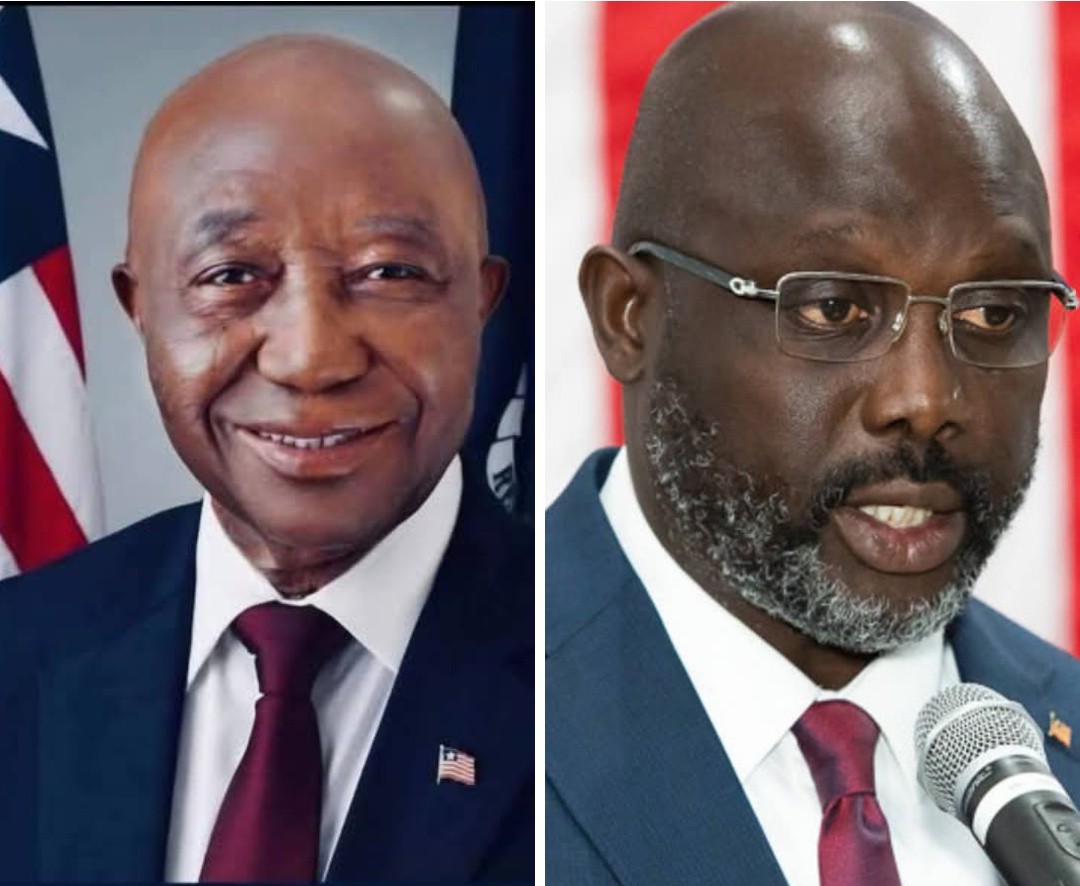
MONROVIA, Liberia — A statistical comparison of Liberia’s last two administrations is reshaping the country’s political debate, with emerging macroeconomic data suggesting that President Joseph Nyuma Boakai has delivered stronger early economic indicators in less than half the time President George Manneh Weah spent in office.
The comparison is politically significant not because it settles the question of long-term governance, but because it sharpens it.
President Weah governed for a full constitutional term—72 months from January 2018 to January 2024—under difficult conditions that included post-Ebola economic fragility, the drawdown of the United Nations Mission in Liberia (UNMIL), and the COVID-19 shock. President Boakai, by contrast, has governed for just 28 months, inheriting a post-pandemic economy with easing global inflation but persistent domestic fiscal strain.
The central question now is no longer who governed under harder circumstances. It is who converted available conditions into stronger measurable outcomes. On that count, the numbers increasingly favor Boakai—at least in the short term.
Growth: Boakai’s Early Pace Outruns Weah’s Full-Term Average
Over six years in office, Weah’s administration posted an average annual growth rate of approximately 1.9 percent, a figure weighed down by contractions of 2.5 percent in 2019 and 3.0 percent in 2020 before rebounding in the later years of his presidency.
While that recovery brought growth to 5.0 percent in 2021, 4.8 percent in 2022, and 4.7 percent in 2023, the broader six-year average remained weak by regional standards and insufficient to significantly reduce poverty in a country with rapid population growth. Boakai’s first two years tell a different story.
Liberia’s economy expanded by 4.0 percent in 2024 and 5.1 percent in 2025, giving the Boakai administration an early average growth rate of 4.55 percent—more than double Weah’s six-year average. That acceleration has been driven by stronger export performance, a 17 percent expansion in mining, and a 31.5 percent rise in exports to US$2.1 billion. The implication is politically consequential: Weah governed longer, but Boakai has so far generated stronger growth momentum in less time.
Inflation: The Sharpest Contrast Between the Two Administrations
If growth defines momentum, inflation defines public memory. Weah’s presidency was marked by prolonged inflationary pressure, particularly in its early years. Consumer inflation surged to 23.6 percent in 2018 and 27.0 percent in 2019, among the highest rates on the continent, before gradually easing in later years. Across his term, average inflation remained high, eroding wages and weakening household purchasing power.
Food and fuel inflation became the defining economic burden of the Weah years, especially for low-income households. Boakai’s early record has been strongest where Weah’s was weakest.
Since taking office in January 2024, Boakai’s administration has reduced inflation from 10 percent to 4 percent by the end of 2025, the lowest level recorded in more than two decades. The Liberian dollar has also strengthened modestly against the U.S. dollar, while staple commodities such as rice and fuel have remained comparatively stable.
In political terms, inflation matters more than headline growth because it is the indicator voters feel first. On price stability, Boakai currently holds the stronger public-facing record.
Poverty: Improvement, but Structural Hardship Remains
Neither administration has fundamentally resolved Liberia’s poverty crisis, but Boakai’s early numbers suggest modest improvement. Under Weah, extreme poverty worsened during the COVID period, rising from 44.4 percent in 2019 to 46.3 percent in 2020 before easing in later years. By the end of his presidency, overall poverty remained structurally high, with roughly 60 percent of Liberians living below the national poverty line and rural poverty significantly more severe than urban deprivation.
Boakai’s administration has reported a decline in extreme poverty from roughly 41 percent in 2022 to about 34 percent by 2024, supported in part by social interventions and education spending, including the US$88.7 million EXCEL Project targeting 350,000 students and 12,000 teachers. The trend is encouraging, but not transformative. Poverty remains Liberia’s most durable governance failure across both administrations.
Fiscal Stability: Boakai Gains Ground on Reserves and Deficits
Fiscal management marks another major point of divergence. Weah’s administration struggled with persistent deficits, often exceeding 6 percent of GDP, while foreign reserves declined sharply in the later years of his presidency. By October 2023, gross international reserves had fallen to US$478 million, limiting policy flexibility and external confidence.
Under Boakai, the fiscal deficit has narrowed to roughly 3 percent of GDP, while reserves have climbed to US$576 million—an increase of US$101 million. That rise, combined with improved reserve coverage and stronger export earnings, has strengthened macroeconomic confidence and given the administration more room to manage external shocks. This is one of Boakai’s clearest macroeconomic advantages: tighter fiscal discipline with stronger reserve accumulation.
Roads, Governance, and the Politics of Delivery
Weah’s administration placed infrastructure at the center of its political identity, particularly roads. His government launched and advanced several major corridor projects and made road connectivity a signature political message. But execution often lagged ambition.
Official figures show that by the end of Weah’s term, only 96.4 kilometers of community, urban, and city roads had been paved under documented implementation targets, despite broader groundbreaking and corridor announcements.
Boakai’s administration has leaned less on ceremonial launches and more on measurable corridor rehabilitation. Within its early delivery framework, the government reported 783 kilometers of critical road corridors rehabilitated and has tied infrastructure more explicitly to long-term investment and energy access planning.
The distinction is political as much as technical: Weah emphasized scale of ambition; Boakai is emphasizing pace of execution.
Governance Optics and Institutional Control
The clearest political contrast may lie in governance signaling. Weah entered office on an anti-corruption platform, but his administration was weakened by corruption scandals, foreign sanctions on senior officials, and declining public confidence in accountability systems. Boakai has moved aggressively to distinguish his presidency from that record.
His administration has suspended hundreds of public officials for asset declaration failures, launched audits, introduced public ministry performance rankings, and built its governance message around compliance and discipline. Public perception data already suggests modest gains in confidence around anti-corruption enforcement.
That does not yet amount to institutional transformation. But politically, it has helped Boakai establish a stronger reform narrative than his predecessor.
The Real Test Is Time
The data supports a clear short-term conclusion: Boakai has produced stronger macroeconomic indicators in 28 months than Weah did over much of his six-year term. But the larger conclusion remains unfinished.
Weah governed longer and through deeper external shocks. Boakai has governed less time, under comparatively more stable external conditions, and has not yet faced the durability test of a full presidential term.
That makes the current comparison politically useful, but analytically incomplete. For now, the numbers suggest that Weah governed longer. Boakai, so far, has governed tighter.


