


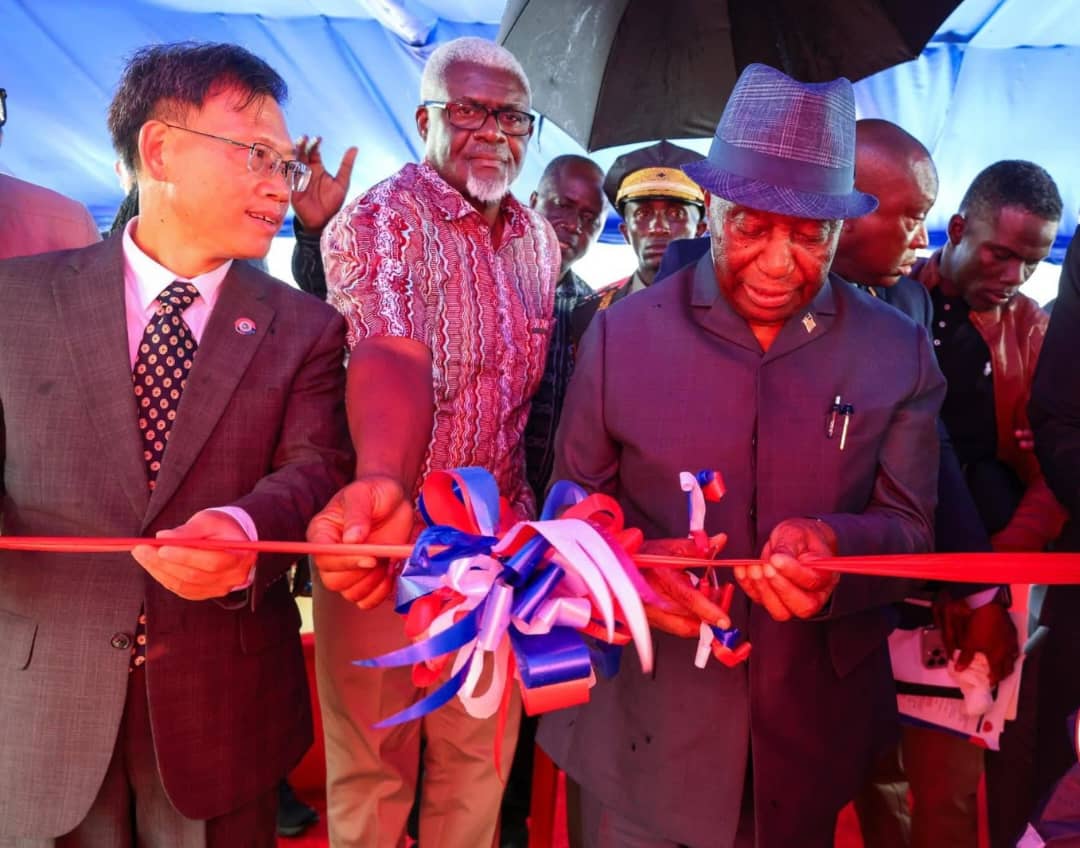
President Joseph Boakai has officially launched Liberia’s first Digital Village in Foya, Lofa County, presenting it as a bold move to close the country’s digital gap—but questions linger over whether the initiative signals sustainable transformation or a symbolic rollout.
Unveiled under the banner “Connecting for a Brighter Future,” the project introduces internet access, solar-powered electricity, and digital learning tools to a rural district long underserved by basic infrastructure. Backed by the Ministry of Posts and Telecommunications, the Liberia Telecommunications Authority, and Chinese tech giant Huawei, the initiative reflects both ambition and heavy reliance on external partnerships.
At the ceremony, Boakai framed the program as a necessary correction to longstanding inequality, arguing that technological progress must extend beyond Liberia’s urban centers. He positioned the Digital Village as more than a connectivity project, casting it as a gateway to improvements in education, healthcare, agriculture, and small business development. Still, such projections hinge on consistent implementation—an area where similar initiatives in the region have often struggled.
The Foya site itself operates on a solar mini-grid powering around 50 homes, along with a school and clinic, while expanded telecom infrastructure is expected to reach tens of thousands of residents. While officials tout job creation and broad community impact, the scale of the rollout raises questions about depth versus reach, and whether benefits will be evenly distributed or concentrated in pilot zones.
Government officials were quick to credit key institutions and leadership figures for driving the project, reinforcing its positioning as a flagship achievement of the administration’s ARREST Agenda. At the same time, Boakai’s explicit praise for China—and reaffirmation of Liberia’s One-China Policy—highlights the geopolitical undertones of development partnerships that increasingly shape national infrastructure projects.
Huawei representatives promoted the Digital Village as a model that can be replicated across rural Liberia, blending renewable energy with digital access. Yet, replication will depend not only on funding, but also on governance, maintenance capacity, and long-term policy consistency—factors that often determine whether pilot projects evolve into lasting systems.
With plans to expand the initiative nationwide, the government is betting on technology as a driver of inclusive growth. The real test, however, will be whether this “digital village” becomes a scalable solution—or remains an isolated success story in a country still grappling with structural development challenges.


