


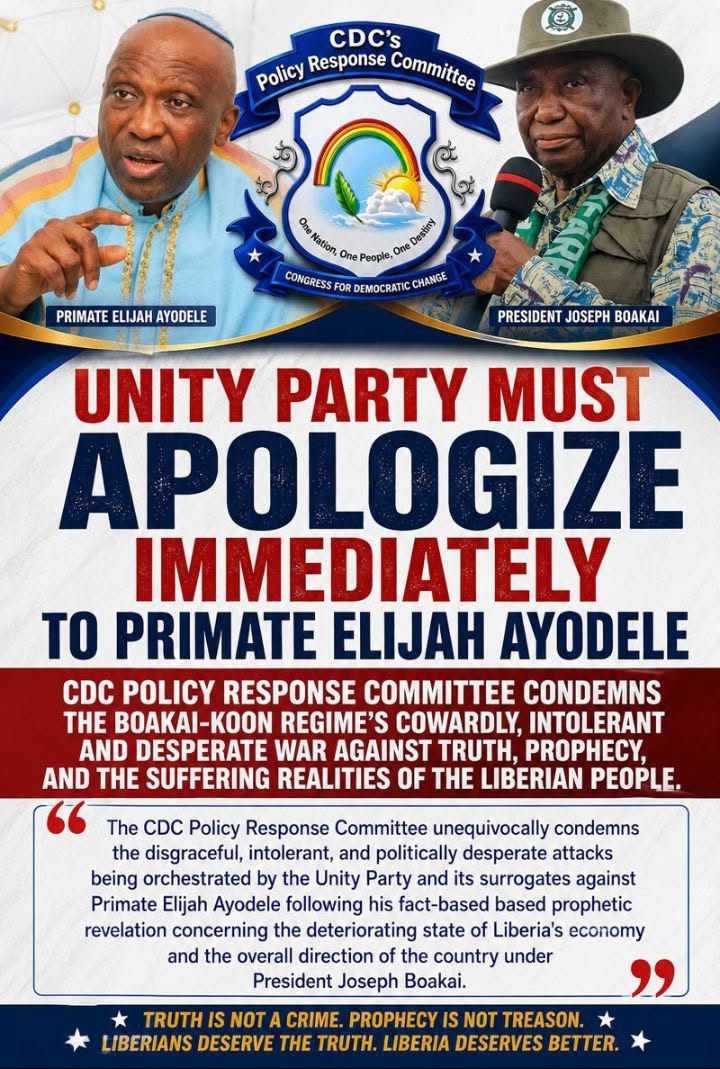
MONROVIA, Liberia — Liberia’s political tensions intensified this week after the Congress for Democratic Change (CDC) Policy Response Committee launched a strong defense of Nigerian cleric Primate Elijah Ayodele while accusing the ruling Unity Party government of attempting to suppress criticism and distract public attention from mounting economic and governance concerns.
In a lengthy statement issued on Monday, the CDC-backed committee condemned what it described as attacks against the Nigerian religious leader following his recent remarks and prophetic observations about Liberia’s economic conditions and political direction under President Joseph Nyuma Boakai.
The opposition group argued that the controversy surrounding Ayodele’s comments has evolved into a broader debate about freedom of expression, political tolerance, and the government’s response to criticism.
According to the committee, the Unity Party and government supporters have focused on challenging the cleric’s statements rather than addressing concerns about rising living costs, unemployment, deteriorating public services, and economic hardships facing ordinary Liberians.
“The issue is not the prophet himself,” the statement said. “The issue is whether the government is willing to confront the realities many Liberians are experiencing daily.”
The CDC Policy Response Committee maintained that Ayodele’s comments reflected concerns already being discussed by citizens across the country. The group cited economic challenges, infrastructure deficits, unemployment, and social difficulties as issues requiring urgent government attention rather than political confrontation.
The statement also criticized what it described as selective outrage by members of the ruling establishment, arguing that political criticism was widely tolerated during previous administrations, including the administration of former President George Weah.
According to the committee, public officials should expect scrutiny and criticism as part of democratic governance.
The CDC further alleged that the government has struggled to deliver on key promises made during the 2023 election campaign, particularly those associated with the administration’s “Rescue Agenda.” The opposition group pointed to concerns about investment, job creation, public infrastructure, and economic management as areas where it believes progress has fallen short of public expectations.
The committee also referenced several controversial national issues, including disputes surrounding legislative leadership, public sector reforms, taxation policies, and the outsourcing of certain government functions. It argued that these developments have contributed to growing public frustration and uncertainty.
Beyond defending Ayodele’s remarks, the CDC used the occasion to renew criticism of the Boakai administration’s overall performance, asserting that many Liberians continue to face worsening economic conditions despite promises of reform and recovery.
The statement further accused the government of attempting to shift public discourse away from pressing socioeconomic challenges by focusing attention on the pastor’s comments.
While acknowledging that some of Ayodele’s observations may be controversial, the CDC argued that religious leaders and public figures have long played a role in shaping political discussions across Africa and that differing opinions should not be treated as threats to national stability.
The committee also recalled previous prophecies and political predictions made by religious leaders about Liberia’s future, arguing that such pronouncements have historically generated debate without necessarily becoming matters of state concern.
The latest dispute comes amid growing political exchanges between supporters of the ruling Unity Party and opposition figures as Liberia approaches the midpoint of President Boakai’s first term.
Government officials have not formally responded to the CDC statement. However, supporters of the administration have previously defended the government’s record, citing efforts to stabilize the economy, strengthen institutions, attract investment, and implement reforms designed to improve governance and public service delivery.
As the political debate continues, the controversy surrounding Ayodele’s remarks has evolved into a larger contest over governance, economic performance, and the limits of political criticism in Liberia’s democratic space.
For now, the disagreement underscores the increasingly sharp divide between the country’s ruling establishment and opposition forces, each offering competing narratives about Liberia’s current trajectory and future prospects.


