


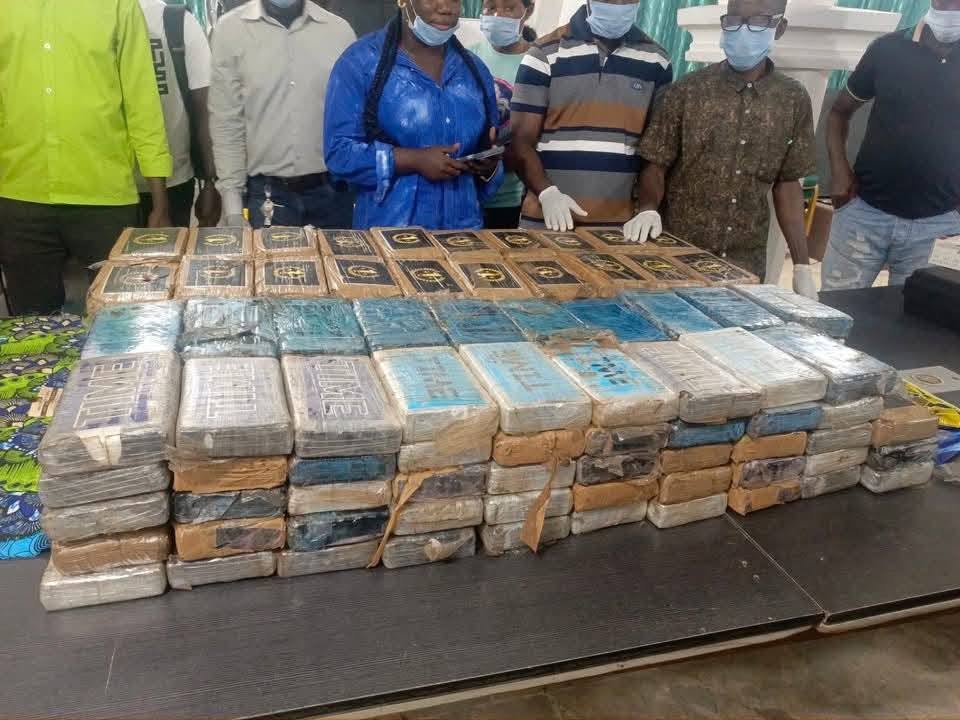
MONROVIA, LIBERIA — The interception of cocaine valued at an estimated US$19.2 million at Roberts International Airport has been hailed as one of Liberia’s most significant anti-narcotics operations in recent years. Yet beyond the celebration surrounding the seizure lies a more troubling reality: the massive drug bust raises critical questions about the reach and sophistication of international trafficking networks operating within Liberia.
Law enforcement authorities recently announced the confiscation of nearly 200 compressed plates of cocaine concealed in six cargo boxes allegedly destined for export. While the operation has been widely praised as a major achievement for the Liberia Drug Enforcement Agency (LDEA), security experts and observers argue that the seizure exposes deeper vulnerabilities within the country’s transportation, security, and border management systems.
For decades, West Africa has remained a strategic transit corridor for international drug cartels moving narcotics from Latin America to Europe and other global markets. Liberia’s geographic location, extensive coastline, and evolving security infrastructure have long made it susceptible to exploitation by transnational criminal organizations seeking alternative trafficking routes.
The latest discovery at the country’s principal international airport has renewed concerns about how such a substantial quantity of narcotics was able to enter the transportation chain in the first place.
Questions are now being asked about the movement of the shipment before its interception. How did nearly 200 plates of cocaine reach a major international gateway without detection? At what stage was the cargo introduced into the system? Were airport personnel, cargo handlers, or other insiders involved in facilitating its movement?
Security analysts contend that these questions are as important as the seizure itself.
While the LDEA has credited intelligence gathering and coordinated surveillance efforts for the successful operation, experts caution that drug trafficking operations of this magnitude rarely involve a handful of individuals acting alone. Large-scale narcotics movements typically depend on complex criminal structures consisting of financiers, logistics coordinators, transport facilitators, corrupt officials, and international syndicates operating across multiple countries.
As a result, many observers argue that arresting couriers or low-level operatives, if any are identified, will not be enough to dismantle the network behind the shipment. The real test, they say, will be whether investigators can identify and prosecute the individuals who financed, organized, and protected the operation.
The seizure also highlights the increasingly sophisticated tactics employed by modern drug cartels. Criminal organizations now use advanced concealment methods, exploit weaknesses in cargo-screening systems, and often infiltrate legitimate commercial channels to move narcotics across borders.
These evolving methods underscore the need for Liberia’s security institutions to continuously upgrade technology, strengthen intelligence capabilities, and improve inter-agency cooperation to stay ahead of organized criminal enterprises.
Beyond the immediate security implications, the incident has broader social and economic consequences.
Drug trafficking remains one of the most damaging forms of transnational crime. It fuels corruption, undermines public institutions, finances organized criminal activity, and contributes to violence and instability. It also increases the risk of substance abuse among young people, creating long-term public health and social challenges.
The estimated value of the seized cocaine—more than US$19.2 million, or approximately LRD 3.6 billion—illustrates the enormous financial stakes involved.
Analysts note that the value of the shipment exceeds the annual operating budgets of several public institutions and could fund significant investments in healthcare, education, infrastructure, and community development. Instead, such resources are tied to criminal enterprises that threaten national stability and development.
Perhaps most concerning is the possibility that the confiscated shipment may represent only a portion of the narcotics moving through the region.
International anti-drug experts have long warned that successful interceptions often reveal larger trafficking networks already in operation. For every shipment discovered, there may be others that evade detection and reach their intended destinations.
This reality suggests that while the seizure represents a significant success, it should also serve as a warning that traffickers continue to view Liberia as a potentially valuable route for international drug operations.
The government is now being urged to use the case as an opportunity to strengthen anti-drug policies and institutional capacity. Security specialists have called for increased investment in modern cargo-scanning technology, enhanced airport security systems, stronger border surveillance, and advanced training programs for law enforcement personnel.
They also emphasize the importance of greater collaboration with regional and international partners, recognizing that drug trafficking networks operate across multiple jurisdictions and require coordinated responses.
Public accountability has emerged as another key issue.
Many Liberians are demanding transparency regarding whether any individuals in positions of authority facilitated, ignored, or benefited from the movement of the shipment. Observers argue that the credibility of the country’s anti-drug efforts will largely depend on whether investigations are conducted impartially and without political interference.
LDEA Officer-in-Charge Fitzgerald T.M. Biago has assured the public that all individuals connected to the trafficking network will be investigated, regardless of their status or influence.
That commitment, many believe, must now be demonstrated through concrete action.
Historically, major drug cases in developing countries have often generated public attention but failed to lead to the prosecution of powerful financiers and influential figures who operate behind the scenes. The outcome of this investigation could therefore become an important measure of Liberia’s commitment to combating organized crime.
The seizure sends a clear message that Liberian authorities possess the capacity to detect and disrupt major narcotics operations. However, experts stress that true success will not be measured solely by the quantity of drugs confiscated.
Instead, success will depend on the ability of authorities to dismantle criminal networks, prosecute those responsible at every level, and prevent future shipments from entering the country.
As Liberia continues its battle against illicit narcotics, policymakers are increasingly recognizing that drug trafficking is more than a law enforcement challenge. It is also a national security issue, a governance concern, and a development challenge that affects every sector of society.
The US$19.2 million cocaine seizure at Roberts International Airport therefore represents both a victory and a warning.
It is a victory because law enforcement officers successfully intercepted a massive shipment before it reached international markets.
It is a warning because it reveals the persistent determination of international drug cartels to exploit vulnerabilities within Liberia’s borders.
The critical question now is whether Liberia will use this moment to strengthen its defenses and dismantle the networks behind the operation—or whether the country will wait until an even larger trafficking crisis emerges.
The fight against narcotics requires more than seizures and public announcements. It demands sustained political will, institutional integrity, public cooperation, technological investment, and a justice system capable of holding powerful actors accountable.
Without those measures, experts warn, Liberia risks becoming more than a transit point for illicit drugs—it risks becoming a key battleground in the global struggle against organized narcotics trafficking.


