


KAKATA, Margibi County – Questions about the integrity of Liberia’s justice system have moved to the forefront in Margibi County after a major drug trafficking case was abruptly suspended amid allegations of jury tampering involving an officer of the Liberia Drug Enforcement Agency (LDEA).
The development has triggered a court-ordered investigation and renewed public discussion about the importance of protecting judicial proceedings from outside influence.
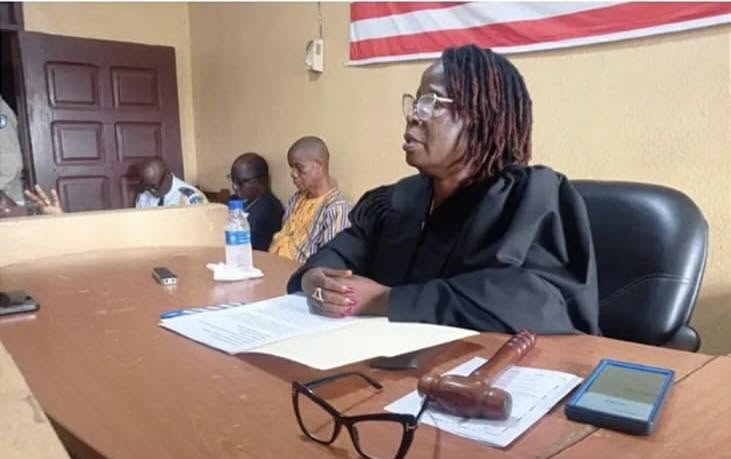
Resident Judge of the 13th Judicial Circuit Court, Her Honor Judge Victoria Duncan, ordered the immediate disbandment of the jury and suspended the ongoing trial involving defendant Quita Dolo Kosso after allegations surfaced that an LDEA officer may have improperly contacted members of the jury during the proceedings.
The allegations center on LDEA Officer Myron Swen, who is accused of engaging in unauthorized communication with jurors assigned to hear the high-profile drug case. The reported contact raised serious concerns about whether the jury’s independence may have been compromised, prompting swift intervention by the court.
In response, Judge Duncan halted the proceedings and ordered a comprehensive investigation into the matter. The inquiry is being conducted openly in court, a move intended to ensure transparency, accountability, and public confidence in the judicial process.
The decision has drawn significant attention because it underscores the court’s willingness to prioritize the integrity of legal proceedings over the expedient resolution of a criminal case.
Legal observers note that allegations of jury tampering strike at the heart of the justice system because jurors are expected to make decisions based solely on the evidence presented in court and the applicable law. Any attempt to influence their judgment outside the courtroom threatens the fairness of the trial process and can undermine public trust in judicial outcomes.
Judge Duncan’s response reflects principles she publicly emphasized only weeks earlier during the opening of the May Term of Court on May 11, 2026.
Addressing jurors, court officials, lawyers, and members of the public during the ceremony, she delivered a strong message about the responsibilities associated with jury service and the need to safeguard the independence of the courts.
“Justice is not a static concept,” Judge Duncan declared at the opening session, encouraging jurors to “listen carefully, deliberate thoughtfully, and act with integrity.”
She further reminded jurors that their role requires independence, objectivity, and a firm commitment to resisting any form of external pressure or influence.
Those remarks have gained renewed significance in light of the current allegations.
According to court officials, the investigation will seek to determine whether improper communication occurred, the nature and extent of any contact, and whether such actions affected the fairness of the proceedings.
The findings could have important implications not only for the suspended case but also for broader efforts to strengthen confidence in Liberia’s judicial institutions.
The controversy has also attracted attention from civil society leaders and members of the diplomatic community.
Among those commending the court’s handling of the matter is Ambassador Cecilia Forgbe McGill, Executive Director of Diplomats Without Borders and a prominent Liberian diplomat.
Ambassador McGill praised Judge Duncan for what she described as a principled and professional response to allegations that could have compromised the administration of justice.
According to McGill, the judge demonstrated a strong commitment to transparency and the rule of law by refusing to ignore the claims and instead ordering an immediate investigation.
She noted that continuing with the trial under a cloud of suspicion could have damaged public confidence in the court’s eventual verdict and raised questions about the credibility of the judicial process.
“Rather than allowing the proceedings to continue under suspicion, Judge Duncan acted decisively to protect the credibility of the court and public confidence in the justice system,” McGill observed.
The ambassador’s comments reflect growing recognition of the importance of judicial independence and procedural fairness in Liberia’s democratic governance framework.
Judge Duncan has long emphasized these values in her public statements.
During her May Term address, she referenced the writings of renowned English jurist Sir William Blackstone, highlighting the enormous responsibility entrusted to ordinary citizens who serve as jurors.
“This duty is not easy,” she told jurors at the time. “It requires impartiality, patience, and courage. Jurors must set aside personal bias, resist outside influence, and commit themselves wholly to fairness and justice.”
Those words now serve as a powerful reminder of the standards expected within Liberia’s courts as authorities investigate the allegations.
The May Term of Court had been scheduled to hear a number of significant criminal and civil cases across Margibi County. However, attention has now shifted toward the jury tampering investigation, which is expected to take priority as the court seeks to establish the facts surrounding the allegations.
Legal experts say the outcome of the inquiry could influence future safeguards designed to protect jurors and preserve the integrity of court proceedings.
For now, the trial involving Quita Dolo Kosso remains suspended while the investigation continues.
As the court works to uncover the truth, the case has become a broader test of Liberia’s commitment to judicial accountability, transparency, and the principle that justice must not only be done but must also be seen to be done.
The coming weeks are expected to determine whether the allegations have merit and what consequences, if any, may follow. More importantly, the investigation is likely to serve as a defining moment in reinforcing the message that no individual or institution is above the standards required to ensure a fair and


