


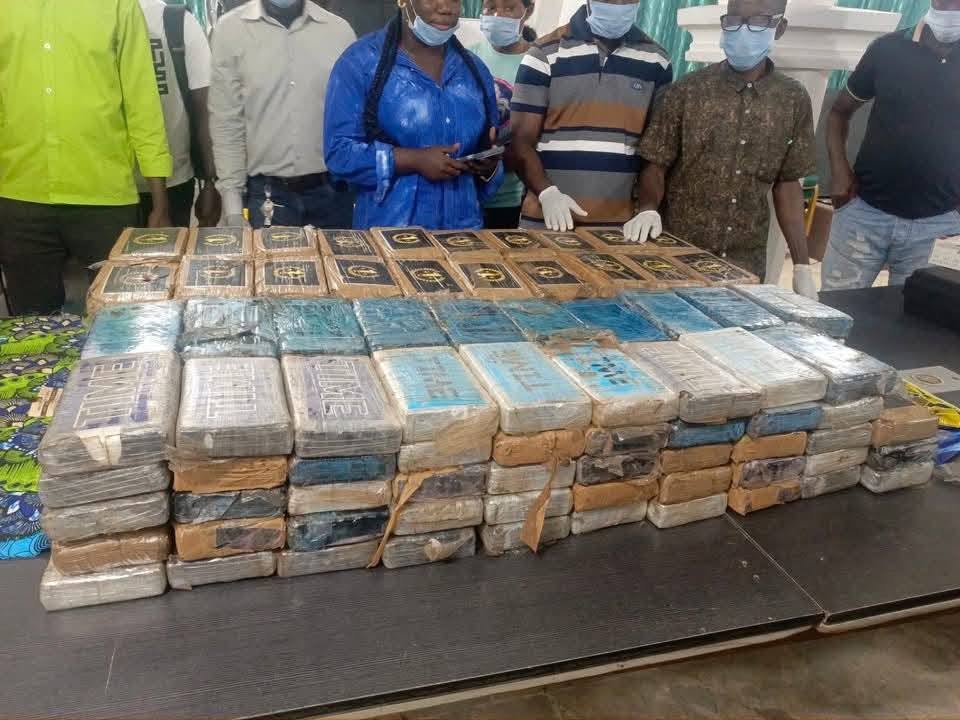
MONROVIA, Liberia — Could the recent cocaine seizure at Roberts International Airport be exposing a much larger and more sophisticated trafficking network operating through Liberia?
That question is gaining increasing attention following claims published by Sahara that the June 8 interception of cocaine valued by Liberian authorities at approximately US$19.2 million may represent only a fraction of a broader transshipment operation allegedly utilizing diplomatic cargo channels.
According to the report, the shipment—consisting of 198 compressed plates of cocaine concealed in six cargo boxes and allegedly destined for Europe aboard a Brussels Airlines flight—was not an isolated incident. Rather, it is being portrayed as part of a larger pattern of suspicious cargo movements that have reportedly passed through Liberia since the current administration assumed office in 2024.
The claims, which have not been independently verified by Liberian authorities, suggest that more than 50 controversial diplomatic consignments may have departed Liberia during the period. The report argues that the seizure became significant not merely because of the quantity of narcotics involved, but because it was one shipment that failed to complete its journey undetected.
If accurate, the allegations raise profound questions about the integrity of cargo screening procedures, oversight mechanisms, and the potential exploitation of diplomatic privileges by criminal organizations seeking to move illicit substances across international borders.
Liberia’s Growing Vulnerability
The allegations emerge against a backdrop of increasing international concern about West Africa’s role in global narcotics trafficking networks.
For years, the region has been identified by international security agencies as a strategic transit corridor linking Latin American cocaine producers with markets in Europe and North Africa. The United Nations Office on Drugs and Crime (UNODC) has repeatedly warned that West Africa’s geographic location, combined with institutional vulnerabilities and porous borders, has made several countries attractive transit points for international drug syndicates.
Recent findings from the World Drug Report 2025 indicate that cocaine seizures linked to Africa increased by approximately 48 percent over the previous year. Analysts attribute this trend to the growing diversification of drug trafficking routes and the increasing sophistication of transnational criminal organizations seeking alternative pathways into European markets.
Within that regional landscape, Liberia’s extensive coastline, limited surveillance infrastructure, and strategic aviation connections have long been viewed as potential vulnerabilities.
Questions Surround Diplomatic Cargo Claims
Perhaps the most controversial aspect of the report involves allegations that the seized cocaine was packaged and transported under diplomatic cover.
According to the publication, intelligence services from the United Kingdom and the United States had reportedly been monitoring the shipment prior to its interception. The report claims that investigators intended to track the consignment until it reached Europe, where arrests could be made at a later stage. However, the alleged use of diplomatic cargo reportedly complicated those plans.
International diplomatic conventions provide certain protections for official diplomatic consignments, making inspections and seizures highly sensitive matters. Any action involving diplomatic cargo can carry significant legal and diplomatic implications, particularly under the principle of reciprocity that governs relations between states.
The report alleges that concerns over those implications contributed to alternative efforts aimed at disrupting the shipment before it departed Liberia. To date, Liberian authorities have not publicly confirmed the diplomatic cargo allegations.
Official Investigation Continues
The Liberia Drug Enforcement Agency (LDEA) has maintained that the seizure resulted from intelligence gathering, surveillance operations, and coordinated enforcement efforts.
Authorities have publicly identified one individual, Emmanuel T. Zeon, as a person connected to the shipment. According to investigators, Zeon allegedly delivered the cargo to the airport before departing the area shortly afterward.
However, critics and observers continue to question whether individuals identified thus far represent the full extent of those involved.
Drug trafficking experts have frequently noted that large-scale international narcotics operations typically involve multiple layers of organization, including financiers, logistics coordinators, transport facilitators, document handlers, and international distribution networks.
As a result, many observers argue that identifying couriers or intermediaries alone may not reveal the full architecture of such operations.
Calls for Transparency
The controversy has renewed calls for a comprehensive and transparent investigation into the circumstances surrounding the shipment.
Security analysts argue that several critical questions remain unanswered:
How did such a substantial quantity of cocaine enter Liberia’s transportation chain?
At what point did the shipment reach Roberts International Airport? Were there weaknesses in existing screening systems? Did any individuals abuse official privileges or positions of authority?
And perhaps most importantly, are there larger networks operating behind the scenes?
The answers to those questions may ultimately determine whether the seizure is remembered as an isolated law enforcement success or as the event that exposed deeper vulnerabilities within Liberia’s security and regulatory systems.
A National Security Challenge
Beyond the immediate criminal investigation, the case highlights broader concerns regarding Liberia’s ability to confront increasingly sophisticated transnational criminal enterprises.
Narcotics trafficking presents challenges that extend beyond law enforcement. It can fuel corruption, undermine public institutions, facilitate money laundering, strengthen organized crime, and damage international confidence in governance systems.
Experts caution that successful drug interdictions often reveal only a portion of larger trafficking operations. For every shipment intercepted, there may be others that escape detection.
That reality has intensified calls for increased investment in airport security, cargo screening technology, intelligence gathering, inter-agency cooperation, and international law enforcement partnerships.
Awaiting Further Evidence
While the claims outlined in the Sahara report have generated significant public discussion, many of the allegations remain unverified and should be treated accordingly until supported by evidence from official investigations.
What is clear, however, is that the June 8 seizure has sparked a broader national conversation about drug trafficking, institutional accountability, and Liberia’s vulnerability to international criminal networks.
Whether the incident represents a single criminal operation or the exposure of a larger trafficking system remains a question that investigators will now be under increasing pressure to answer.
For many Liberians, the issue is no longer simply about one shipment of cocaine. It is about understanding how such a shipment reached the country’s principal international gateway and whether deeper networks remain hidden beneath the surface. As investigations continue, the public will be watching closely for answers.
Credit : The Sahara


