


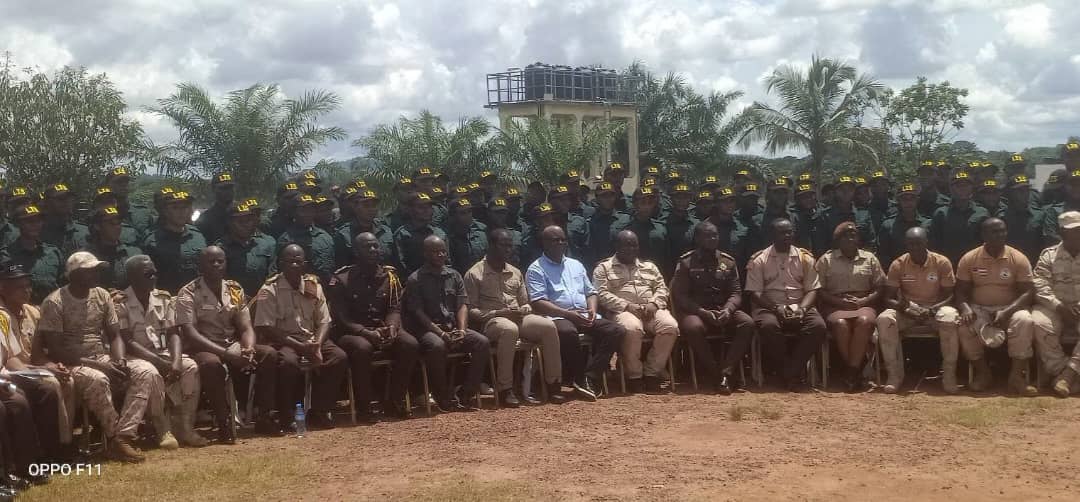
GBARNGA, Bong County — Against the backdrop of heightened national concern over transnational crime and following last week’s major cocaine seizure in Liberia, the Liberia Immigration Service (LIS) has launched an intensive nationwide training program aimed at strengthening the country’s first line of defense against illegal migration, drug trafficking, document fraud, and other cross-border crimes.
The initiative brings together approximately 440 immigration officers from all 15 counties for a rigorous 14-day in-service training exercise being conducted at the Gbarnga Regional Hub in Bong County.
The training marks Batch Eight of the Liberia Immigration Service’s ongoing capacity-building program and reflects the institution’s broader effort to modernize operations, improve professionalism, and enhance the country’s ability to respond to increasingly sophisticated security threats.
With criminal networks becoming more organized and transnational crimes growing more complex, immigration authorities say the need for highly trained personnel has never been greater.
Speaking during the opening ceremony, Commandant of the Liberia Immigration Service Training Academy, DCI Jeffery Morris, described the exercise as a critical investment in the professional development of officers currently serving across Liberia.
According to Morris, the program combines physical fitness training, drills and ceremonies, classroom instruction, and practical exercises designed to improve the competence, discipline, and operational readiness of participants.
He explained that while many of the subjects are traditionally taught over a four-month period at the Immigration Academy, the curriculum has been condensed into a demanding two-week schedule intended to deliver intensive and targeted instruction.
“The objective is to ensure that officers receive the essential knowledge, practical skills, and professional orientation necessary to effectively perform their duties in today’s rapidly evolving security environment,” Morris said.
The Commandant noted that participants will receive specialized instruction in several key areas, including human trafficking, human rights, immigration procedures, document processing, migration management, and the detection of fraudulent travel documents.
Particular emphasis is being placed on identifying forged passports, altered visas, counterfeit immigration records, and other forms of documentation frequently used by criminal networks involved in human smuggling, drug trafficking, and organized crime.
Morris stressed that professionalism, discipline, and courtesy remain fundamental pillars of the training.
He revealed that participants will be required to achieve a minimum score of 70 percent and successfully complete all aspects of the program before becoming eligible for graduation.
According to him, the rigorous standards are intended to ensure that only competent and qualified officers successfully complete the exercise.
The Commandant expressed confidence that officers participating in the training will emerge significantly improved both physically and professionally.
He pointed to the success of previous batches, noting that many graduates of earlier training programs are currently serving effectively in various immigration assignments throughout the country.
Beyond technical instruction, Morris highlighted the Liberia Immigration Service’s ongoing commitment to promoting gender inclusion within law enforcement.
He emphasized that female officers continue to play an increasingly important role in national security and immigration management and reaffirmed the institution’s commitment to creating opportunities for women to contribute meaningfully to the service.
The Commandant also used the occasion to encourage young Liberians to consider careers in law enforcement and public service.
He described the Liberia Immigration Service as a professional institution that continues to attract highly educated individuals, including officers holding bachelor’s degrees, master’s degrees, and other advanced academic qualifications.
“Our institution continues to evolve, and we are proud of the level of professionalism and educational achievement represented within the Liberia Immigration Service,” Morris stated.
Also addressing the gathering, Deputy Commissioner General for Administration, Hon. Nelsco Aleo Wolo, underscored the importance of the training in strengthening Liberia’s overall security architecture.
Wolo noted that officers from every region of the country had assembled in Bong County to participate in what he described as a vital component of the institution’s ongoing transformation agenda.
According to him, the Liberia Immigration Service is currently implementing significant reforms aimed at aligning its operations with international standards and improving its capacity to confront emerging security threats.
He explained that modern border management requires a highly skilled workforce capable of identifying and responding to increasingly sophisticated criminal activities.
Among the threats highlighted by Wolo were human trafficking, drug smuggling, cybercrime, document fraud, migrant exploitation, and other transnational offenses that often cross multiple jurisdictions.
“The security environment is constantly changing, and criminal networks continue to develop new methods to evade detection,” he said. “Our officers must therefore possess the knowledge, skills, and professional competence necessary to meet these challenges effectively.”
The Deputy Commissioner General explained that the training program is specifically designed to strengthen officers’ capabilities in border management, intelligence gathering, migration control, document examination, and threat assessment.
These competencies, he noted, are essential to protecting Liberia’s territorial integrity while facilitating lawful travel and migration.
Wolo further emphasized that the institution’s modernization efforts extend beyond traditional training programs.
He highlighted ongoing initiatives focused on digital transformation, technological advancement, personnel development, and institutional reform.
According to him, the Liberia Immigration Service recognizes that modern security challenges require modern solutions, including the use of technology and intelligence-driven operations.
He stressed that well-trained and educated immigration officers remain critical to safeguarding Liberia’s borders and enhancing the country’s reputation within the international community.
“Professional immigration officers serve not only as protectors of our borders but also as representatives of Liberia to the world,” Wolo stated. “Their conduct, competence, and professionalism contribute directly to how our country is perceived internationally.”
The training exercise comes at a time when Liberia, like many countries across West Africa, faces growing pressure to strengthen border security and combat transnational criminal networks operating across the region.
Recent developments have renewed public attention on the need for enhanced surveillance, stronger immigration controls, improved intelligence sharing, and greater inter-agency cooperation among security institutions.
Officials believe that investments in training and personnel development remain among the most effective tools for strengthening national security and improving institutional performance.
As the 14-day exercise progresses, participants are expected to undergo intensive instruction and evaluation before returning to their respective assignments throughout the country.
Upon completion, the officers will resume duties equipped with enhanced knowledge and practical skills designed to improve immigration enforcement, strengthen border security, combat transnational crime, and support Liberia’s broader efforts to maintain national stability and public safety.
For the Liberia Immigration Service, the training represents more than a routine professional development exercise. It reflects an ongoing commitment to building a modern, disciplined, and highly capable institution prepared to confront emerging security threats while protecting Liberia’s borders and serving the nation with professionalism and integrity.


