


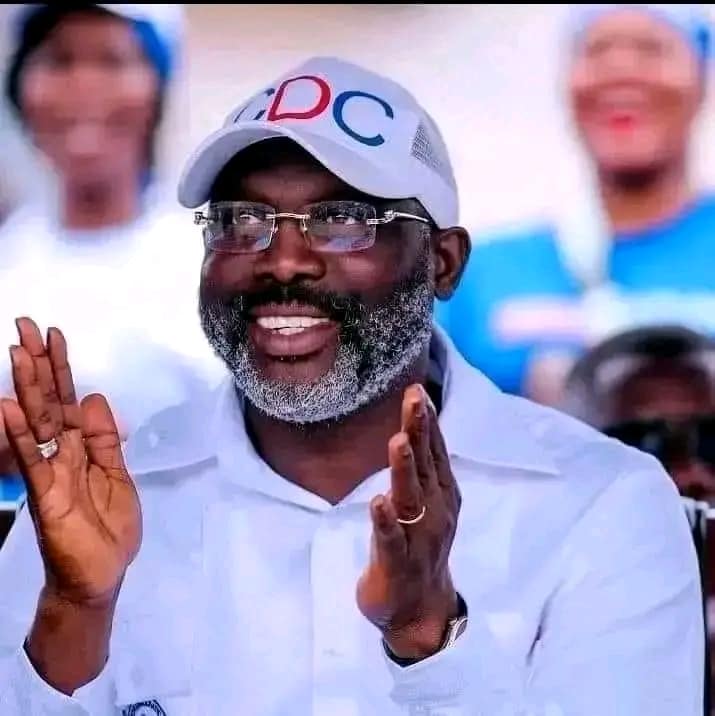
ZWEDRU, Grand Gedeh County — Former President George Manneh Weah, Standard Bearer of the Congress for Democratic Change (CDC), has used the party’s 22nd anniversary celebration in Zwedru to reassert the movement’s grassroots identity while sharply criticizing the current Unity Party-led government, framing the CDC as a resilient political force preparing for a return to power in 2029.
Speaking before partisans, opposition leaders, and invited guests, Weah described the CDC not as a conventional political institution but as a “revolution of hope” rooted in ordinary Liberians who felt excluded from traditional power structures. “Twenty-two years ago, a movement was born… in the hearts of ordinary people — market women, students, motorcyclists, farmers, workers, and young people who demanded to be heard,” Weah said.
He emphasized that the CDC’s political foundation was built on inclusion and social mobility, arguing that the movement proved “leadership should not be inherited — it must be earned.”
Weah also used the occasion to highlight his personal political journey, linking it to broader narratives of social mobility in Liberia.
“The journey from the slum to the Presidency was never about George Weah. It was about the market woman, the struggling family, the young person seeking opportunity,” he stated.
Reflecting on his administration, Weah pointed to infrastructure development and social interventions, including roads, housing projects, and education reforms, as central priorities of his government.
However, the tone of the speech shifted toward a more critical assessment of the current administration under President Joseph Boakai, with Weah arguing that national conditions have deteriorated since the CDC left office.
He claimed that Liberians are facing worsening economic hardship, weakened public services, and unfulfilled political promises.
Families are struggling. Young people and entire communities have been forgotten. Businesses are closing. Hardship has taken over the land,” he said.
Weah further alleged that governance under the Unity Party has been marked by political persecution, weakening of democratic institutions, and declining rule of law — claims that remain part of ongoing political debate in Liberia.
He also raised concerns about national security and drug trafficking, asserting that Liberia faces growing governance and security risks, though these assertions were not accompanied by official evidence in his statement.
Despite the criticism, the former president framed the anniversary as a moment of political consolidation for the CDC, emphasizing unity and resilience within the party.
“A movement built by the people cannot be destroyed by propaganda… The CDC is alive. The CDC is united. The CDC is energized,” he declared.
Weah also used the platform to rally supporters toward the 2029 general elections, describing the current moment as the beginning of a new phase of political mobilization.
“The road to 2029 begins today,” he said, calling on partisans to expand outreach across counties and communities nationwide.
The Zwedru gathering also featured participation from several opposition political leaders, including Alexander B. Cummings (ANC), Musa Hassan Bility (CMC), Benoni Urey (ALP), Simeon Freeman (MPC), Dee-Maxwell Kemayah (MOVEE), as well as former officials and civil society actors. Their presence was framed by Weah as evidence of political openness and potential cooperation within Liberia’s opposition landscape.
As the CDC marks more than two decades of existence, Weah’s message underscored both continuity and contestation in Liberia’s political space — celebrating the party’s grassroots origins while positioning it for a renewed electoral push.
The speech ultimately reinforced a familiar political question in Liberia’s post-war democracy: whether movements built on populist legitimacy and grassroots identity can sustain influence in the face of evolving governance challenges and competing national narratives.


