


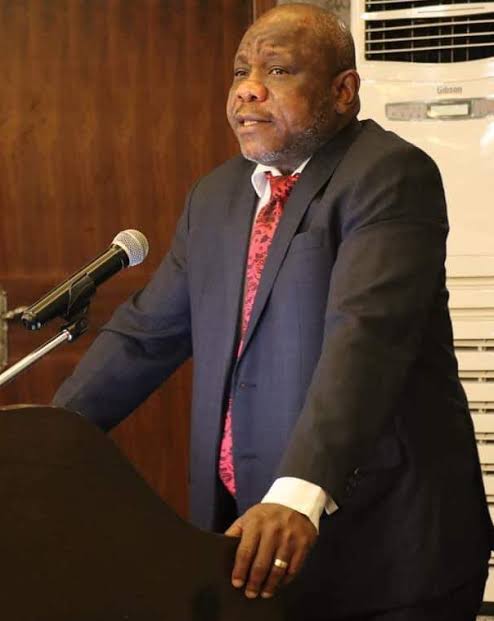
MONROVIA, Liberia — June 25, 2026-In a 9-page missive to Secretary-General António Guterres, Samuel D. Tweah Jr. accuses President Boakai’s administration of political persecution, jury tampering, and the systematic erosion of the rule of law—a warning that echoes Liberia’s dark pre-civil war past.
The smoldering embers of a looming national calamity are glowing ever brighter under President Joseph Nyuma Boakai, and the international community’s “deafening silence” must end.
This is the stark warning issued by former Finance and Development Planning Minister Samuel D. Tweah Jr. in a nine-page letter to United Nations Secretary-General António Guterres and other international leaders, in which he alleges a systematic “political witch-hunt” targeting opposition figures and an “opprobrious and well-orchestrated design to silence political dissent” .
At the heart of the former minister’s appeal is a high-stakes legal battle that has become emblematic of what he describes as a broader “degeneration of the rule of law” in Liberia. Tweah, who served as the financial architect of former President George Weah’s administration, was acquitted on May 8, 2026, by a 15-member jury in Criminal Court “C” of charges including economic sabotage, theft of property, and money laundering related to an alleged US$6.2 million financial scheme . The jury also acquitted his co-defendant, Moses Cooper, in a verdict that triggered rapturous celebrations among opposition supporters and sent the government “quaking under the pressures of political fear” .
However, the controversy did not end with the jury’s decision. Ten days after the jurors were disbanded and returned to their private lives, three jurors who had voted guilty filed an affidavit alleging juror misconduct. Tweah contends this was no coincidence. He accuses the government of influencing the complaint, arguing that if jurors had felt strongly about misconduct, they would have raised the issue immediately—not after a nationally broadcast press conference in which the government publicly accepted the verdict .
“These jurors would have immediately filed their complaints if they felt strong and passionate about jury misconduct, independent of, and uninfluenced by, promptings from both the Prosecution and the Defense,” Tweah writes, asserting that the government is now attempting to “manipulate the verdict or give the appearance that finality had not arrived” .
The defense team has since filed a writ of prohibition with the Supreme Court, arguing that the investigation is an “executive witch-hunt” intended to undermine a lawful verdict and that the trial court lacks jurisdiction to investigate jurors after they have been formally discharged . Justice Yusuf D. Kaba initially issued a temporary stay, later ordering that any investigation into jury tampering must occur in open court with both prosecution and defense present—a decision that appears to have partially addressed due process concerns .
Tweah’s legal defense during the trial was built on a meticulous dismantling of the prosecution’s case. He argued that the Public Financial Management Law of Liberia authorizes the Finance Minister to release funds under national security or exigent circumstances, and that the passage of the national budget by the National Legislature is the signal authorizing the release—not letters of request from spending entities . He further cited precedent for similar transfers approved under his signature, including more than $20 million to the National Elections Commission, $25 million to the World Food Program for Covid-19 relief, and $1 million to the UN Population Fund .
His defense counsel, Cllr. Arthur Tamba-Johnson, delivered a compelling closing argument that has since become legendary in Liberian legal circles. He impelled the jurors to “go and make history by setting the defendants free against a powerful despotic Government wanting their destruction for political purposes,” famously intoning that their rendering of justice would spark “national celebrations and reverberations” .
But for Tweah, the threat extends far beyond his own case. His letter expands into a damning indictment of what he describes as the Boakai administration’s “wanton and reckless disregard for the rule of law” . He points to three incidents he considers “exemplary of this callous abuse of executive political power”:
First, the government’s disregard for the Supreme Court’s 2025 opinion delegitimizing a “Majority Bloc” of lawmakers who sought to remove Speaker J. Fonati Koffa. Despite the Court conferring legitimacy to the Speaker, the Boakai administration “trashed this ruling, a treasonous legal and political opprobrium,” and continued to do business with the Majority Bloc .
Second, the government’s removal of tenured officials from autonomous agencies like the Governance Commission and the Liberia Anti-Corruption Commission, despite a Supreme Court ruling that where statutes grant fixed tenure and specify grounds for removal, the President does not have unrestricted authority to dismiss these officials at will .
Third, the government’s disbanding of jurors in the Capitol Building fire incident case—a move Tweah argues was precipitated not by genuine concerns about jury compromise, but by the fact that jurors were asking “technical questions that seem to betray, in the eyes of the Prosecution, the direction of their decision” .
“Jurors are expected to ask questions during trial,” Tweah writes. “Why should they be penalized for the questions they ask? Is this the same dominance we are about to witness in the pending post-verdict investigation into allegations of jury misconduct/tempering?” .
The former minister’s allegations have found resonance beyond his political base. The Student Unification Party (SUP) at the University of Liberia has condemned the “political witch-hunt” and voiced concern over the country’s descent into lawlessness . Solidarity and Trust for a New Day (STAND), a national rights-based advocacy group, has staged protests against the collapse of rule-based order and is planning a major protest on July 17 to draw national and global attention to the “worsening national degeneration” . Political opposition figures, including Alexander Cummings of the Alternative National Congress and human rights lawyer Cllr. Tehwon Gongloe of the Liberia’s People Party, have also spoken out against the government’s undermining of judicial independence and selective fight against corruption .
Tweah’s appeal to the international community is urgent and unflinching. “The international community has paid heavy price to procure Liberia its current democratic dividend, where Liberians themselves have paid the heaviest price in lives and opportunity cost,” he writes. “When this dividend is being squashed by Liberian leaders who have shown no appreciation of the complex fragility of the Liberian political situation… the clarion warning signs are all too visible for members of the international community to see” .
“Prevention is cheaper than resolution,” he warns.
Copies of the letter were also sent to the Chairperson of the African Union, the Chairman of ECOWAS, the President of the European Council, the Chairmen of the U.S. House and Senate Foreign Relations Committees, the Co-Chairs of the Tom Lantos Human Rights Commission, and members of the diplomatic community in Liberia .
As the post-verdict investigation continues—amid allegations of personal relationships between the jury forelady and Solicitor General Augustine C. Fayiah, and claims of bribes offered and rejected—the question now confronting Liberia’s international partners is stark: How long will they remain silent as the gains of two decades of democratic reconstruction are systematically eroded?
The smoldering embers, as Tweah describes them, glow ever brighter. The international community would do well to take heed before they erupt into a conflagration that consumes the fragile peace and democratic viability of a nation still scarred by fourteen years of civil war .


