


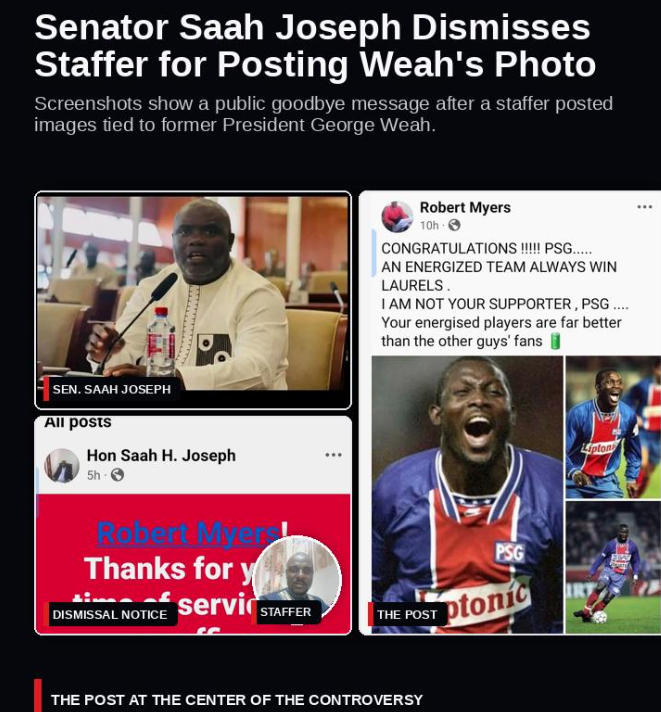
A growing controversy surrounding Saah H. Joseph is fueling debate in Liberia about political loyalty, freedom of expression, and the shifting alliances that continue to reshape the country’s political landscape.
At the center of the dispute is Robert Myers, a former administrative assistant in Senator Joseph’s office, who claims he was dismissed shortly after making a social media post celebrating the recent victory of Paris Saint-Germain while featuring images of George Weah — the Liberian football icon whose legacy remains deeply tied to the French club.
According to Myers, the dismissal occurred only hours after the Facebook post was published. However, he alleges the issue extended beyond football celebrations and reflected deeper political tensions linked to Senator Joseph’s recent departure from the Coalition for Democratic Change (CDC) and his alignment with a new political movement, the Political Action Party (PAP).
The incident has quickly evolved from a workplace dispute into a broader conversation about political identity and intolerance within Liberia’s political culture.
For many Liberians, George Weah represents more than partisan politics. Long before becoming president, Weah built an international football legacy that remains a major source of national pride, particularly through his achievements with Paris Saint-Germain and his historic Ballon d’Or victory — the highest individual honor in global football.
As a result, public celebrations involving Weah’s image, especially in connection to PSG, are often viewed culturally rather than politically. Critics of Joseph’s alleged decision argue that dismissing a staff member over such a post blurs the line between political disagreement and personal expression.
The controversy also highlights the political complexity surrounding Senator Joseph’s own career trajectory.
Since entering elected office in 2011, Joseph’s political rise has been closely associated with the CDC political structure and the popularity of George Weah. He first entered the House of Representatives representing Montserrado County District 13 before later winning a Senate seat in the by-election created after Weah assumed the presidency in 2018.
Political analysts note that Joseph’s electoral success over more than a decade unfolded largely during the height of CDC political dominance.
His subsequent break from the CDC in 2025 and support for the current ruling establishment marked a significant political transition. While party realignments are common in Liberian politics, critics argue that the reported dismissal of a staffer over a Weah-related social media post suggests growing sensitivity around political loyalty inside emerging political camps.
Supporters of Myers contend that the Facebook post itself contained no direct political attack or partisan mobilization. Instead, they describe it as an emotional reaction shared by many Liberians celebrating a football moment connected to one of the country’s most globally recognized figures.
Others, however, argue that in Liberia’s highly polarized political climate, even symbolic gestures involving former political leaders can carry political meaning, especially for politicians attempting to consolidate support within newly formed political movements.
The incident is also raising broader questions about workplace freedoms in political offices and whether staff members are increasingly expected to publicly align with the political identity of their employers.
As public reactions continue online, the controversy reflects a deeper national tension between political loyalty and personal expression in a country where politics and personality often overlap heavily.
At the time of reporting, Senator Joseph’s office had not publicly responded to the allegations surrounding Myers’ dismissal.


