


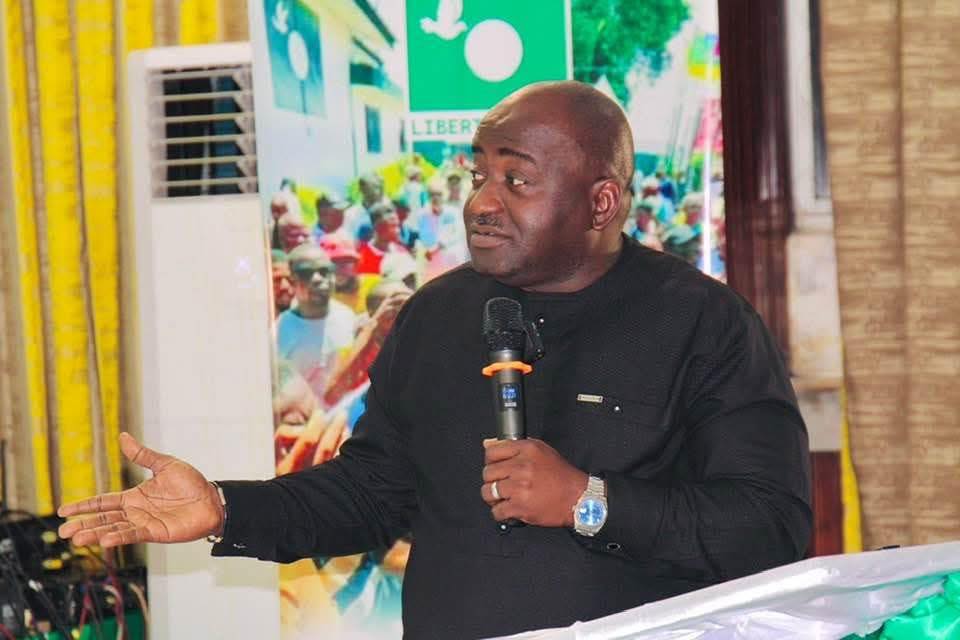
A growing national debate over Liberia’s resource governance has resurfaced after Musa Bility accused the country’s leadership of allowing major natural resource agreements to be negotiated away from public scrutiny, raising concerns about accountability, transparency, and the long-term future of Liberia’s economy.
In a sharply critical statement titled “The Great Liberian Tragedy,” the Nimba County District 7 lawmaker argued that concession deals involving iron ore, gold, diamonds, timber, and rubber are often finalized without meaningful public participation or independent technical evaluation.
Writing from Saclepea, Bility questioned why ordinary Liberians — whom he described as the true owners of the country’s natural wealth — frequently remain unaware of the terms under which national resources are being managed or transferred to foreign concessionaires.
His comments reflect a broader and longstanding concern in Liberia: despite decades of abundant natural resources, many communities located near mining, logging, and agricultural concession areas continue to face poverty, weak infrastructure, unemployment, and limited access to healthcare and education.
According to Bility, one of the country’s deepest structural weaknesses is its dependence on foreign companies to assess and report the value of the very resources they extract.
“For more than a century,” he argued, Liberia has lacked the technical capacity to independently verify production levels, revenues, environmental impact, and financial obligations tied to concession agreements. In effect, he warned, foreign corporations have been allowed to operate as “their own auditors” while the state struggles to independently validate what is being taken from the country and what Liberia is actually earning in return.
The criticism highlights a recurring challenge facing many resource-rich African nations — the paradox of possessing enormous natural wealth while failing to convert those resources into broad national development.
Bility painted a bleak picture of the consequences. While Liberia continues exporting raw materials abroad, he said, local communities remain trapped in underdevelopment as forests disappear, mineral deposits shrink, and profits largely flow outside the country.
The lawmaker further argued that concession agreements should be structured not only to generate revenue, but also to build lasting Liberian expertise in fields such as geology, engineering, environmental science, accounting, auditing, and resource management.
Instead, he warned, Liberia remains heavily dependent on foreign technical knowledge while exporting unprocessed raw materials with limited value addition to the domestic economy.
Beyond criticizing concession agreements themselves, Bility also called for stronger oversight institutions and mandatory public accountability mechanisms. He stressed that agencies responsible for monitoring natural resources should undergo constant audits, public reviews, and transparent reporting.
“Transparency should not be optional,” he argued, insisting that public accountability must become a minimum standard rather than a political talking point.
His remarks arrive at a time when debates over concession agreements, corruption, and economic inequality continue to dominate Liberia’s political discourse. Critics of the current system argue that successive governments have failed to create sustainable frameworks ensuring that ordinary Liberians meaningfully benefit from the country’s natural wealth.
Bility concluded his statement with a warning that carried both political and historical implications: once Liberia’s resources are exhausted, the country may be remembered not for the wealth it possessed, but for the opportunities it failed to transform into national progress.
As of press time, Liberia’s Executive Branch had not publicly responded to the allegations surrounding secretive negotiations and lack of transparency in resource agreements.


