


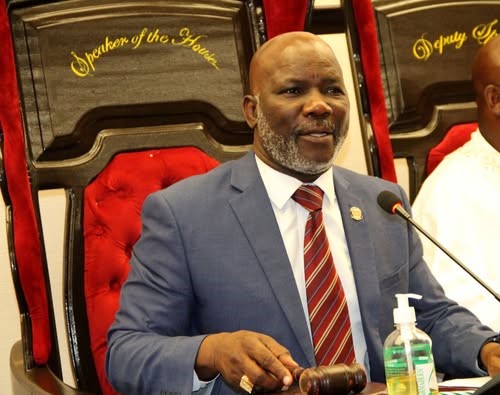
A fresh power struggle is unfolding once again at Liberia’s Capitol, raising a critical question about leadership stability: is Speaker Richard Nagbe Koon on the brink of removal just months after his predecessor was ousted?
Less than seven months after the removal of former Speaker Cllr. J. Fonati Koffa, similar tensions have resurfaced. Reports gathered by D-Kanty News Network (DKNN) team indicate that an organized push to remove Speaker Koon is gaining serious momentum within the House of Representatives. According to sources within the Speaker’s inner circle, what began as a small internal dispute has rapidly evolved into a full-scale rebellion.
Initially driven by a group of 22 dissatisfied lawmakers from the Majority Bloc, the movement has now expanded to 48 representatives backing a resolution to unseat Koon—just one vote short of the 49 required under Article 49 of the Liberian Constitution to remove a sitting Speaker.
The group is not only mobilizing votes but also applying pressure tactics. Lawmakers involved in the effort have threatened to deny the Speaker a quorum and boycott major legislative and government activities, effectively paralyzing the House until leadership changes.
Notably, several influential lawmakers once aligned with Deputy Speaker Thomas Fallah have withdrawn their support for Koon, openly admitting that backing him was never intended as a long-term political commitment.
Those pushing for his removal have outlined a series of grievances in a multi-count resolution. These include allegations of administrative and financial mismanagement, failure to address staff welfare issues, and what they describe as a troubling erosion of legislative independence.
Critics accuse Koon of poor leadership, lack of transparency, and questionable financial practices. Concerns have also been raised over the treatment of legislative staff and civil servants, particularly regarding salary adjustments and delays in holiday payments.
Adding to the controversy are reports of leaked communications and personal matters that have fueled public scrutiny. Some lawmakers, including Representative Marvin Cole, have suggested that Koon should consider recusing himself, citing concerns about his moral standing.
Perhaps the most politically sensitive accusation is that Koon has compromised the independence of the Legislature by relying heavily on support from President Joseph Boakai’s Executive Mansion to maintain his position—an allegation that critics say undermines the constitutional principle of separation of powers.
Despite mounting opposition, Speaker Koon and his allies are resisting the push. Supporters, including Representative Thomas Romeo Quioh, argue that the allegations lack both legal merit and procedural grounds for removal. Koon himself has dismissed the rebellion, maintaining that he does not subscribe to factional politics and remains committed to serving.
However, the deepening divide became more visible on Tuesday, June 2, 2026, when the House failed to hold its regular session due to a lack of quorum. Only 15 lawmakers appeared—far below the number required to conduct official business—forcing the cancellation of proceedings.
In response, Speaker Koon expressed frustration over what he described as a persistent pattern of absenteeism, warning that such behavior undermines legislative effectiveness and delays action on critical national issues.
“The continuous absence of members disrupts our work and weakens our ability to serve the Liberian people,” Koon stated. “Lawmakers must take their responsibilities seriously.”
He further announced that members who repeatedly fail to attend sessions without valid reasons could face salary cuts and other disciplinary measures, signaling a tougher stance on internal accountability.
The incident has intensified public criticism of the Legislature, with many citizens questioning lawmakers’ commitment and productivity. Social media reactions, particularly on Facebook, reflect growing frustration over delays in passing key legislation while lawmakers continue to receive taxpayer-funded salaries and benefits.
Political observers argue that the ongoing absenteeism and internal conflict risk damaging the credibility of the House, which plays a critical role in governance, lawmaking, and oversight.
As the anti-Koon bloc inches closer to the constitutional threshold for removal, the situation remains highly volatile. With just one additional vote needed, the coming days could determine whether Liberia witnesses yet another leadership shake-up in its Legislature—or whether Speaker Koon can survive the mounting political storm.


