


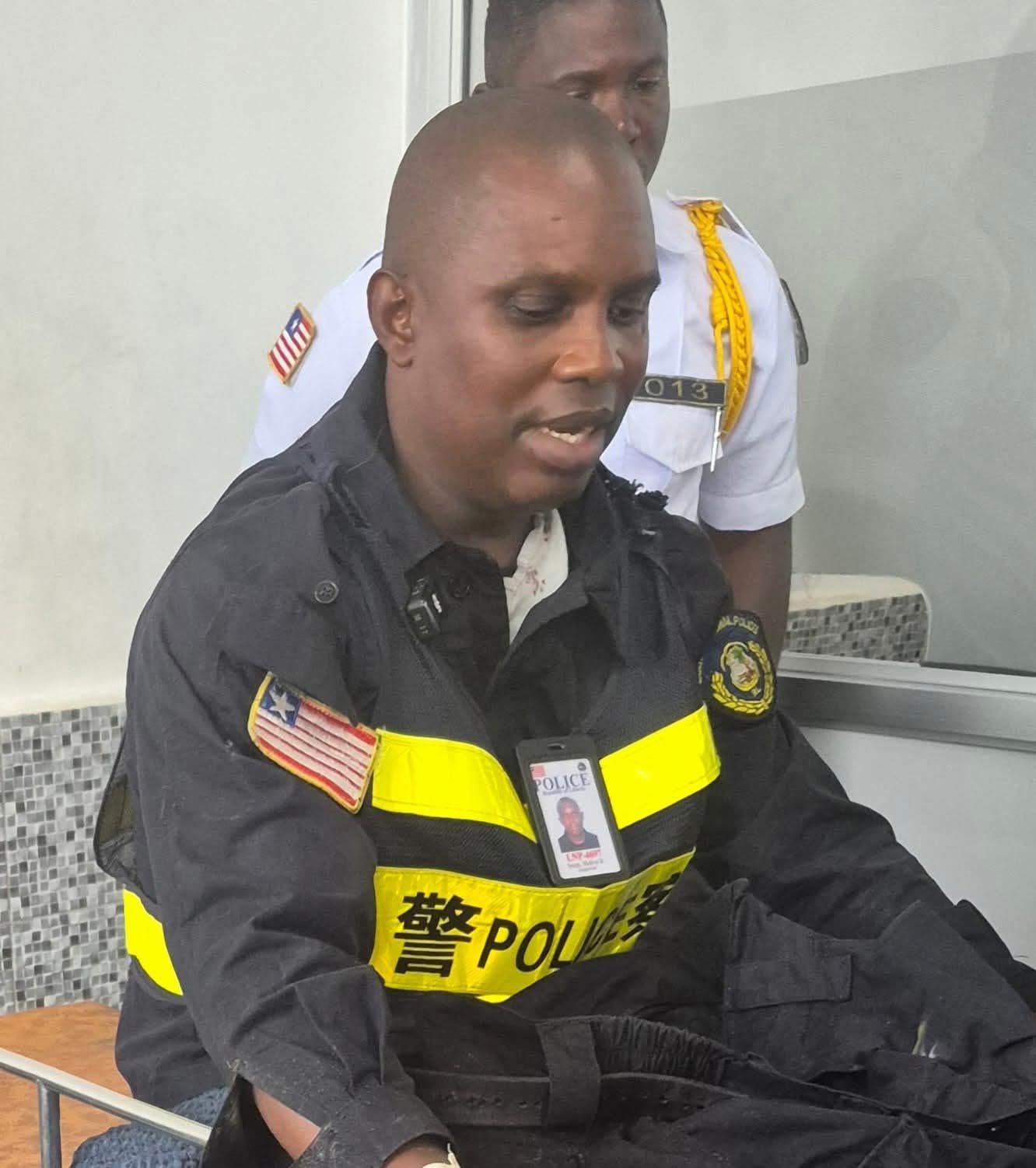
The Liberia National Police (LNP) has launched a fresh investigation into a man arrested for impersonating as a police officer — a crime he was previously apprehended for in 2023. The incident, which occurred on Sunday night, August 17, 2025, near the Vamoma checkpoint, has reignited public debate about the troubling rise in law enforcement impersonation and the broader implications for national security.
According to police reports, the suspect, dressed in full LNP uniform, was struck by an unknown vehicle and rushed to JFK Medical Center. While undergoing treatment, hospital staff and investigators discovered that he was not a legitimate police officer but was in possession of a forged LNP identification card. The ID bore the name Melvin D. Swen, with the rank of Inspector.
During preliminary questioning, the man maintained that he was Swen and resided in Matadi Estate. However, ongoing investigations have linked him to another possible identity, Cornelius D. Neville, reportedly of Cow Factory, Jamaica Road. The LNP says it is now working to verify his true identity before filing formal charges.
The Law on Police Impersonation
Impersonating a public authority figure is a criminal act under Liberian law. Chapter 12, Section 12.70 of the Penal Law of Liberia explicitly prohibits “false personation of a public servant.” The provision states:
“A person is guilty of a felony of the third degree if he pretends to hold a position in the public service with intent to induce another to submit to such pretended official authority or to rely upon such pretense to his prejudice.”
The law further emphasizes that impersonation undermines public trust in government institutions and carries penalties of imprisonment and/or fines.
A Recurring Pattern: Data on Impersonation Cases
This is not an isolated case. LNP records and civil society monitoring groups suggest that impersonation of security officers has been a persistent challenge. In 2023 alone, at least 18 individuals were arrested nationwide for posing as police officers, immigration agents, or soldiers. By mid-2024, the number had increased to 24 reported arrests, reflecting a steady rise in such offenses.
The motives behind impersonation vary, but most offenders exploit uniforms and forged IDs to extort money from motorists, harass vulnerable citizens, or gain unauthorized access to restricted spaces. In some cases, impostors have been linked to more serious crimes, including theft, robbery, and sexual violence.
Analysts say Liberia’s post-war security environment, where the trust gap between citizens and law enforcement remains fragile, creates fertile ground for such practices.
Why Does This Keep Happening?
Weak Enforcement and Lenient Sentencing: Many impersonators, after arrest, serve minimal jail time or pay small fines before returning to the streets. This emboldens repeat offenders, such as the current suspect who was first arrested in 2023.
Easy Access to Uniforms and Badges: Despite official controls, police uniforms and insignia are widely available on the black market and in used clothing stores. This makes it relatively easy for impostors to present themselves as legitimate officers.
Low Public Awareness: Citizens often hesitate to question individuals in uniform due to cultural respect for authority. This reluctance allows impersonators to operate with little resistance.
Economic Hardship: With unemployment estimated at over 14% nationally, some offenders exploit impersonation as a survival strategy, using the perceived authority of law enforcement to extract bribes.
The Security Implications
The latest case raises troubling questions about national security and public safety. If unchecked, impersonation not only erodes trust in the police but also endangers lives. Citizens may fall prey to scams, unlawful arrests, or even violent crimes committed under the guise of law enforcement.
Security experts warn that repeated lapses also undermine Liberia’s fragile justice system. “When people cannot distinguish between genuine officers and impostors, confidence in the rule of law collapses,” said one Monrovia-based legal analyst.
The LNP has vowed to pursue charges once the suspect recovers medically. Officials also used the incident to call on the public to remain vigilant and report suspicious individuals in uniform.
For reform advocates, however, this case underscores the urgent need for stricter laws and stronger enforcement. Proposals include harsher penalties for repeat offenders, tighter control of uniforms and ID cards, and a public awareness campaign to help citizens detect impersonators.
Until these measures are implemented, cases like that of the alleged “Inspector Swen” may continue to resurface — eroding confidence in Liberia’s security institutions and leaving citizens vulnerable to deception and abuse.


