


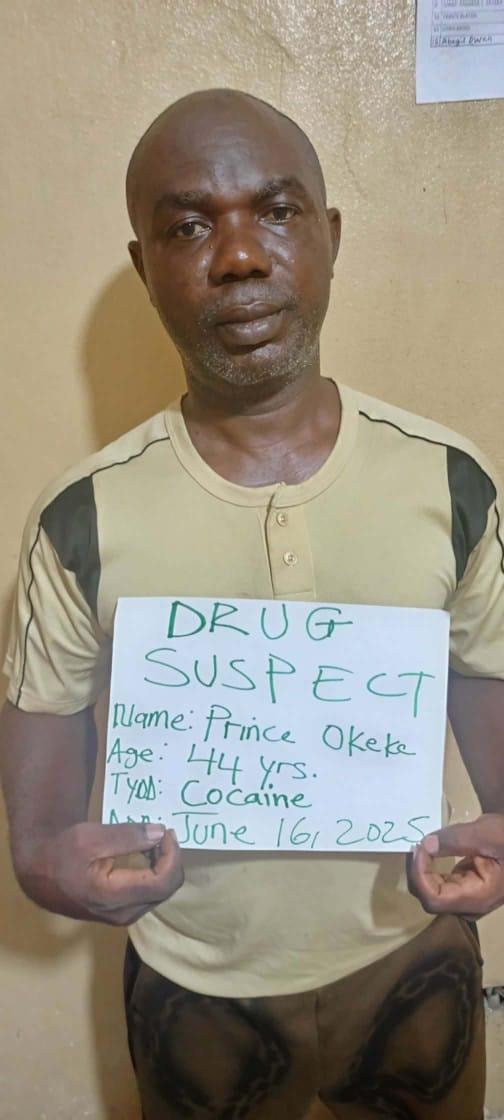
The conviction of Nigerian national Prince Okeke by the 13th Judicial Circuit Court in Margibi County has once again placed Liberia’s narcotics problem under the spotlight—this time raising troubling questions beyond a single criminal case. While the guilty verdict is being hailed as a legal victory, it also exposes persistent systemic failures that continue to allow hard drugs to enter the country despite frequent arrests and high-profile prosecutions.
Prince Okeke was found guilty in one of Liberia’s most closely scrutinized drug trafficking cases, involving the importation of more than 8.6 kilograms of raw heroin through Roberts International Airport (RIA). The consignment, valued at nearly US$389,000, points to an operation far more sophisticated than the actions of isolated couriers.
In her ruling, Resident Circuit Judge Victoria Worlobah Duncan convicted Okeke on multiple counts, including unlicensed importation, illicit trafficking of controlled substances, criminal conspiracy, and criminal facilitation. The court concluded that Okeke played a central coordinating role within a broader transnational drug network, serving as the local contact responsible for receiving and directing couriers arriving from abroad.
The prosecution’s case relied heavily on circumstantial but corroborated evidence—an approach the court firmly endorsed. Judge Duncan cited Okeke’s extended flight from law enforcement after being summoned by the Liberia Drug Enforcement Agency (LDEA), his decision to switch off his phone for over four months, and his contradictory statements as strong indicators of guilt. Referencing Supreme Court precedent, the court held that such conduct reflects a “consciousness of guilt” and is admissible in sustaining a criminal conviction.
Two co-accused, Arondo L. Bonancy and Abel S. Gbedia, were arrested at RIA with the heroin concealed in their luggage. Both provided voluntary statements consistently identifying Okeke as the individual assigned to receive them and facilitate the onward movement of the drugs. The court further noted that Okeke’s own admissions—acknowledging his relationship with one of the couriers and providing financial assistance after their arrest—undermined his defense and strengthened the prosecution’s case.
Judge Duncan emphasized that modern drug trafficking networks are deliberately structured to shield coordinators from direct contact with narcotics. As a result, courts must rely on patterns of behavior, corroborated testimonies, evasive conduct, and internal role allocation within criminal enterprises. Citing past rulings, including Jusu v. Republic and Republic of Liberia v. George Obi, she reaffirmed that circumstantial evidence, when properly corroborated, can be as compelling as direct proof.
The court was equally dismissive of Okeke’s defense. His claim of being an herbal drink seller was unsupported by evidence, his denial of links to airport operations conflicted with testimony and records, and he failed to explain discrepancies surrounding his registered GSM number. These inconsistencies, the judge ruled, were not accidental but deliberate efforts to conceal his involvement.
While sentencing has been scheduled for January 23, 2026—pending a presentence investigation report—Okeke has already noted an appeal to the Supreme Court, temporarily suspending further proceedings.
Yet beyond the courtroom, the case raises far more unsettling questions.
If couriers are repeatedly intercepted and middlemen convicted, how do such large quantities of heroin continue to pass through Liberia’s main international airport? Who within the system enables these networks to operate with such confidence? Are arrests merely capturing expendable foot soldiers while higher-level facilitators remain untouched? And why does Liberia continue to appear attractive as a transit corridor for international drug syndicates?
The Okeke conviction underscores judicial willingness to confront organized narcotics crime, but it also exposes gaps in border security, intelligence coordination, and institutional accountability. Without a deeper investigation into how drugs consistently breach entry points—and who benefits from these failures—courtroom victories risk becoming symbolic rather than transformative.
As Liberia intensifies its fight against illicit drugs, the critical question remains unanswered: is the country dismantling drug networks at their roots, or merely trimming the branches while the system that enables them remains intact?


