


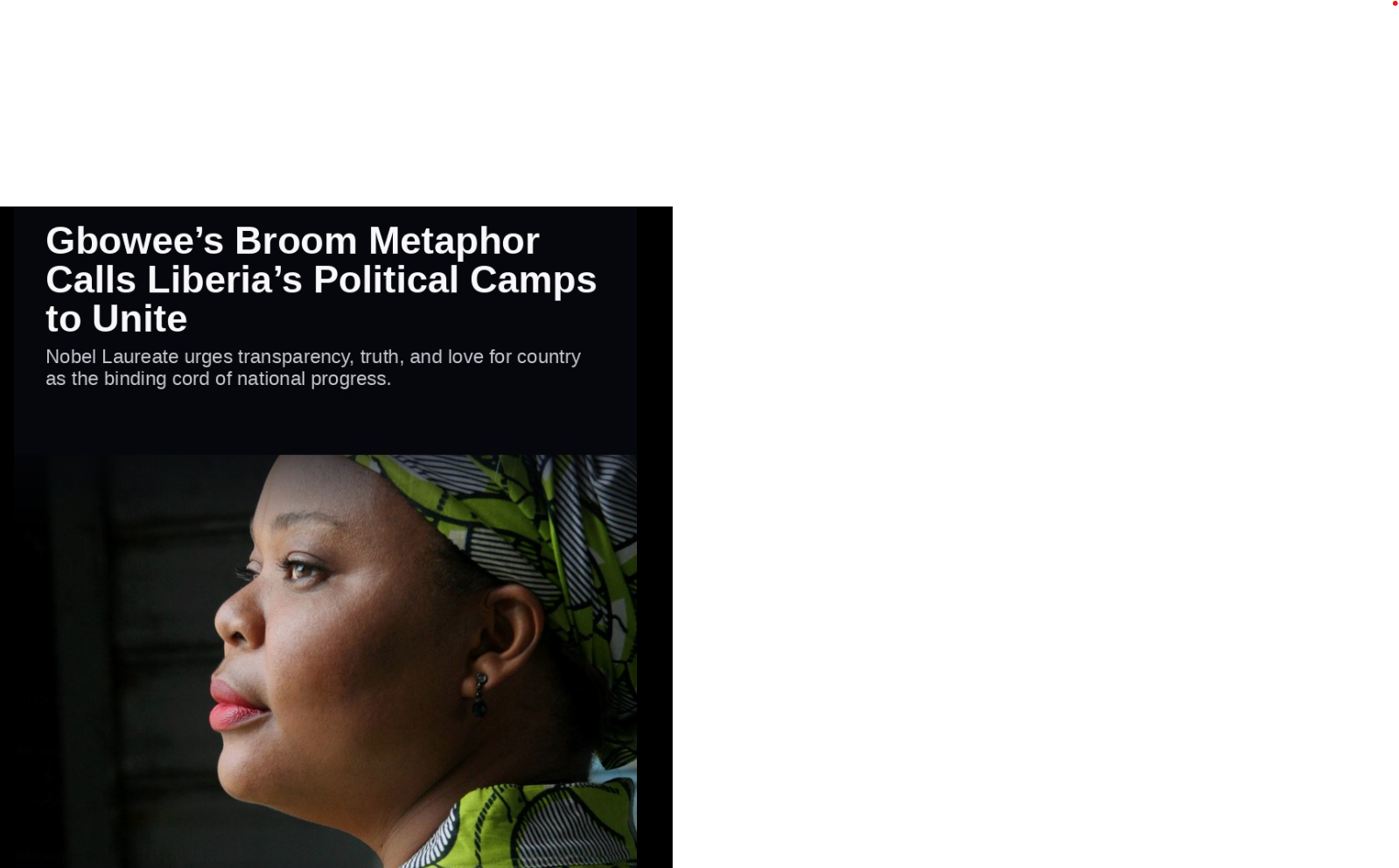
MONROVIA, Liberia — A powerful Unification Day message from Nobel Peace Prize winner Leymah Gbowee has reignited a broader national conversation about Liberia’s political divisions, governance challenges, and whether the country’s competing political forces are working toward national progress or drifting further apart.
Using one of Liberia’s most familiar household objects as a symbol, Gbowee delivered a message that moved beyond ceremonial greetings and instead issued a pointed challenge to the nation’s political class. Her statement suggested that Liberia’s struggle may no longer be simply about political competition, but about whether its institutions and leaders can find enough common purpose to move the country forward.
The Nobel Laureate made the remarks through a Facebook post published on Unification Day, where she used the image of a broom to illustrate what she described as the current state of Liberia’s fragmented political environment.
“A broom isn’t a broom before it’s tied together,” Gbowee wrote. “Before being bound together, a broom is a collection of straws scattered with no defined purpose.”
Though simple in language, the message carried deeper political implications.
Gbowee compared scattered broom straws to what she described as Liberia’s three major political forces — the ruling establishment, opposition groups, and the so-called “No Position” bloc — arguing that separation and division have created an environment where collective national goals become increasingly difficult to achieve.
“When these groups are separated and scattered from one another, we are unable to work together to meet our common goals,” she stated. “We are not coordinated, and we move in opposite directions from one another.”
Beyond Symbolism: A Broader Political Challenge
The message quickly gained traction beyond social media, with many viewing it as more than a reflection on unity and more as a direct commentary on the country’s current political climate.
Liberia has experienced increasing political tensions in recent months, including disputes within government institutions, debates over constitutional authority, disagreements inside the Legislature, and growing public discussions surrounding governance and accountability.
Against that backdrop, Gbowee’s remarks appeared to raise a larger question: Can Liberia sustain meaningful development if political actors remain divided by interests, personalities, and power struggles?
Rather than assigning blame to any particular group or individual, Gbowee framed the issue as a collective challenge requiring a collective response.
She argued that unity requires more than simply occupying the same national space or sharing political institutions. According to her message, lasting national cohesion must be built upon common values capable of holding diverse interests together.
“To become a broom that cleans the house, the hundreds of tiny straws need to be held firmly together with a very strong cord at the top,” she wrote.
She identified that “cord” as shared national values.
“Similarly, when the three groups come together, united by the cord of our common values — transparency, truth, equality, and love for country — we turn an unproductive situation, an unproductive nation around.”
“We become unified.”
A Message Backed by History
For many Liberians, Gbowee’s message carries influence not only because of her international recognition but because of her historical role in Liberia’s own journey toward peace.
Leymah Gbowee rose to global prominence through her leadership of the Women of Liberia Mass Action for Peace movement, a campaign that united Christian and Muslim women during Liberia’s civil conflict.
The movement became one of the country’s most influential peace initiatives and played a significant role in ending Liberia’s second civil war.
Her efforts later earned international recognition when she received the Nobel Peace Prize in 2011 alongside Ellen Johnson Sirleaf and Tawakkol Karman for their nonviolent efforts advancing women’s rights and peacebuilding.
That history has led many observers to view Gbowee’s latest message not as a routine social media post, but as a warning informed by experience.
Unification Day Under New Scrutiny
The timing of the statement also attracted attention.
Unification Day traditionally serves as a national reminder of Liberia’s commitment to bringing together diverse communities, cultures, and political interests. Yet for many citizens, celebrations often occur against persistent concerns about national cohesion.
Political observers suggest that Gbowee’s comments effectively transformed the day from a ceremonial occasion into a test of leadership and national commitment.
Her use of a broom—a common object found in homes and communities across Liberia—was also widely viewed as deliberate.
Rather than relying on political language or institutional rhetoric, she grounded a national message in an image immediately recognizable to ordinary Liberians regardless of social status, education level, or political affiliation.
The Bigger Question Ahead
As reactions to the message continue, many analysts believe the larger issue raised by Gbowee extends beyond political camps themselves.
The question may not simply be whether Liberia has divisions. Political disagreement exists in every democracy.
Instead, the issue increasingly becomes whether those differences are being managed in ways that strengthen institutions or deepen national fractures.
Her remarks therefore appear to challenge leaders across the political spectrum to examine not only how they govern or oppose, but how they contribute to the larger national project.
As Liberia reflects on another Unification Day, Gbowee’s message leaves behind a question that may linger long after the celebrations end:
Can a nation move forward together if its political forces continue moving in different directions?


