


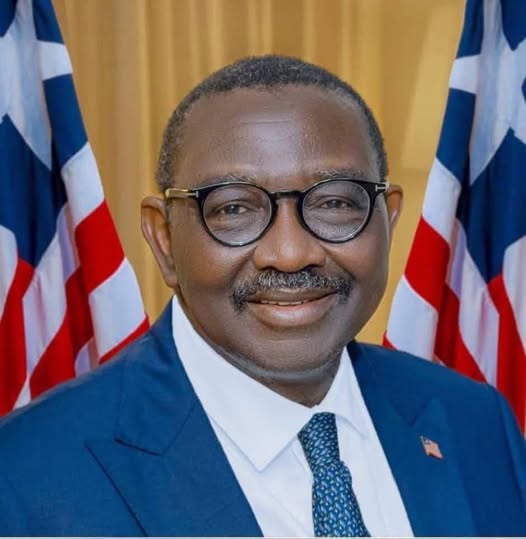
Monrovia, Liberia — The acquittal of former Finance Minister Samuel D. Tweah Jr. in one of Liberia’s most closely watched corruption trials has deepened national debate over judicial credibility, prosecutorial effectiveness, and the future of the country’s anti-corruption agenda.
The controversy intensified after Liberia’s Ministry of Justice publicly responded to the verdict delivered by Criminal Court “C” in the high-profile economic sabotage case involving Tweah and several former officials of the George Weah administration.
Speaking during a major press conference on Tuesday, Attorney General and Justice Minister Cllr. N. Oswald Tweh acknowledged growing public reactions surrounding the ruling but emphasized that the government remains committed to respecting judicial independence and the rule of law.
Analytically, the Ministry’s response reflects the delicate balance between political accountability and judicial autonomy in Liberia’s evolving democratic system. While the government faces public pressure to demonstrate seriousness in combating corruption, it must simultaneously avoid perceptions of interference in judicial proceedings.
The case centered on allegations involving more than US$6.2 million and over LD$1 billion in government-linked national security funds that prosecutors claimed were unlawfully transferred and mismanaged during the previous administration. Samuel Tweah and other former officials faced multiple charges, including economic sabotage, money laundering, criminal conspiracy, and theft of property.
However, after months of legal proceedings, the jury acquitted Tweah of all major charges. Several co-defendants, meanwhile, received mixed outcomes ranging from convictions to hung jury decisions, creating a fragmented legal conclusion that has fueled competing political interpretations.
Supporters of the former finance minister have portrayed the acquittal as evidence of political vindication and proof that the prosecution failed to substantiate its allegations. Critics, on the other hand, argue that the outcome exposes weaknesses in investigative preparation, prosecutorial coordination, and the broader institutional capacity to successfully litigate complex financial crimes.
From a governance perspective, the verdict has evolved beyond a single courtroom outcome into a broader referendum on Liberia’s anti-corruption architecture. Questions are now being raised about the effectiveness of state institutions in handling politically sensitive corruption cases, especially those involving senior former officials.
Justice Minister Oswald Tweh reportedly reaffirmed that the Ministry of Justice remains committed to pursuing corruption cases through constitutional and lawful mechanisms despite courtroom setbacks. His remarks appeared aimed at reinforcing public confidence in the government’s anti-corruption posture amid mounting political polarization surrounding the case.
The verdict also places renewed focus on the administration of President Joseph Boakai, whose government has repeatedly emphasized transparency, accountability, and institutional reform as core governance priorities. Political observers argue that the long-term implications of the case may depend less on the acquittal itself and more on whether future prosecutions demonstrate stronger evidentiary preparation and institutional consistency.
Ultimately, the Samuel Tweah case underscores a recurring challenge within many emerging democracies: the difficulty of translating anti-corruption rhetoric into successful judicial outcomes without undermining due process or public trust in the courts.


