


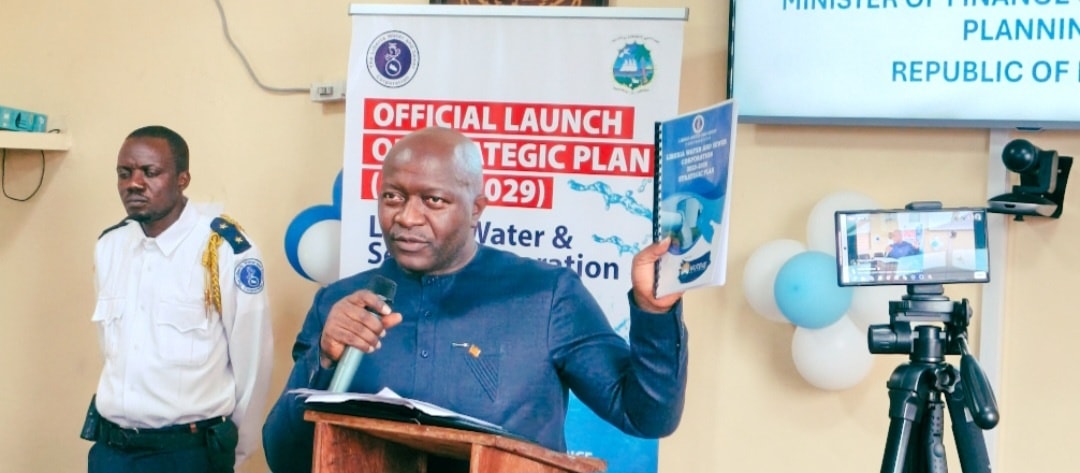
Monrovia, Liberia – August 8, 2025 – In a significant move to overhaul Liberia’s water and sanitation infrastructure, the Liberia Water and Sewer Corporation (LWSC) has unveiled a comprehensive $156.6 million five-year strategic plan aimed at doubling access to pipe-borne water, strengthening sanitation systems, and transforming customer service delivery across the country by 2029.
Speaking during the launch ceremony held Thursday at the Ministry of Public Works, LWSC Managing Director Mohammed Ali described the plan as a much-needed “reset” for the utility after the 2018 strategy failed to materialize.
“When we took over, the system wasn’t completely broken, but it wasn’t functioning,” Ali said. “This plan shows how and where we will improve service.”
Locally Designed, Internationally Backed
The new strategic plan was developed with technical support from USAID and local consultancy Wutuve, co-led by Liberian experts Isaac Vah-Tukpah and Dr. Joe Baysah. The plan focuses on infrastructure upgrades, operational efficiency, and accountability, and it places strong emphasis on utilizing Liberian knowledge to tailor solutions to the country’s unique challenges.
“No U.S. friend understands our problems like we do,” Ali emphasized, defending the decision to rely on Liberian consultants instead of foreign firms.
The strategic roadmap, spearheaded by LWSC Deputy Managing Director for Technical Services Patrick Sandiki, will guide all institutional and infrastructure investments through 2029.
Key Objectives by 2029
The five-year plan outlines bold, measurable goals: Water Connections: Increase from 15,000 to 30,000, Sewer Connections: Grow from 1,560 to 3,000, Revenue Collection Efficiency: Improve from 57% to 95% and Government Subsidy Dependence: Decrease from 50% to 20%
Ali also acknowledged systemic inefficiencies and external obstacles, including recurring damage to water infrastructure caused by uncoordinated roadwork and politically driven construction.
“There are communities without water today because someone broke our pipes with a yellow machine,” he lamented, calling for improved collaboration between public agencies.
Government Endorsement
Finance and Development Planning Minister Augustine Kpehe Ngafuan, who attended the launch, welcomed the plan as a “bold but necessary” vision for national development. He pledged the government’s full backing while cautioning that failure was not an option.
“If this plan fails, it’s not just Mo Ali or LWSC—it’s a national failure,” Ngafuan warned. “Water brings life. A child could die because of our inaction.”
Ngafuan encouraged the LWSC to remain focused on execution, rather than just policy. “Let this plan be your mantra,” he urged, expressing optimism that successful implementation would signal a turning point for Liberia’s water sector.
Customer-Centric Commitments
In a move to enhance public trust and improve service delivery, LWSC also introduced a new Service Delivery Charter and Five-Bill Action Plan. These initiatives aim to make the corporation more responsive and accountable to customers by promising: 12 hours of clean water supply daily, Complaint resolution within 7 days, Professional and transparent customer engagement and Quarterly customer satisfaction surveys
According to Deputy Managing Director for Sales and Marketing Janice Love Bropleh, LWSC is targeting a 90% complaint resolution rate within one week and an 80% customer satisfaction threshold.
A National Blueprint for Reform
Throughout the event, the plan was framed not just as an institutional reform strategy for LWSC but as a national blueprint for rebuilding trust in public utilities.
“This isn’t just LWSC’s plan—it’s our national plan,” Ngafuan declared, urging other government agencies to emulate LWSC’s approach, particularly its commitment to engaging Liberian professionals at home and abroad.
While the plan faces significant implementation challenges—including fragile infrastructure, funding limitations, and inter-agency coordination—stakeholders agree that successful execution could dramatically reshape Liberia’s public water and sanitation landscape.
If achieved, the five-year strategy could significantly reduce water-borne diseases, enhance urban planning, and foster a culture of performance-based public service in one of Liberia’s most critical sectors.


