


Liberia’s media landscape is facing renewed scrutiny as tensions between journalists and government officials bring press freedom back to the center of national debate.
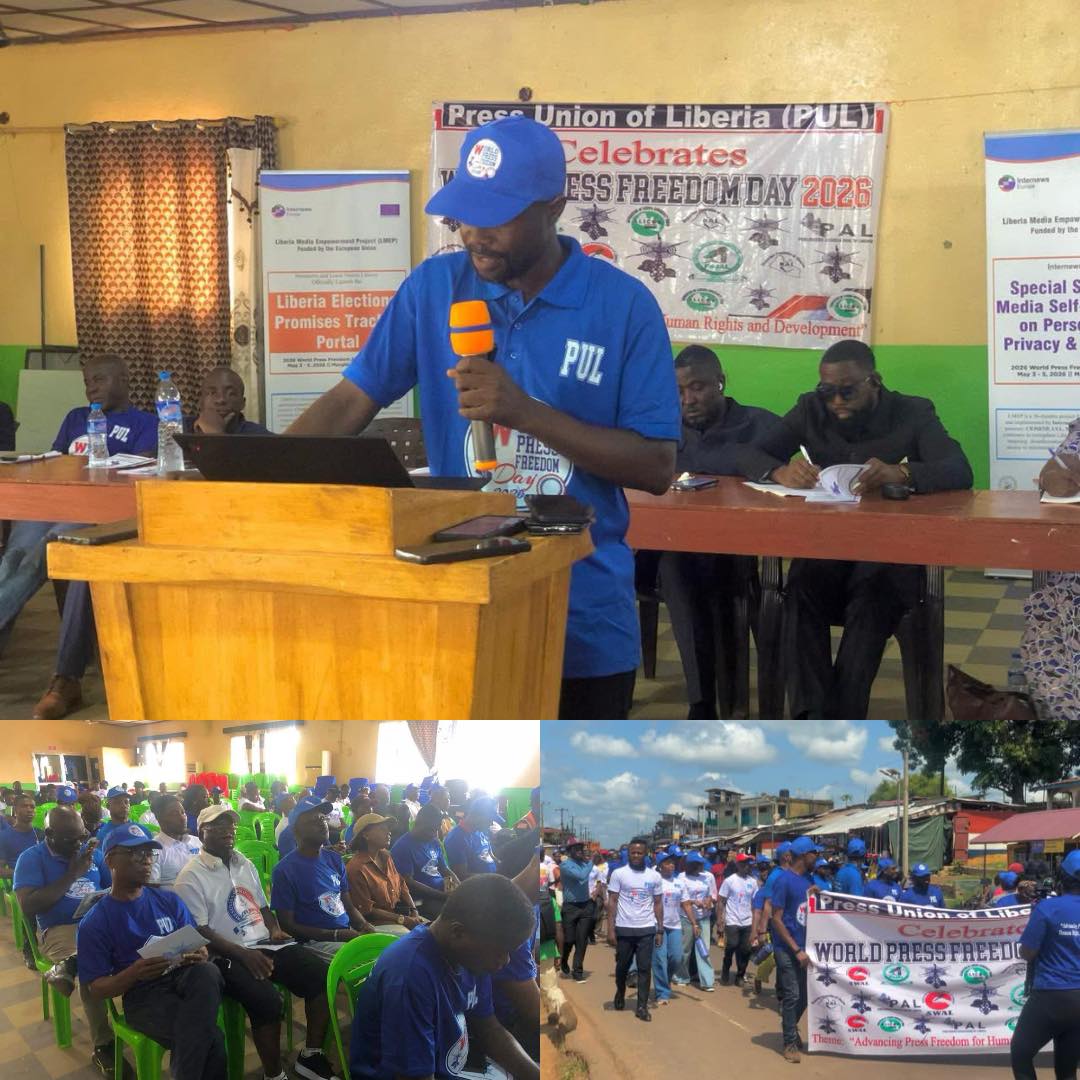
At this year’s World Press Freedom Day celebration in Kakata, Press Union of Liberia (PUL) President Julius Kanubah used the platform to frame media freedom not simply as a right, but as a test of the country’s democratic maturity. His remarks come amid growing friction between the Union and state actors, highlighting concerns about how criticism and dissent are handled within official circles.
Kanubah’s address signaled a shift from ceremonial reflection to pointed advocacy. He argued that restrictions—whether direct or subtle—on free expression could undermine governance, accountability, and public trust. In doing so, he positioned press freedom as a structural necessity for national development rather than an abstract principle.
The PUL President also pushed back against recent characterizations of the Union by a government official, interpreting such remarks as indicative of a broader pattern of political sensitivity toward media scrutiny. Without escalating the rhetoric, he maintained that institutional independence must remain non-negotiable, particularly for organizations tasked with holding power to account.
Observers note that the exchange reflects an evolving dynamic in Liberia’s democratic space, where public officials and media institutions increasingly clash over narrative control and accountability. The situation underscores the challenge of balancing government communication strategies with the autonomy of the press.
Kanubah further grounded his argument in Liberia’s constitutional history, emphasizing that freedom of expression has long been embedded in the country’s legal and political framework. His message to the current administration was clear: safeguarding these rights is not optional but foundational to governance.
This year’s observance, held under the theme “Advancing Press Freedom for Human Rights Development,” brought together a wide cross-section of stakeholders, including journalists, civil society groups, students, and government representatives. Discussions largely centered on the role of independent media in promoting transparency and protecting civil liberties.
As Liberia continues to navigate its democratic trajectory, the debate sparked in Kakata points to a broader question—how resilient press freedom remains in practice, especially when it intersects with political power.


