


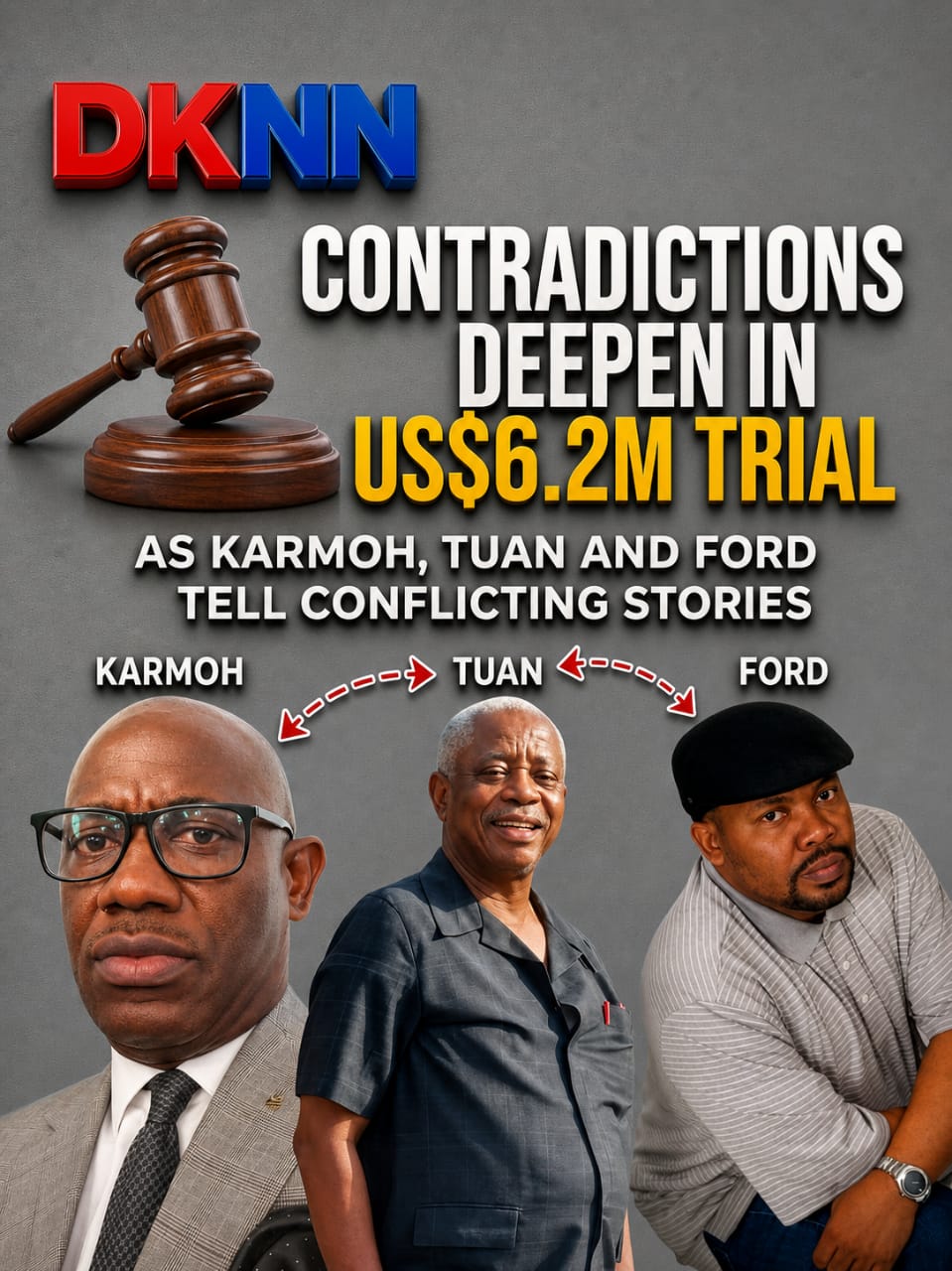
Monrovia, Liberia — What began as a high-profile corruption case over the disappearance of US$6.2 million is increasingly evolving into a courtroom battle over credibility, as three former senior government officials continue to offer sharply conflicting accounts about how the money was handled and who authorised its movement.
At the centre of the trial is no longer just the question of where the money went but also whether the state’s own former officials can present a consistent account of what happened. Testimony from former Financial Intelligence Agency (FIA) Director Stanley Ford, former National Security Advisor Jefferson Karmoh, and former Acting Justice Minister Nyanti Tuan has exposed significant contradictions, complicating the prosecution’s effort to establish a clear chain of responsibility.
Weeks earlier, Stanley Ford told the court that the FIA played a significant operational role in Liberia’s joint security framework, working closely with law enforcement and intelligence institutions on sensitive matters often shielded from public view. He argued that a July 2023 communication concerning the FIA was not about formally integrating the agency into the joint security command but rather assigning it a radio communication code — Unit 800 — for operational coordination.
Ford’s testimony, however, portrayed the FIA as an active security actor, a position that now appears difficult to reconcile with later attempts by other defendants to minimise the agency’s operational role in the transfer of the funds.
Jefferson Karmoh, taking the stand in his defence, sought to draw a firm line between himself and the disputed transaction. The former National Security Advisor denied authorising, directing, or discussing the transfer of the US$6.2 million to the FIA, rejecting claims that he worked with Nyanti Tuan to facilitate the movement of the funds.
Karmoh told the court he only became aware of the transfer after being copied on correspondence and insisted that his involvement was limited to administrative communication. He acknowledged assigning the FIA the Unit 800 communication code but maintained that the designation was strictly for radio contact within the security network and did not amount to formal inclusion in the National Security Council structure.
He argued that allegations linking him directly to the transfer were based on a misreading of his official communication and maintained that his letter had been taken out of context.
But Nyanti Tuan, testifying later, offered a markedly different version – one that directly undercut Karmoh’s defence. Tuan told the court that Karmoh was not only aware of the funds but was also the very official who informed him about their availability for joint security operations during the tense 2023 election period.
According to Tuan, Karmoh instructed him to prepare the letter to the FIA as part of the process, with his own role limited to formalising and transmitting the request. Tuan rejected any suggestion that Karmoh was unaware, telling the court that the former national security advisor had ample opportunity to challenge the transaction at the time but never did.
In one of the trial’s more pointed moments, Tuan argued that Karmoh’s silence should be interpreted as tacit approval, effectively placing the former security advisor at the centre of the decision he now denies.
Tuan also used his testimony to attack the prosecution’s broader case, arguing that state lawyers have failed to establish the most basic elements of theft. He said prosecutors had not shown who ultimately received the money, failed to prove that any of the accused personally benefited, and had not demonstrated how the alleged criminal scheme was executed.
He maintained that the transaction was tied to legitimate national security operations, not personal enrichment, and defended the use of the FIA as part of an emergency security response during a politically sensitive election year. In such operations, Tuan argued, outcomes often matter more than bureaucratic paperwork, particularly where intelligence and security concerns are involved.
That argument now leaves the court with a narrower but more difficult question: whether the transaction was a lawful national security expenditure carried out under emergency conditions or an unlawful diversion of public funds disguised as state security.
With testimony concluded and final arguments expected on May 8, the case is no longer defined only by the missing US$6.2 million but by whether the court believes the men who once stood at the centre of Liberia’s national security establishment.


