


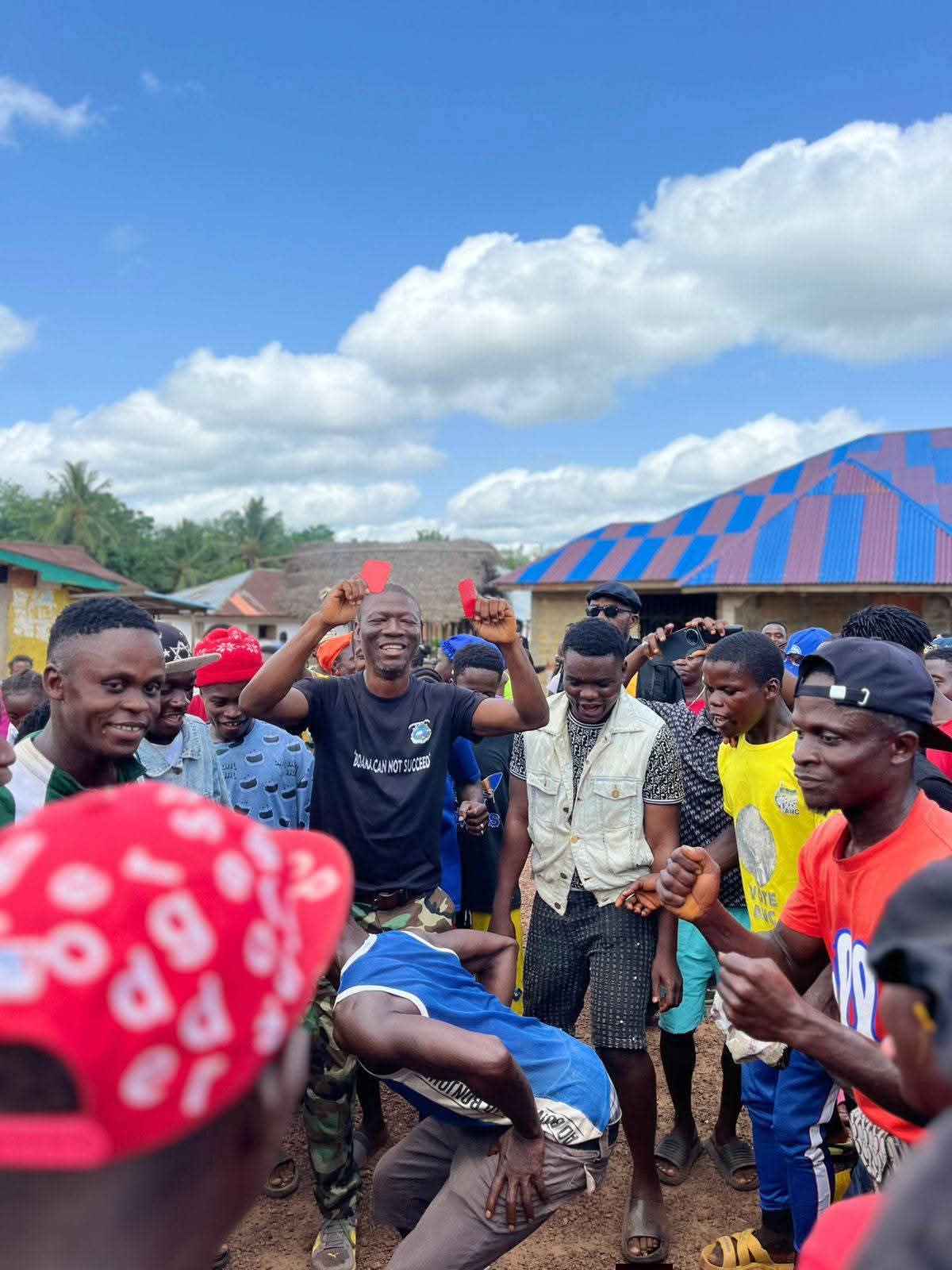
In Liberia’s increasingly performative political landscape, symbolism is becoming strategy—and no figure illustrates this shift more clearly than Montserrado County District 10 Representative Yekeh Kolubah. His ongoing nationwide “Red Card” tour against the administration of President Joseph Boakai and Vice President Jeremiah Koung is not merely a political protest; it is an early-stage attempt to reshape opposition momentum through spectacle-driven mobilization.
At its core, Kolubah’s campaign introduces a simple but powerful metaphor borrowed from sport: the “red card” as a signal for disqualification. By publicly holding two red cards—one for the President and one for the Vice President—he is reframing executive leadership as a game in which the current administration has, in his view, violated the rules of public trust and should be “benched” by voters.
This framing is not accidental. It reflects a broader trend in modern political communication where symbolic gestures increasingly substitute for structured policy critique. In Kolubah’s case, the symbolism is amplified through physical presence: county-by-county engagement designed to convert political frustration into visible crowd energy.
Reports from counties such as Grand Bassa, Sinoe, and River Gee indicate significant turnout, with supporters adopting chants that personalize the message of political rejection. The slogan “Yekeh gave the Papay red card, he will not play the second half” demonstrates how quickly political messaging can evolve into populist narrative shorthand, particularly when reinforced through repetition and public gatherings.
From an analytical standpoint, this tour represents an attempt to test the elasticity of grassroots opposition outside formal party structures. Unlike traditional campaigns organized through party machinery, Kolubah’s approach relies heavily on personal branding, emotional resonance, and informal civic mobilization.
However, this form of early mobilization raises structural questions about the boundaries of political activity in Liberia’s electoral system. The National Elections Commission is legally mandated to regulate and sequence electoral processes, including the official declaration of campaign periods. Under Liberia’s electoral framework, particularly Section 5.1 and 5.2 of the New Elections Law, the Commission maintains exclusive authority over the administration and timing of campaign activities.
This legal architecture is designed to prevent premature campaigning that could distort electoral fairness or create uneven political advantages. It also serves to maintain a controlled transition from civic engagement to formal electoral competition.
Kolubah’s activities therefore sit in a grey zone: while framed as an “open county tour,” their political messaging, scale, and timing closely resemble early campaign mobilization. This blurring of lines reflects a broader challenge in Liberia’s political environment—distinguishing between constitutionally protected expression and regulated electoral campaigning.
The emergence of such dynamics is not unique to Kolubah, but his high visibility amplifies the tension between political expression and institutional regulation. His approach leverages direct public engagement, bypassing traditional party filters and engaging citizens at a highly emotional and participatory level.
Yet this also exposes a governance dilemma. On one hand, such tours reflect democratic vibrancy and citizen engagement. On the other, they risk undermining the structured electoral timetable established to ensure fairness and procedural order.
The public reaction has been mixed. While supporters view the tour as a legitimate expression of accountability politics, others see it as a premature escalation that tests the limits of electoral discipline. This tension underscores an ongoing debate in Liberian politics: where does civic activism end and electoral campaigning begin?
In strategic terms, Kolubah’s “Red Card” campaign may be less about immediate electoral impact and more about long-term positioning. By sustaining visibility across counties and embedding symbolic language into political discourse, he is effectively building narrative capital that could influence future electoral cycles.
What is unfolding, therefore, is not just a protest tour—but an early experiment in decentralized political mobilization that challenges both party structures and electoral timing norms.
Whether this model becomes a blueprint for future opposition activity or prompts tighter regulatory interpretation by electoral authorities remains an open question. What is clear, however, is that Liberia’s political communication space is becoming increasingly fluid, where symbolism, legality, and mobilization intersect in complex and sometimes contested ways.


