


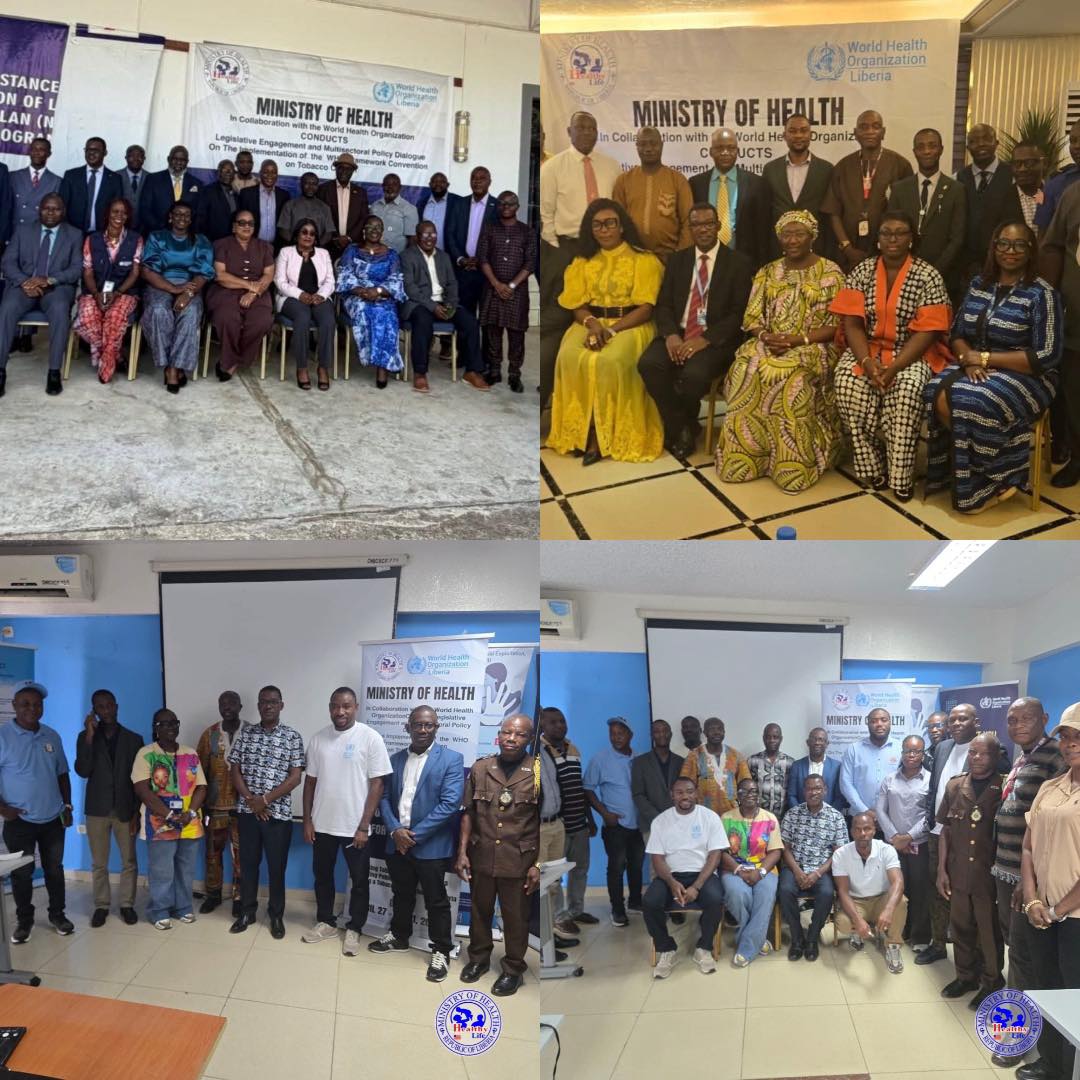
Liberia’s latest national consultation on tobacco control signals a shift in tone—from policy endorsement to policy execution. The four-day engagement led by the Ministry of Health Liberia, with support from the World Health Organization, was less about reaffirming commitment to global standards and more about confronting a persistent implementation deficit that has defined the country’s tobacco control trajectory for over a decade.
At issue is not whether Liberia aligns with the WHO Framework Convention on Tobacco Control—it formally does, having signed and ratified the treaty years ago. The real challenge lies in translating that alignment into enforceable domestic systems. This distinction framed much of the discussion: Liberia is no longer in a phase of policy adoption, but in one of institutional delivery.
The consultation, held in Monrovia, brought together a cross-section of policymakers, health experts, and international partners. While such gatherings are often procedural, this one carried a more urgent undertone. The country is grappling with rising non-communicable diseases and the expanding economic burden associated with tobacco use—pressures that expose the limitations of partial compliance with international frameworks.
A central analytical thread emerging from the discussions is the gap between legal commitment and operational capacity. Liberia’s intent to domesticate the Protocol to Eliminate Illicit Trade in Tobacco Products highlights this tension. On paper, the protocol offers a comprehensive mechanism to address tobacco smuggling, regulate supply chains, and reduce access to cheap illicit products. In practice, however, its success depends on enforcement infrastructure, inter-agency coordination, and sustained political will—areas where gaps remain evident.
Representing Health Minister Dr. Louise M. Kpoto, Gabriel Gorbee Logan articulated the core dilemma with notable clarity: ratification without implementation yields minimal public health returns. His position reflects a broader institutional realization—that symbolic compliance with global treaties does not translate into measurable outcomes unless embedded within national legal and administrative systems.
From a policy analysis standpoint, Liberia’s tobacco control challenge can be broken into three structural constraints.
First is regulatory weakness. Key provisions of the WHO treaty—such as restrictions on tobacco advertising, youth access controls, and comprehensive public awareness strategies—remain either under-enforced or inconsistently applied. This creates a fragmented regulatory environment where formal rules exist but lack deterrent effect.
Second is the persistence of illicit trade. The availability of smuggled tobacco products undermines both pricing policies and public health messaging. Cheaper, unregulated products not only sustain consumption levels but also disproportionately target younger and lower-income populations, effectively neutralizing prevention strategies.
Third is institutional coordination. Tobacco control is inherently multi-sectoral, requiring synchronized action across health, finance, customs, law enforcement, and education sectors. The consultation itself underscores recognition of this need, but coordination mechanisms remain a work in progress.
What distinguishes this moment is the convergence of internal and external pressure. Regionally, the WHO Regional Office for Africa has intensified its push for stronger legal frameworks and enforcement regimes. Domestically, rising healthcare costs and disease burdens are forcing a reassessment of preventive policy effectiveness. Together, these dynamics are narrowing the space for incremental action.
Importantly, the consultation reframed tobacco control not just as a health issue, but as an economic and governance concern. Tobacco-related illnesses strain public health systems, reduce workforce productivity, and increase household financial vulnerability. Meanwhile, illicit trade represents lost government revenue and weakened regulatory authority.
Seen through this lens, full implementation of the WHO framework is not merely a compliance exercise—it is a cost-containment and state-capacity strategy. The WHO has consistently identified tobacco control as one of the most cost-effective public health interventions, but that cost-effectiveness is contingent on execution, not intention.
The outcome of the consultation is therefore best understood as a strategic pivot point. The recommendations expected to emerge—ranging from legislative reforms to public education campaigns—will test whether Liberia can transition from commitment to coherence. Success will depend less on the breadth of policy proposals and more on the depth of enforcement mechanisms that follow.
In analytical terms, Liberia’s tobacco control effort is entering a phase where credibility is at stake. The frameworks are in place, the risks are well documented, and the international support is available. What remains uncertain is whether institutional systems can be aligned quickly and effectively enough to close the longstanding gap between policy and practice.


