


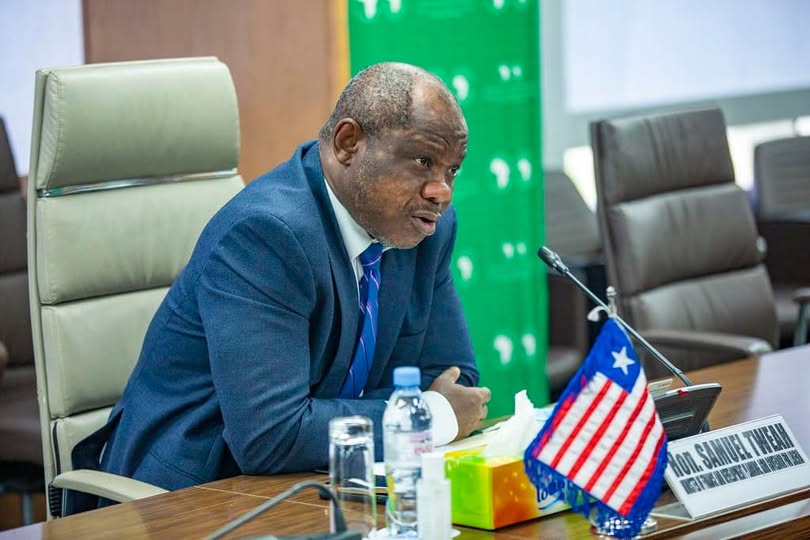
Former Minister of Finance and Development Planning Samuel D. Tweah Jr. has been ranked ahead of Augustine Kpehe Ngafuan and Boima Kamara in a comparative assessment of Liberia’s economic management, with proponents citing macroeconomic data to argue that his tenure produced stronger measurable results during one of the country’s most difficult economic periods.
The assessment, compiled by political commentator Foday N. Massaquoi, frames its conclusions around fiscal and macroeconomic indicators comparing conditions at the end of the Unity Party (UP) administration in 2017 with those recorded under the Coalition for Democratic Change (CDC) government by the end of 2023. The analysis emphasizes outcomes rather than political sentiment, asserting that economic performance should be judged on empirical evidence.
According to the data presented, Tweah assumed office at a time of economic fragility, inheriting an economy described as weakened by twelve years of UP governance. His appointment placed him at the center of the CDC’s Pro-Poor Agenda for Prosperity and Development, with responsibility for stabilizing public finances amid declining revenues, external shocks, and later the COVID-19 pandemic.
Macroeconomic indicators cited in the review suggest notable shifts during Tweah’s tenure. Net international reserves reportedly increased from US$110 million in 2017 to US$240 million by 2023. Domestic revenue collection rose from a peak of US$450 million under the UP administration to US$627 million under the CDC. Domestic debt declined modestly from US$437 million to US$400 million, while international debt increased from US$670 million to US$1.2 billion, reflecting expanded borrowing amid infrastructure investment and crisis financing.
Economic growth is reported to have risen from 2.5 percent in 2017 to 4.7 percent by 2023, while inflation declined from 12.4 percent to 10.5 percent. The exchange rate data show that although the Liberian dollar depreciated significantly over the broader period, the rate of U.S. dollar appreciation slowed under the CDC, from 136 percent during the UP era to 43 percent by 2023. The poverty trend is also cited as shifting from increasing to decreasing, according to the assessment.
In governance and service delivery indicators, the report points to Liberia’s Millennium Challenge Corporation (MCC) scorecard performance, noting a failed status during the UP’s final year in office compared to a pass under the CDC. Infrastructure data indicate that while road construction slowed due to global disruptions, electricity access expanded significantly, with household connections rising from approximately 149,000 to 240,000.
Supporters argue that these outcomes underscore Tweah’s resilience and effectiveness, particularly given global economic headwinds, pandemic-related disruptions, and what they describe as political resistance. The analysis contrasts his performance with that of former finance ministers Ngafuan and Kamara, whom it accuses of presiding over policies that entrenched stagnation rather than recovery.
While critics continue to debate the broader social impacts of CDC-era economic policies, the comparative figures presented have fueled renewed discussion about Tweah’s legacy. For his advocates, the data reinforce the claim that his tenure represents the most results-driven period of economic management in Liberia’s recent history, achieved under conditions widely regarded as among the most challenging the country has faced.


