


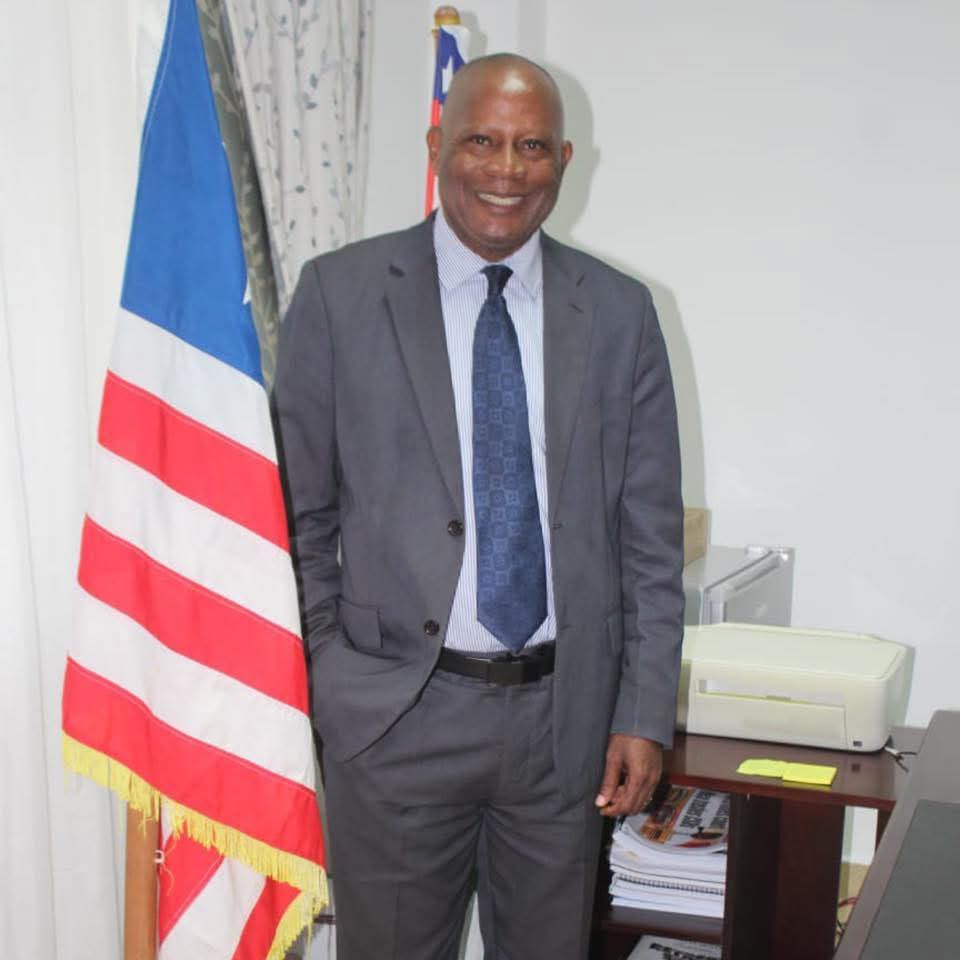
Monrovia, Liberia — Prominent Liberian legal scholar and former lawmaker Augustine S. Chea has argued that the acquittal of former Finance Minister Samuel D. Tweah Jr. in the controversial US$6.2 million economic sabotage case is constitutionally final and cannot be overturned through appeal or retrial.
In a detailed legal analysis released following the verdict, Cllr. Chea dismissed public commentary suggesting that Tweah could still face retrial through the appellate process, insisting that such arguments misunderstand Liberia’s criminal appellate procedures and constitutional protections against double jeopardy.
“Commentaries suggesting that Samuel Tweah may be retried, whether through the appellate process or otherwise, are fundamentally mistaken,” Chea wrote. “As it stands, the matter is conclusively settled in his favor.”
The high-profile case involving Tweah and several former government officials has become one of the most politically sensitive judicial proceedings in recent Liberian history. Prosecutors accused the defendants of economic sabotage, money laundering, theft of property, criminal conspiracy, and criminal facilitation tied to alleged irregular handling of US$6.2 million in government funds associated with national security operations.
However, the jury acquitted Tweah and former Financial Intelligence Agency Comptroller D. Moses P. Cooper on all charges, while returning mixed verdicts against other defendants, including Jefferson Kanmoh.
According to Chea, Liberia’s Constitution and Criminal Procedure Law make it virtually impossible for the government to retry Tweah following a jury acquittal.
“A jury acquittal is ordinarily final and protected by double jeopardy principles,” he explained, citing Article 21(h) of the Constitution of Liberia and Section 3.2 of Liberia’s Criminal Procedure Law.
Chea further referenced major Liberian Supreme Court decisions, including Koffa v. Republic and U.S. Trading Co. v. Johnson-Morris, which reinforced constitutional protections against double jeopardy in criminal prosecutions.
“Once the jury acquitted Tweah, double jeopardy precludes any retrial or appeal by the prosecution,” Chea asserted. “It’s a done deal. A fait accompli.”
The legal expert argued that appellate courts generally review only the convictions properly brought before them on appeal and do not automatically reopen acquittals involving co-defendants who are not appellants before the court.
Beyond defending Tweah’s acquittal, Chea also strongly criticized the conviction of Jefferson Kanmoh for criminal facilitation, arguing that prosecutors failed to prove the essential legal elements required for conviction beyond a reasonable doubt.
“The prosecution failed to prove beyond reasonable doubt that he knowingly and intentionally facilitated any unlawful diversion or criminal conversion of the alleged US$6.2 million,” Chea wrote.
According to him, prosecutors relied heavily on circumstantial administrative evidence rather than direct proof of criminal intent. He argued that Kanmoh’s alleged assignment of a security code to the Financial Intelligence Agency and his awareness of emergency security funding during the 2023 election period were insufficient to establish criminal facilitation under Liberian law.
“Knowledge that emergency funds existed is not equivalent to knowledge that the funds were unlawfully sourced, illegally disbursed, or criminally converted,” Chea emphasized.
He further argued that administrative coordination and operational involvement consistent with official government duties cannot automatically be interpreted as criminal conduct without proof of unlawful intent.
“Where conduct is equally consistent with lawful official duty and unlawful intent, the law requires that the doubt be resolved in favor of the accused,” Chea stated.
In support of his position, Chea cited several Liberian Supreme Court rulings, including Hans Caperhat Williams and Mardia P. Williams v. Republic of Liberia, Nyazee Barway et al. v. Republic of Liberia, Jappa v. Republic of Liberia, and Raynes et al. v. Republic of Liberia, all of which reaffirmed the constitutional principle that criminal convictions cannot rest on speculation, weak inferences, or uncorroborated testimony.
The legal commentary has intensified ongoing national debate surrounding the verdict and the broader credibility of Liberia’s anti-corruption prosecutions under President Joseph Boakai’s administration.
Political analysts say the mixed verdict has become both a legal and political flashpoint, with opposition supporters portraying the acquittals as evidence of prosecutorial weakness or political targeting, while government supporters continue to argue that accountability efforts must proceed despite setbacks.
Chea concluded that the evidence against Kanmoh ultimately failed to satisfy Liberia’s constitutional standard requiring proof beyond a reasonable doubt.
“Official awareness of emergency security funding and administrative involvement consistent with governmental responsibilities cannot sustain a criminal conviction without proof of intentional unlawful participation,” he argued.
As legal appeals and post-verdict arguments continue to unfold, the Samuel Tweah economic sabotage case is increasingly being viewed as a landmark test of Liberia’s criminal justice system, constitutional protections, and the legal limits of anti-corruption enforcement.


