


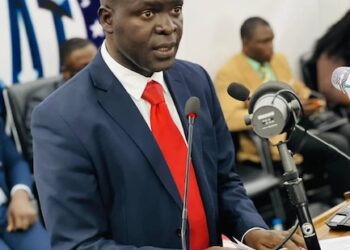
Monrovia, Liberia – May 9, 2026 — The Executive Director of Liberia’s Environmental Protection Agency (EPA), Emmanuel K. Urey Yarkpawolo, has called on the University of Liberia Faculty Association (ULFA) to redefine its mission beyond salary negotiations and welfare advocacy by becoming a catalyst for institutional reform, academic excellence, mentorship, and national development.
Speaking on Friday during the ULFA Leadership Inaugural Ceremony at the University of Liberia Capitol Hill Campus, Dr. Yarkpawolo stressed that while faculty welfare remains important, the broader responsibility of the association should focus on transforming the university into a leading center for research, innovation, discipline, and evidence-based problem-solving.
“The University of Liberia Faculty Association must go beyond negotiating salaries and benefits,” Dr. Yarkpawolo declared. “Welfare is important, but transformation must remain the greater mission.”
Delivering remarks under the theme, “From Militancy to Mentorship: The Faculty Association as a Vehicle of Change, Critical Thinking, and Research at the University of Liberia,” the EPA Executive Director challenged faculty members to reposition themselves as mentors, intellectual leaders, and guardians of academic integrity.
His address comes at a time when Liberia’s higher education sector continues to face mounting pressure over limited funding, weak research infrastructure, student unrest, and declining institutional confidence. Against that backdrop, Dr. Yarkpawolo argued that ULFA must evolve from a traditional labor-centered body into a strategic intellectual force capable of influencing national development.
He described the University of Liberia as the country’s flagship public university and a “national inheritance and moral trust” that carries the responsibility of shaping critical thinkers, strengthening governance, and producing research capable of addressing Liberia’s pressing social and economic challenges.
According to him, universities must encourage constructive activism rooted in knowledge and evidence rather than confrontation and instability.
“A university must not kill activism; it must educate activism,” he stated. “The goal is not silence, but critical consciousness.”
Dr. Yarkpawolo also used the occasion to highlight reforms underway at the EPA, presenting them as examples of how institutions can transition from bureaucratic stagnation to practical national relevance. He cited the decentralization of EPA operations across Liberia’s 15 counties, stronger environmental regulation enforcement, improved staff morale, and increased investments in scientific research and academic partnerships.
Among the major achievements outlined was the growing collaboration between the EPA and the University of Liberia in environmental science education and research. He referenced support for undergraduate and graduate environmental science programs, the establishment of a modern Climate Change Laboratory at UL through Canadian support, and the approval of EPA-affiliated doctoral programs by the university faculty.
The EPA Executive Director further disclosed that the agency recently secured a €100,000 Elemental Analyzer through a competitive process at the International Atomic Energy Agency. The equipment, now housed at the EPA’s central laboratory, is expected to support scientific research and national investigations, including inquiries into the reported oil discovery in Grand Bassa County.
“These are marks of transformation,” Dr. Yarkpawolo asserted. “They represent movement from complaint to competence, from division to delivery, from theory to service, and from institutional weakness to national problem-solving.”
Political and academic observers note that his speech reflects a broader debate about the future role of higher education institutions in Liberia. Many universities across Africa continue to struggle with balancing labor activism, academic quality, and institutional reform. Dr. Yarkpawolo’s remarks suggest that faculty associations should increasingly serve as engines for national policy innovation and civic leadership rather than focusing exclusively on labor disputes.
He also proposed the creation of a Faculty Mentorship Program aimed at training student leaders in constitutional advocacy, policy writing, negotiation, nonviolent communication, and evidence-based leadership.
“The best protest is a well-researched position paper; the best revolution is a generation trained to think,” he emphasized.
Addressing students directly, he encouraged a shift from emotionally driven activism to research-oriented engagement capable of influencing national discourse and public policy.
“Your anger may attract attention, but your evidence will command respect,” he told the audience.
Dr. Yarkpawolo additionally renewed calls for increased government investment in the University of Liberia, highlighting the significant funding disparity between UL and major international institutions. He noted that UL operates on an estimated budget of approximately US$40 million, compared to the nearly US$5 billion budget of the University of Wisconsin–Madison.
He urged the Government of Liberia to increase UL’s annual budget to at least US$100 million, arguing that meaningful national transformation cannot occur without sustained investment in higher education.
“No nation can demand a world-class university while funding it like an afterthought,” he stressed.
As Liberia continues to confront economic, governance, and environmental challenges, Dr. Yarkpawolo’s message underscored the growing expectation that universities and faculty leadership must play a more active role in shaping national progress through research, mentorship, innovation, and intellectual leadership.


