


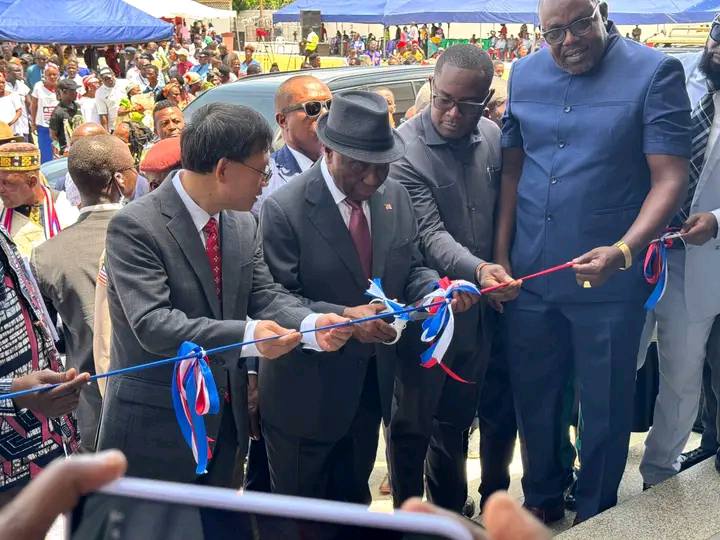
Paynesville, Liberia – President Joseph Boakai has officially dedicated the newly constructed broadcast complex of the Liberia Broadcasting System, describing the $5.5 million investment as a major step toward strengthening public communication, press freedom, and national development in Liberia.
The dedication ceremony, held Friday at the LBS Compound in Paynesville, highlighted the Liberian government’s growing media modernization agenda and deepening bilateral relationship with the People’s Republic of China, which funded the project through China Aid.
President Boakai said the modern broadcasting facility symbolizes “a new era in public communication and national development,” while publicly expressing gratitude to Chinese President Xi Jinping and the Chinese government for supporting Liberia’s state media infrastructure.
The project significantly upgrades Liberia’s national broadcasting capacity, increasing LBS transmission power from 2,000 kilowatts to 10,000 kilowatts — an expansion expected to improve nationwide coverage and strengthen information dissemination across the country.
According to Boakai, the facility includes seven modern recording and broadcasting studios, a centralized control system, satellite broadcasting capability, and technical infrastructure that meets international broadcasting standards. The complex also contains a fire hydrant and water supply system intended to benefit both the institution and nearby communities.
Media Modernization and Strategic Messaging
The commissioning of the new LBS complex comes at a critical time for Liberia’s media sector, which continues to face challenges related to infrastructure, financial sustainability, and technological modernization.
Analysts say the investment reflects the Boakai administration’s attempt to reposition state media as a more influential institution in national governance, public education, and civic engagement. The president emphasized that his administration envisions LBS evolving into a true public broadcasting service capable of informing, educating, and promoting national unity.
“Today, we proudly declare that LBS is back on track as a world-class broadcasting institution,” Boakai stated during the ceremony.
The president also used the occasion to reinforce his government’s public commitment to press freedom — an issue that remains politically sensitive across West Africa amid growing concerns about media suppression and shrinking civic space in some countries within the region.
Honoring Fallen Journalist Charles Gbeyon
In one of the ceremony’s most symbolic moments, President Boakai announced that the broadcast complex would be named in honor of late Liberian journalist Charles Cornelius Gbeyon, recognizing his contributions to the country’s media landscape.
The announcement carried emotional significance as two of Gbeyon’s children traveled from the United States to witness the dedication.
Boakai said the decision reflects his administration’s broader support for journalists and democratic freedoms. “You may silence a journalist, but you can never silence the ideals of truth, liberty, and freedom,” the president declared.
The statement appeared aimed at reassuring both local and international observers that Liberia remains committed to democratic governance and media independence despite periodic tensions between political actors and journalists.
Rebuilding After Conflict
Founded in 1956 as the Liberia Broadcasting Corporation, LBS remains one of Liberia’s oldest public institutions and historically served as the country’s primary national broadcaster.
However, the institution suffered major setbacks during Liberia’s civil conflicts, which damaged infrastructure, displaced professionals, and weakened operational capacity for years.
During his remarks, President Boakai reflected on that difficult history and paid tribute to several veteran broadcasters and media professionals whose contributions shaped the institution over decades. Among those recognized were Tommy Raynes, Eustace Smith, Kwame Clement, Victoria Raffell, Olivia Shannon, Cyrus Badio, Patrick Manjoe, Charles Snetter, and others.
Political observers note that the rehabilitation of LBS carries both practical and symbolic importance. Beyond improving broadcasting services, the modernization effort represents an attempt to rebuild national institutions that were weakened by war and years of underinvestment.
China’s Expanding Footprint
The project also highlights China’s expanding influence in Liberia’s infrastructure and development sectors. Over recent years, Beijing has financed several public projects across Liberia, including roads, educational facilities, and government infrastructure.
Boakai referred to the facility as “a special gift” from President Xi Jinping and the Chinese people, underscoring the increasingly strategic relationship between Monrovia and Beijing.
Diplomatic analysts say China’s continued investment in Liberia reflects broader geopolitical efforts to strengthen partnerships across Africa through infrastructure diplomacy and development assistance.
Call for Professionalism
President Boakai concluded the ceremony by urging employees of LBS to protect and professionally manage the new facility, stressing that the institution’s credibility would depend not only on modern infrastructure but also on ethical journalism and public trust.
He further called for renewed national commitment to democracy, civic responsibility, and development through credible information sharing.
“As we dedicate this facility, let us recommit ourselves to building a Liberia where information empowers citizens, where truth strengthens democracy, and where the media remains a partner in national development,” the president said.
The president also acknowledged the efforts of the LBS Board, Director General Eugene Fahngon, and technical staff for overseeing the implementation of the project.


