


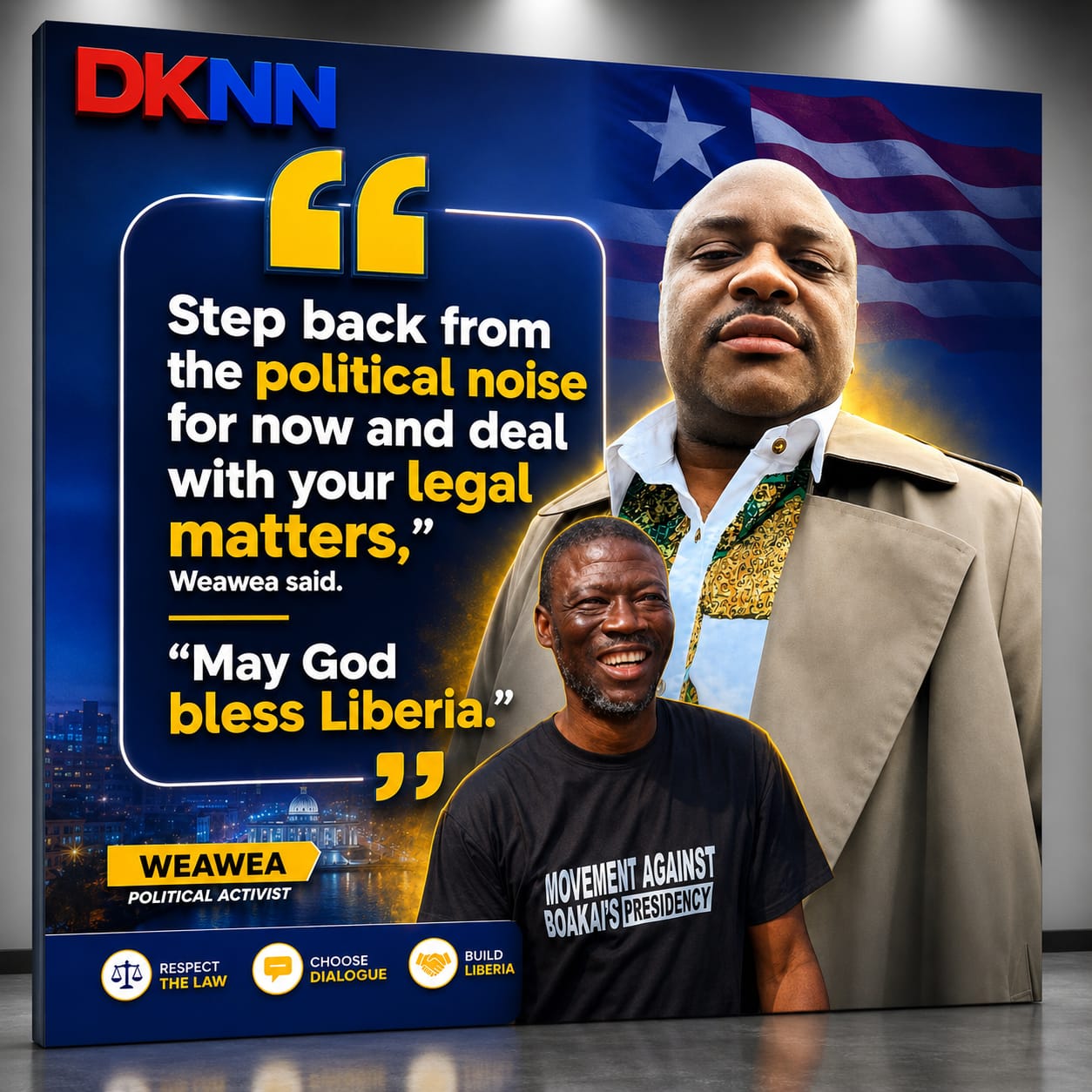
Monrovia — The ongoing political activities of Montserrado County District #10 Representative Hon. Yekeh Kolubah has triggered renewed debate over electoral discipline, legal accountability, and the boundaries of pre-campaign political engagement in Liberia.
Against this backdrop, Hon. Solomon Weawea, Executive Director of the Liberia National Heritage and Culture Development Association (LNHCDA), has urged Kolubah to suspend all political mobilisation efforts and redirect his attention to his pending legal matters before the Supreme Court of Liberia.
Speaking from Monrovia on May 7, 2026, Weawea argued that premature campaigning undermines both institutional order and electoral fairness, particularly when the National Elections Commission (NEC) has not officially declared the commencement of campaign activities. He framed early political mobilisation as a procedural breach that risks distorting the regulated electoral timetable.
From an analytical standpoint, Weawea likened early campaigning to exhausting strategic resources before a formal contest begins—suggesting that such actions weaken political positioning ahead of the 2029 general elections and introduce avoidable instability into an already sensitive political environment.
He emphasised that Liberia’s electoral framework is designed around clear temporal boundaries, with the NEC serving as the sole authority to authorise campaign activities. Until such a formal declaration is made, he argued, political actors are expected to remain within the confines of political engagement without active voter mobilisation.
This intervention comes amid heightened political tension following reports that Kolubah was allegedly attacked in Ganta, Nimba County, by individuals reportedly linked to supporters of the ruling Unity Party. While these allegations remain politically sensitive, Kolubah’s camp has maintained that his movements across counties are not campaign-related but rather intended for constituency engagement and public interaction.
The situation highlights a recurring governance challenge in Liberia’s electoral cycle: the blurred line between political outreach and early campaigning, particularly in environments where enforcement of electoral regulations is often contested or inconsistently interpreted.
Weawea further stressed that adherence to electoral rules is not merely procedural but essential to sustaining democratic stability. In his view, restraint by political actors during pre-election periods helps reduce tensions, prevent misinterpretation of political activities, and preserve public trust in democratic institutions.
He concluded by reiterating his appeal for Kolubah to prioritise his legal proceedings before the Supreme Court, framing the advice as a civic concern rather than a partisan intervention. According to him, separating legal accountability from political mobilisation is critical to maintaining institutional clarity and national peace.
Overall, the situation underscores a broader analytical question within Liberia’s democratic practice: how effectively can electoral institutions enforce campaign timelines while managing politically charged environments where legal disputes and political ambitions increasingly overlap?


