


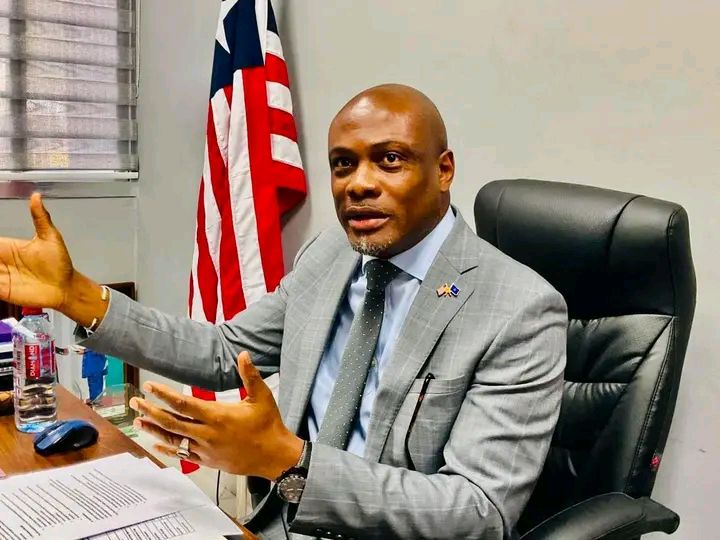
An emerging policy debate has been reignited in Liberia following comments from Representative Taa Wongbe of Nimba County District #9, who has raised structured concerns about governance performance and border security management, particularly along the Liberia–Guinea frontier.
In an analytical statement, the lawmaker positioned his stance as one grounded in national interest rather than partisan alignment. He emphasised that his responsibility is neither to uncritically defend government actions nor to engage in opposition for its own sake, but to evaluate policies through the lens of public accountability and citizen welfare.
A key focus of Wongbe’s remarks is the reported instability and uncertainty along the Liberia–Guinea border. He referenced persistent reports of armed presence in the area, noting that border communities continue to experience fear and insecurity amid what he described as limited or unclear official communication from state authorities. From a governance perspective, he framed this as a breakdown in risk communication and state presence in sensitive territorial zones.
The lawmaker further expanded his critique to include Liberia’s broader governance indicators, citing findings from the Millennium Challenge Corporation (MCC) scorecard. He pointed to weak performance in areas such as rule of law, government effectiveness, and natural resource governance, arguing that these indicators reflect structural deficiencies rather than isolated administrative issues.
Within this context, Wongbe questioned the alignment between national reform rhetoric and measurable governance outcomes. He specifically referenced the government’s ARREST agenda, noting that its emphasis on “Rule of Law” appears inconsistent with the concerns highlighted in external governance assessments. His argument suggests a gap between policy framing and institutional implementation capacity.
Analytically, the statement reflects a broader tension in post-conflict governance systems: the divergence between reform narratives and on-the-ground administrative effectiveness. Border insecurity, in this framing, becomes not only a security issue but also a governance signal—indicating limitations in state coordination, surveillance capacity, and local engagement.
The remarks also highlight the political role of legislators in hybrid governance environments, where oversight extends beyond parliamentary debate into public diagnostic commentary on state performance. Wongbe’s framing positions legislative engagement as a mechanism for continuous accountability rather than episodic critique.
He concluded his statement with a brief affirmation that “the work continues”, signalling ongoing political engagement with national governance issues. Within the broader context of Liberia’s institutional reform agenda, this suggests sustained pressure for policy responsiveness, particularly in areas related to security governance and institutional credibility.
Overall, the concerns raised underscore an ongoing policy challenge: reconciling national reform ambitions with effective implementation in border security management and broader governance systems.


