


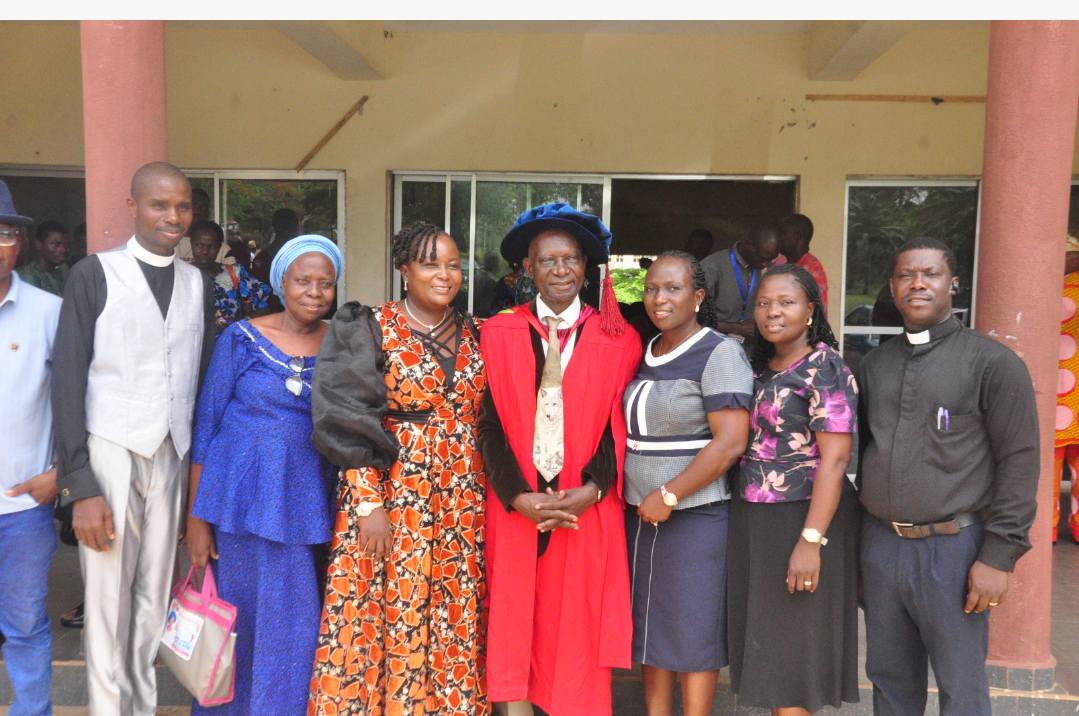
The Federal University of Technology Akure (FUTA) has celebrated the distinguished career and enduring contributions of Professor Isaac Abayomi Adebayo as the renowned academic formally retired from active service after more than three decades of excellence in teaching, research, mentorship, and university administration.
At his valedictory lecture held on May 7, 2026, Prof. Adebayo delivered a thought-provoking discourse on the transformative role of biotechnology in addressing some of the world’s most pressing challenges, including food insecurity, public health crises, environmental sustainability, and industrial development. His lecture reflected not only the depth of his academic experience but also the growing importance of scientific innovation in shaping the future of developing nations.
Speaking on emerging trends in biotechnology, Prof. Adebayo emphasized that advances in genetic engineering, precision agriculture, bioinformatics, artificial intelligence, and nanotechnology are rapidly redefining global scientific practice. According to him, these innovations are creating sustainable solutions capable of improving agricultural productivity, strengthening healthcare systems, and accelerating industrial growth.
The professor noted that biotechnology has already revolutionized agriculture through the development of genetically modified crops and precision farming techniques that increase yields, reduce pesticide dependence, and minimize greenhouse gas emissions. He stressed that such innovations are particularly important for developing countries facing population growth, climate change, declining soil fertility, and rising food demands.
Beyond agriculture, Prof. Adebayo highlighted biotechnology’s expanding role in healthcare, especially in areas such as gene therapy, monoclonal antibody production, and marine pharmaceuticals. He explained that advances in biotechnology are contributing to more targeted and effective treatments for cancer, blood disorders, and other life-threatening diseases. He further observed that the integration of biotechnology with artificial intelligence and data mining is accelerating scientific discoveries by enabling researchers to identify gene functions and develop therapies with greater precision and efficiency.
Describing the future as one increasingly driven by “programmable biology,” Prof. Adebayo argued that agriculture, medicine, and manufacturing would continue to converge around shared genetic and technological principles. He therefore called for increased investment in biotechnology research, innovation, infrastructure, and manpower development across Nigeria and other developing countries to fully harness the opportunities presented by the rapidly evolving field.
He also urged universities, governments, and private-sector stakeholders to strengthen collaboration aimed at promoting scientific research, supporting innovation, and commercializing biotechnology products capable of driving national development and economic transformation.
Prof. Adebayo’s retirement marks the conclusion of a remarkable academic journey at FUTA that began on November 24, 1992, when he joined the Department of Animal Production and Health as an Assistant Lecturer. Through years of dedication and scholarly excellence, he rose to the rank of Senior Lecturer in 2003 before attaining full professorship in 2012.
Widely respected as a researcher, mentor, and administrator, Prof. Adebayo made substantial contributions to veterinary medicine and public health in Nigeria. He participated actively in several national intervention programmes, including the National Trypanosomosis Campaign, the Avian Influenza Campaign, and COVID-19 awareness initiatives between 2019 and 2021.
He was also credited with spearheading the establishment of the Veterinary Clinic and Ambulatory Service within the Department of Animal Production and Health at FUTA in 2008. In addition, he played a significant role in curriculum development by designing several Animal Health-related courses that strengthened academic and professional training within the department.
Academically, Prof. Adebayo began his educational journey at Christ School before proceeding to the Institute of Agricultural Research and Training for his Ordinary National Diploma programme. He later obtained both his Doctor of Veterinary Medicine (DVM) and Master of Veterinary Medicine (MVM) degrees from the University of Ibadan. He subsequently completed a split-site Ph.D. programme at Tuskegee University under the Ford Foundation Scholarship in 2004.
Beyond academics, he held several strategic administrative positions within FUTA. He served as Departmental Postgraduate Coordinator beginning in 2004 and later chaired the Students’ Disciplinary (Misconduct) Panel from 2013 to 2026. He also chaired the Agricultural Machinery and Mechanization Committee of the School of Agriculture and Agricultural Technology in 2015.
Prof. Adebayo is a member of several professional organizations, including the Nigerian Veterinary Medical Association, the American Veterinary Medical Association, the American Society for Biochemistry and Molecular Biology, the Nigerian Institute for Science and Technology, and the Nigerian Society for Animal Production.
Tributes poured in during the valedictory lecture as colleagues, students, and associates celebrated his legacy of scholarship, leadership, and mentorship. A prominent member of the FUTA Biotechnology Group, Professor Boboye, described Prof. Adebayo as “a go-getter and researcher par excellence.”
Similarly, the Head of the Department of Animal Production and Health, Professor Samuel Aro, paid glowing tribute to the retiring professor, describing him as “a mentor par excellence, counsellor, dependable confidant, and compassionate father figure to students and colleagues alike.”
As FUTA bids farewell to one of its accomplished scholars, Prof. Adebayo’s career stands as a reflection of the growing intersection between science, innovation, and national development. His advocacy for biotechnology as a tool for food security, healthcare advancement, and sustainable development continues to resonate at a time when countries across Africa are increasingly looking toward science and technology to solve complex economic and environmental challenges.


