


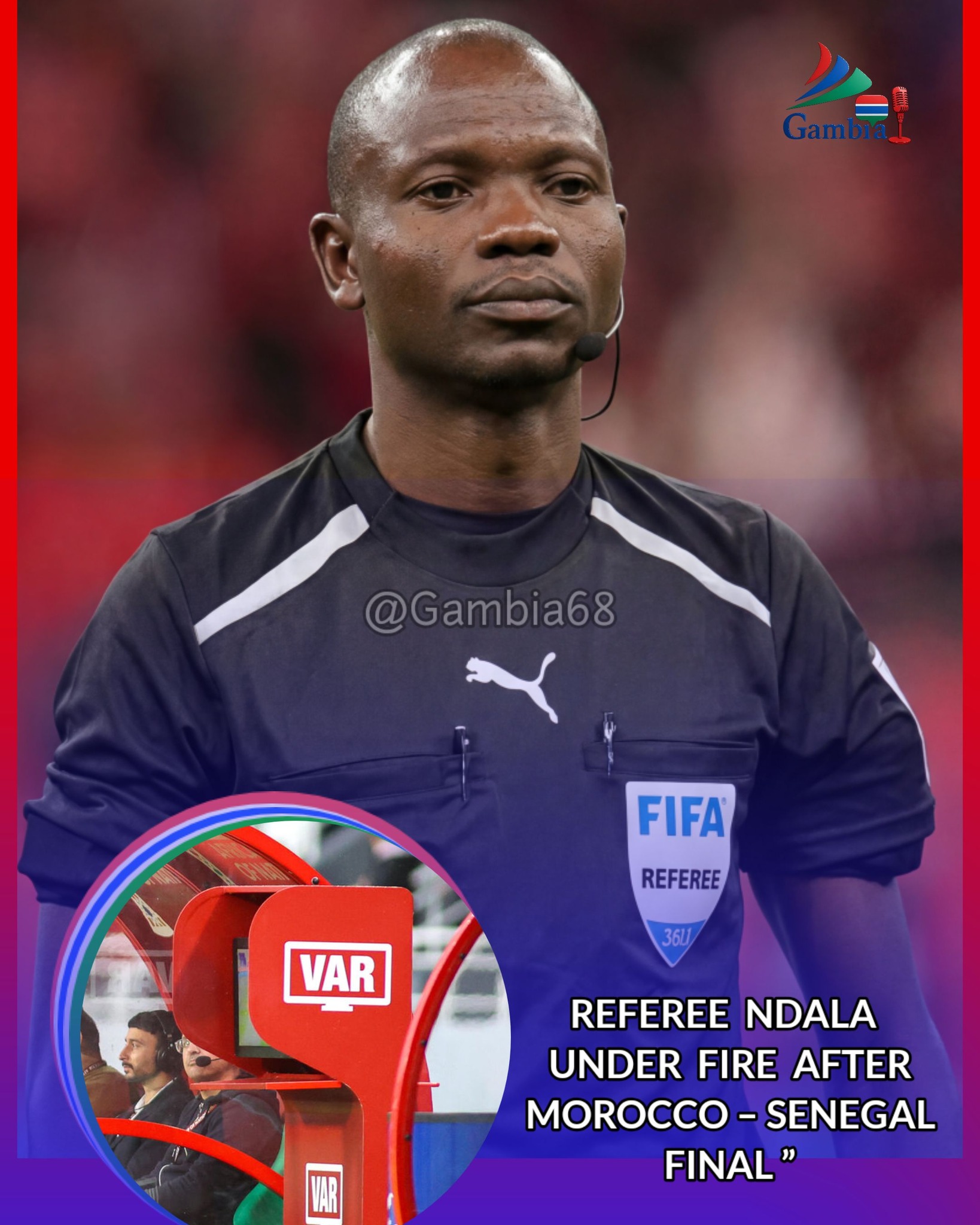
Congolese referee Jean-Jacques Ndala has come under heavy criticism following his handling of the high-stakes Morocco versus Senegal final, a match that has generated as much debate over officiating as it has excitement on the pitch.
The controversy reached its peak late in the encounter when Ndala awarded a penalty in favor of Morocco, a decision that immediately triggered strong protests from Senegalese players and officials. The reaction escalated into a brief walk-off by the Senegal team, temporarily halting play and creating a tense and chaotic atmosphere inside the stadium.
Although the match eventually resumed, the incident diverted attention from the football itself and placed the spotlight squarely on the referee’s decision-making. Critics have described the penalty as overly severe and poorly timed, particularly in a final already charged with emotion and pressure.
Several football analysts questioned whether the laws of the game were applied consistently, noting that similar challenges earlier in the match were not penalized. Others argued that the referee struggled to manage player emotions once tensions flared, allowing the situation to spiral.
Public reaction has been sharply divided. On social media, Senegalese supporters accused Ndala of bias and inconsistency, while many Moroccan fans defended the call, insisting it fell within the rules of the game. Neutral observers expressed frustration that officiating decisions overshadowed what should have been a showcase of African football at its highest level.
Those defending Ndala have pointed to the intense pressure and hostile environment in which the match was officiated, emphasizing that referees are required to make instantaneous decisions regardless of the occasion. They argue that while the penalty was contentious, controversy alone does not prove the decision was incorrect, and that player conduct significantly contributed to the ensuing disorder.
The ongoing debate now centers on whether the referee exercised fairness and effective control. While Ndala applied the rules as he saw them, critics maintain that clearer communication and stronger match management could have prevented the situation from escalating.
As discussions continue, the Morocco–Senegal final serves as a stark reminder of how critical refereeing decisions can define—and sometimes overshadow—the most important moments in African football.


