


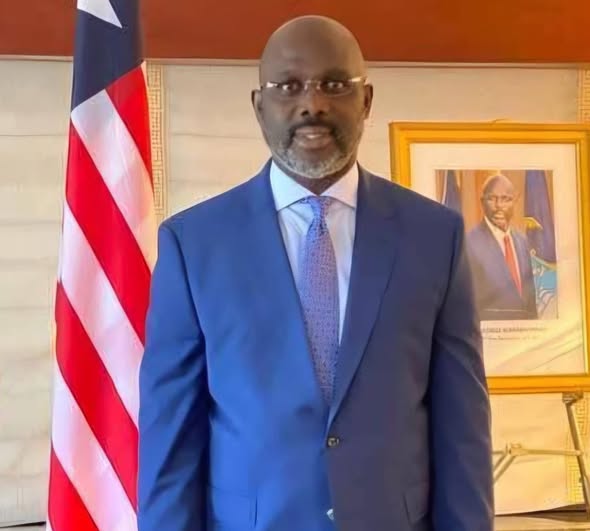
West Africa finds itself at a critical juncture, as praise for leadership and sharp warnings about democratic decline converged during a public appearance by visiting Guinean-Bissauan politician and ECOWAS Parliamentarian Manuel Irenio Nascimento. Speaking on Liberia’s OK Conversation Show, Nascimento described former Liberian President George Manneh Weah as a “ten-star gentleman” and a living African legend whose legacy, he argued, must be protected while he is still alive.
Nascimento challenged Africa’s long-standing habit of honoring leaders only after their death, urging the continent to instead safeguard what he called “living symbols of hope, values, and resilience.” Rejecting conventional accolades, he said Weah’s character and history place him far beyond ordinary recognition. “George Weah is not a five-star gentleman,” he emphasized. “He is a ten-star gentleman—defined by humility, values, and historical significance. Africa must learn to protect its living legends.”
From Football Great to Continental Figure
Weah’s influence, Nascimento noted, extends well beyond Liberia. As Africa’s only Ballon d’Or winner in 1995 and a former FIFA World Player of the Year, Weah achieved global recognition in football before transitioning into politics. His election as Liberia’s president in 2017—nearly 14 years after the end of a devastating civil war that claimed an estimated 250,000 lives—represented a shift toward people-centered leadership rather than elite political inheritance.
Nascimento recalled meeting Weah during a FIFA Congress in Zurich, Switzerland, alongside Liberia’s Bomi County Senator Edwin Melvin Snowe Jr., a meeting rooted in shared interests in football administration and regional cooperation. A former football administrator himself, Nascimento said Weah’s journey resonates deeply across West Africa, where football remains both a cultural force and a pathway of opportunity for millions of young people.
Liberia’s Stability as a Regional Example
The ECOWAS parliamentarian commended Liberia for sustaining more than a decade of uninterrupted peace—an achievement he described as rare in a region frequently disrupted by coups, election disputes, and political unrest. Since the end of its civil war in 2003, Liberia has experienced multiple peaceful transfers of power, most recently during the 2023 elections.

“Liberia stands as an example for West Africa,” Nascimento said, attributing the country’s stability to the humility, unity, and peaceful nature of its people. He contrasted Liberia’s experience with that of several neighbouring states, including Guinea-Bissau, which has endured at least nine coups or attempted coups since gaining independence in 1974.
Shared History and Regional Solidarity
Nascimento highlighted the historical ties between Liberia and Guinea-Bissau, recalling that former Liberian President William R. Tolbert Jr. was the first foreign leader to visit Guinea-Bissau after its initial democratic elections—a gesture of Pan-African solidarity he said should guide present-day regional relations.
As a serving member of the ECOWAS Parliament, he stressed that such historical bonds must inform West African diplomacy, particularly at a time when regional cohesion is under strain.
Recognition of Liberian Leadership
During his visit, Nascimento praised Senator Edwin Melvin Snowe Jr., describing him as a principled and loyal leader whose influence extends beyond Liberia to the wider sub-region. He also commended Liberia’s Ambassador to Nigeria, John Ballout, calling him a dedicated diplomat who reflects Liberia’s renewed engagement in regional affairs. Nascimento disclosed longstanding ties with Musa Hassan Bility, former president of the Liberia Football Association and now Representative for Nimba County District Seven.
A Candid Warning on Democracy
Beyond commendations, Nascimento issued a stark warning to West African leaders, urging them to respect electoral outcomes and abandon the manipulation of democratic processes. “If we continue on this path, democracy in West Africa will collapse,” he warned.
He attributed Guinea-Bissau’s ongoing political crisis to what he described as an “invented coup” and accused the country’s leadership of fostering tribal divisions that previously did not exist. He further criticized the ECOWAS Commission for failing, in his view, to defend election results validated by international observers, including the ECOWAS Parliament itself. “ECOWAS must serve the people of West Africa, not individual interests,” he insisted.
Double Standards and the Cost of Instability
Drawing comparisons with Benin, where a similar political crisis was resolved within 72 hours, Nascimento questioned why Guinea-Bissau remains trapped in prolonged instability. He revealed that his outspoken position has made it unsafe for him to return home, highlighting the risks faced by reform-minded politicians in fragile democracies.
Women, Youth, and Governance Failures
Nascimento underscored the disproportionate burden borne by women across West Africa, noting that most informal traders are women who lack adequate social protection and access to finance. He warned that corruption—described as one of the region’s most destructive forces—continues to undermine development, citing international data showing that many West African states rank below global averages on corruption perception indexes.
He cautioned that poor governance threatens the future of Africa’s youth, who make up nearly 60 percent of the continent’s population.
A Call to Conscience
Concluding his remarks, Nascimento urged African leaders to relinquish power when they are no longer capable of delivering results. “If we are not fit to occupy a seat, we should leave it to more competent hands,” he said, warning that failure to do so would reverse progress and burden future generations.
Ultimately, his praise of George Weah as a “ten-star gentleman” extended beyond personal admiration. It served as a broader call for ethical leadership, democratic accountability, and the preservation of Africa’s living legacies at a time when the region stands at a defining crossroads.


