


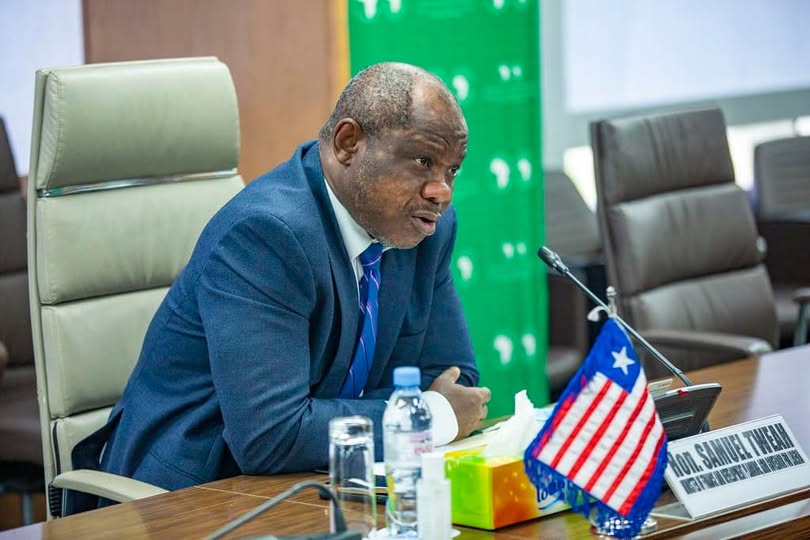
MONROVIA — Former Minister of Finance and Development Planning, Samuel D. Tweah Jr., has welcomed the Liberian Senate’s decision to review the national harmonization policy, describing the move as timely, necessary, and critical to dispelling what he termed long-standing misinformation and political propaganda surrounding the reform.
In a detailed public commentary, Tweah—who presided over the harmonization process—said the review offers Liberia a long-overdue opportunity to confront false narratives that have persisted since the policy’s implementation. He expressed hope that the Speaker of the House of Representatives would also embrace the review, allowing the country to finally “understand the honest facts and truths about harmonization” and put to rest what he called the “illusory talk” of reversing it.
Tweah pledged that he and his former technical team would fully cooperate with the Senate’s review process and urged other key actors who played decisive roles in the reform to do the same. Among those he named were Vice President Jeremiah Kpan Koung, Senator J. Gbleh-bo Browne, former Representatives Clarence Massaquoi, Edward Karfiah, and Senator Francis K. Dopoh—who drafted the National Standardization and Remuneration Act that legally codified harmonization as Liberia’s civil service reform framework.
Recounting the policy’s origins, Tweah pointed to high-level negotiations held at the Farmington Hotel, where government stakeholders grappled with reducing the public wage bill to a sustainable target of US$296 million, equivalent to one percent of GDP. From those discussions emerged what he described as the “Farmington Consensus,” anchored on two core principles: the protection of healthcare workers and teachers from salary cuts, and the requirement that the judiciary, like the legislature, contribute to wage adjustments through national legislation.
According to Tweah, that consensus was ultimately implemented. He stressed that no healthcare workers were cut, while the judiciary was subjected to taxation under the new standardized framework. Beyond safeguarding health workers broadly, he argued that harmonization produced tangible benefits for specific categories of workers, particularly in the health sector.
He cited the case of health workers at the Ganta hospital donated to the Government of Liberia by then-Representative Jeremiah Koung, noting that harmonization enabled the government to assume responsibility for their salaries. Tweah further explained that rural health workers previously paid under the Fixed Amount Reimbursement Agreement (FARA), funded by USAID reimbursements, were formally integrated into the government payroll under harmonization—bringing with it taxation and social security deductions consistent with national law.
The former minister also addressed public discontent that surfaced during the 2023 elections, when some nurses protested harmonization by linking it to political retaliation. Tweah countered that the same tax and social security rules applied to more than 2,000 health workers placed on the payroll after donor funding declined in 2018, emphasizing that harmonization did not single out any group unfairly.
He challenged proponents of “reversing harmonization” to clearly define what such a reversal would entail, arguing that it cannot logically mean restoring vast pay inequities, reintroducing the dual salary system of basic pay and allowances, ending taxation and social security contributions, or removing health workers from the government payroll. Any of these, he warned, would undermine fiscal discipline and institutional equity.
Tweah called on the media to play an active role in the upcoming review by questioning policymakers and legislators who were directly involved in shaping and passing the reform. He said public discourse would be best served by facts, data, and accountability rather than slogans and political rhetoric.
Describing the Senate-led exercise as an opportunity for national clarity, Tweah concluded that harmonization deserves a rigorous, evidence-based evaluation—not as a political tool, but as a cornerstone of Liberia’s civil service reform agenda.


