


International News | South Korea Politics
South Korea’s Supreme Court has upheld a 20-year prison sentence for former President Park Geun-hye, confirming her conviction for abuse of power and coercion.
In its final ruling delivered on Thursday, the court affirmed the reduced sentence handed down by a lower court in July, which cut Park’s original 30-year jail term. Prosecutors had appealed the reduction, but the top court dismissed their challenge. The ruling also maintains a fine of 18 billion won (approximately £12 million or US$17 million).
Park, South Korea’s first female president, was removed from office in 2017 following a sweeping corruption scandal. At the time, she became the country’s first democratically elected leader to be forced out of power, a political crisis that also resulted in the imprisonment of senior executives from major conglomerates.
Now 68, Park was initially sentenced to 30 years in prison and fined 20 billion won. However, a high court later reduced her punishment to 15 years for corruption, with an additional five years for abuse of power, along with a reduced fine. Thursday’s decision by the Supreme Court brings the lengthy legal process to a close.
Convictions and Charges
Park was impeached in 2017 and, in 2018, convicted on 16 of 18 charges, most of them related to bribery and coercion. The court found that she colluded with her longtime friend, Choi Soon-sil, to pressure major corporations—including Samsung and retail giant Lotte—to donate millions of dollars to foundations controlled by Choi.
She was also convicted of forcing companies to enter into lucrative contracts with businesses owned by Choi, as well as soliciting gifts for Choi and her daughter. In addition, Park was found guilty of leaking confidential presidential documents to Choi. Throughout the proceedings, Park denied all wrongdoing and refused to participate in the trials.
The Scandal Behind Her Removal
At the center of Park’s downfall was her close relationship with Choi Soon-sil, a childhood friend who became her most trusted confidante. Public outrage grew after it emerged that Choi had wielded significant, unofficial influence over state affairs.
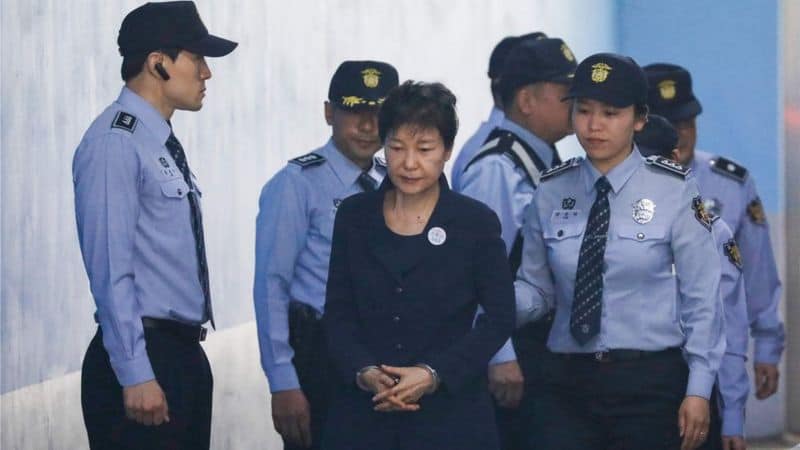
Following months of mass street protests and a prolonged impeachment process, Park was formally removed from office in March 2017 and arrested shortly afterward. Choi was later convicted of corruption and sentenced to 20 years in prison in 2018.
Wider Fallout
The scandal ensnared some of South Korea’s largest corporations, along with senior government officials and figures from the entertainment industry. Samsung’s de facto leader, Lee Jae-yong—also known as Jay Y. Lee—was a central figure after revelations that he had provided a horse to Choi’s daughter, Chung Yoo-ra, an equestrian athlete.
Lee was sentenced to prison but served only five months before an appeals court reduced and suspended his sentence. Chung Yoo-ra was extradited from Denmark to South Korea in 2017 to face questioning.
A Familiar Pattern in South Korean Politics
Park is not the only former South Korean president to face legal consequences. In 2018, ex-president Lee Myung-bak was charged with corruption over allegations of accepting bribes while in office. Earlier, former leaders Chun Doo-hwan and Roh Tae-woo were convicted of treason and corruption in the 1990s.
In a particularly tragic chapter, former president Roh Moo-hyun died by suicide in 2009 while under investigation for corruption.
Source: BBC


