


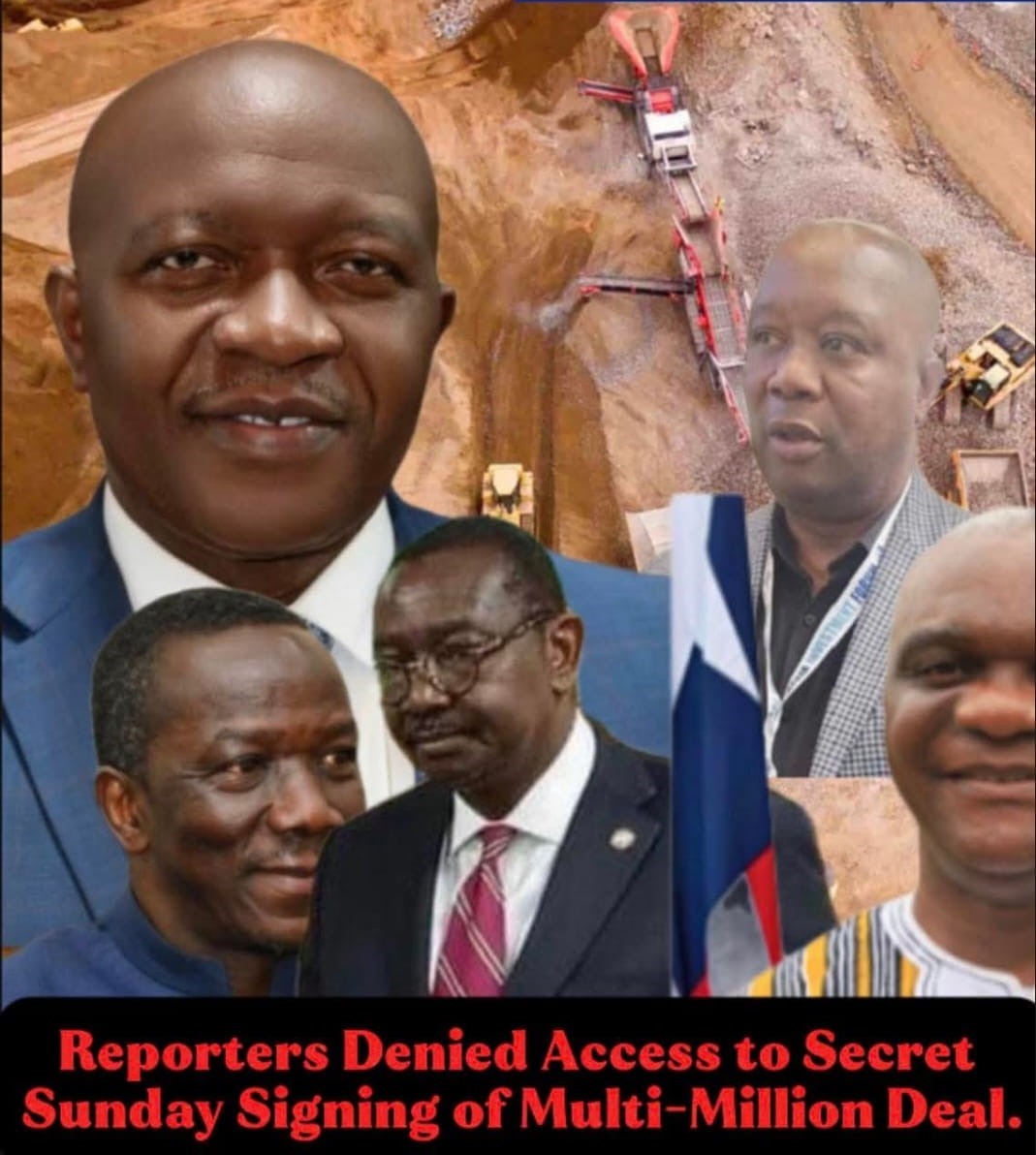
In a move that has sparked national concern and reignited longstanding anxieties about opaque governance, the Government of Liberia recently conducted a major concession signing ceremony behind closed doors — and on a Sunday.
The deal in question involves Ivanhoe Liberia, a subsidiary of High-Power Exploration (HPX), and is tied to the contentious “Liberty Corridor” project, a strategic infrastructure initiative with far-reaching implications for the country’s economic trajectory. What makes this event especially alarming, however, is not merely the nature of the agreement, but the secrecy surrounding it.
The decision to bar the media — after initially extending and then rescinding invitations without providing a credible explanation — is not a simple administrative error. Rather, it represents a systemic disregard for the principles of open governance, transparency, and accountability. When government institutions deliberately withhold critical information from the public, especially concerning long-term strategic deals, they erode trust and give rise to the perception of collusion or underhanded dealing.
This recent episode is not occurring in a vacuum. It comes at a time when Liberia is grappling with contested narratives surrounding the future of its extractive infrastructure — namely, the rail and port facilities historically tied to ArcelorMittal’ s operations in the country.
HPX, through its subsidiary Ivanhoe Liberia, has been locked in a dispute with ArcelorMittal over access to and control of this infrastructure. The implications of this tug-of-war are profound: billions of dollars in foreign investment, the creation or loss of thousands of jobs, control over mineral exports, and Liberia’s strategic leverage in global markets are all at stake.
Given the magnitude of what is involved, the public has every right to be fully informed and involved. Infrastructure and mineral concession agreements are not just contractual matters between companies and ministries; they are decisions that influence national sovereignty, environmental management, labor conditions, and economic development for generations. The rail and port corridors, in particular, represent critical arteries of economic power. Whoever controls them will have an outsized influence on Liberia’s fiscal health and regional competitiveness. So why, then, was the signing of the Ivanhoe agreement done in secret?
The answer remains elusive. However, the circumstances surrounding the media blackout and the timing of the ceremony — on a Sunday, a non-working day — suggest a calculated effort to minimize scrutiny. By shutting out journalists and civil society monitors, the government failed a basic test of democratic accountability. In a country where institutions are still recovering from the historical legacies of corruption, war, and mismanagement, this kind of backdoor deal making sends a regressive message. It implies that the leadership values expedience over inclusion, secrecy over transparency, and external interests over domestic consensus.
There is also the troubling precedent this sets. Liberia has a long and painful history of elite capture of state resources. From the concessionary policies of the Firestone era to post-war resource management scandals, the common denominator has been a governance model that privileges secrecy and marginalizes citizen voices. The HPX-Ivanhoe deal, if allowed to stand as it is — hidden from public scrutiny — risks becoming another chapter in this unfortunate legacy.
Moreover, the lack of disclosure undermines Liberia’s standing in international development and investment communities. Global best practices now place a premium on transparency, community participation, environmental sustainability, and inclusive dialogue. By contrast, closed-door dealings fuel skepticism among partners, potentially endanger future investments, and conflicted with global norms for responsible extractive governance.
At this point, public demand for immediate disclosure is not only justified but also imperative. The National Investment Commission (NIC), along with the relevant ministries — especially the Ministries of Mines and Energy, Finance and Development Planning, and Justice — must publicly release the full text of the agreement. They must also provide a compelling rationale for the secrecy, explain what checks and balances are in place to protect national interests, and outline how Liberians — particularly affected communities — will benefit from the Liberty Corridor project.
Furthermore, the Executive branch must recommit itself to democratic principles by ensuring that future deals of this magnitude are conducted with full transparency and stakeholder engagement. Anything short of that constitutes a betrayal of public trust and fuels public cynicism about the government’s commitment to reform.
The broader question remains: Who does Liberia’s natural wealth serve? If strategic decisions are continually made behind closed doors, the perception will persist — and perhaps accurately so — that the country’s resources are being managed for the benefit of a few rather than for the collective good. The notion that “Liberia belongs to all of us” cannot remain an empty slogan. It must be reflected in how decisions are made, how resources are allocated, and how the public is treated in processes that shape the nation’s future.
In the final analysis, this incident should serve as a clarion call. It is not just about one agreement or one company. It is about what kind of Liberia we want to build — one rooted in secrecy and exclusion, or one anchored in transparency, accountability, and democratic participation. The choice should not be difficult.


