


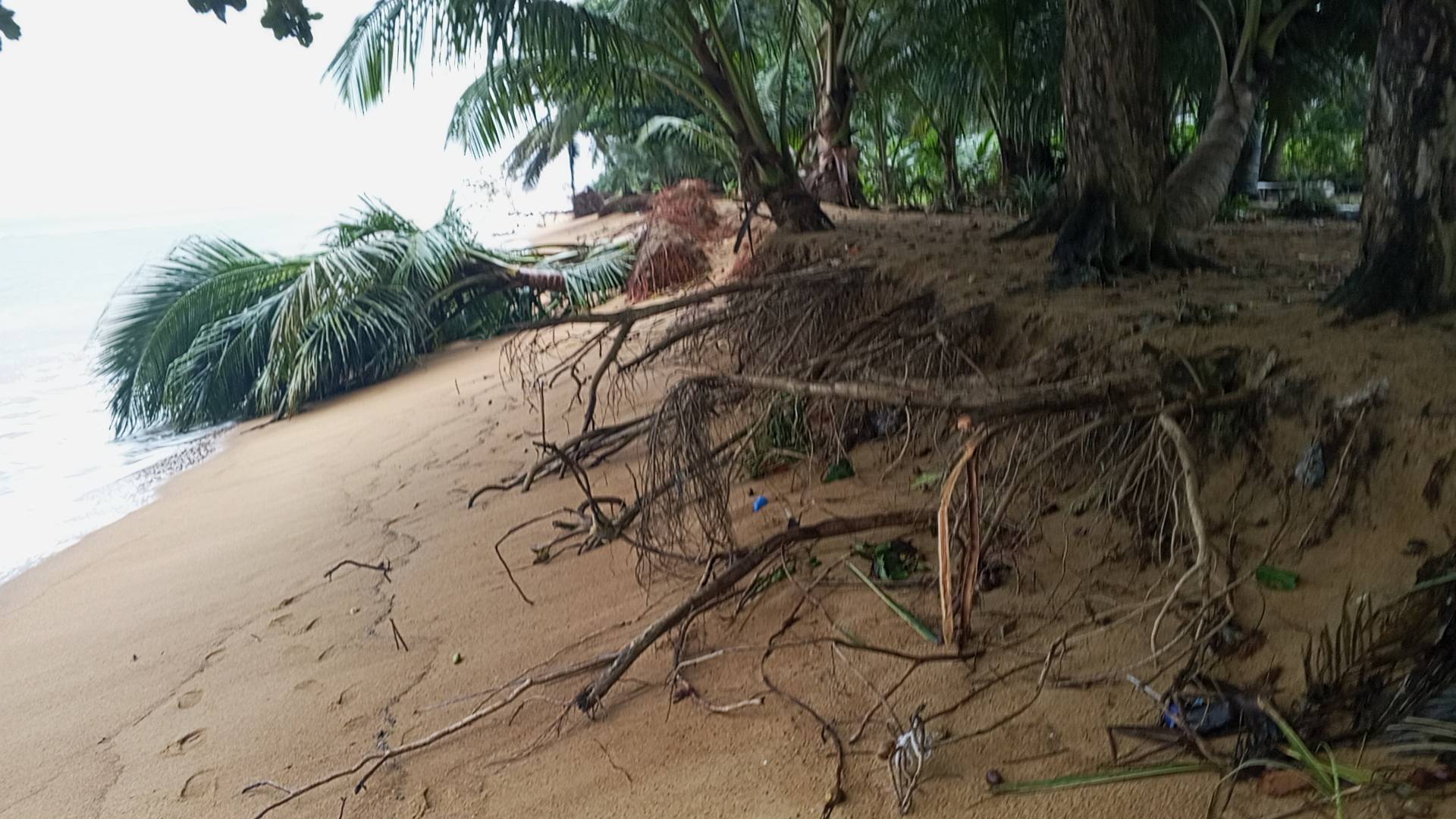
Monrovia / Cestos, Rivercess County – August 6, 2025 – The Atlantic Ocean is rapidly swallowing parts of Cestos, leaving residents of Jackson Community, Lonestar Community, and Kru Town worried as homes, farmland, and livelihoods disappear under the water.
Local leaders say the damage is unlike anything seen in decades. “What is now tidal water used to be football fields and homes back in the 1970s and 80s,” said Mr. Othello Jarvan, Chairman of Jackson Beach Community. He added that the constant erosion has caused many residents to lose sleep as orchards, crops, and protective tree lines are destroyed.
Mining Blamed for Stronger Waves
Residents believe human activities are making things worse. John Gardeah, a longtime Cestos resident, accused unregulated miners along the Cestos River of removing natural waterfalls and sediment barriers that used to slow the river flow before it reached the ocean. He thinks this has made the waves stronger and more damaging near the coast.
For local fishermen like Alphonso Kofa, the struggle happens every day. “Before we land our canoes, we now have to fight against rough seas,” he said, explaining that dangerous landings and smaller catches are threatening their livelihoods.
A National Crisis Growing
The erosion in Cestos reflects a wider problem in the country. A 2010 UNDP report showed that Buchanan’s Balawudeh Town lost about 250 meters of coastline since 1969—about 6.6 meters each year. Predictions suggest that by the 2090s, sea levels in Liberia could rise between 0.13 and 0.56 meters, with storm surges during the dry season reaching over two meters. Low-lying areas in Rivercess, Montserrado, and Grand Bassa are expected to suffer the most.
If Cestos keeps losing 6–7 meters of shoreline every year, the town could lose up to 70 meters in a decade. Under climate change, losses could be twice as much. By 2090, nearly 95 square kilometers of coastal land, including parts of Rivercess, could be flooded—putting $250 million in assets and tens of thousands of people at risk.

Economic Impact
The erosion is breaking down the economy of coastal communities. Fishing areas are shrinking, farmland is disappearing, and trading posts are vanishing. In New Kru Town and West Point alone, over 6,500 people have been displaced and 800 houses destroyed since 2013. Near Monrovia, experts warn that fewer fish could affect 55,000 households if wetlands and mangroves aren’t restored.
Efforts and Challenges
Liberia has tried several solutions. A $2.9 million UNDP-supported seawall built in 2013 had limited success, covering only some areas and not lasting long. In 2021, a $17.2 million climate resilience project funded by UNDP and the Green Climate Fund began in Monrovia, focusing on seawalls and mangrove planting to help 250,000 people.
This year, about $4.3 million was set aside for the Enhancing Resilience of Montserrado Coastal Areas project, which includes parts of Rivercess’s coast. Still, communities in Cestos remain mostly unprotected. Local leaders are urgently asking for help from the government and international partners, warning that without quick action, the damage could become permanent.
Looking Ahead
Experts suggest using a mix of hard solutions like seawalls and breakwaters, along with nature-based methods like restoring mangroves. They also stress the need to regulate mining and sand digging, educate communities, and plan for possible relocations.
For the people of Cestos, the fight is urgent. “This is not just about losing land; it’s about losing our way of life,” one resident said.
As the sea keeps advancing, the question is whether Liberia’s leaders will act fast enough to save Cestos—and protect a part of the nation’s coastal heritage.


