


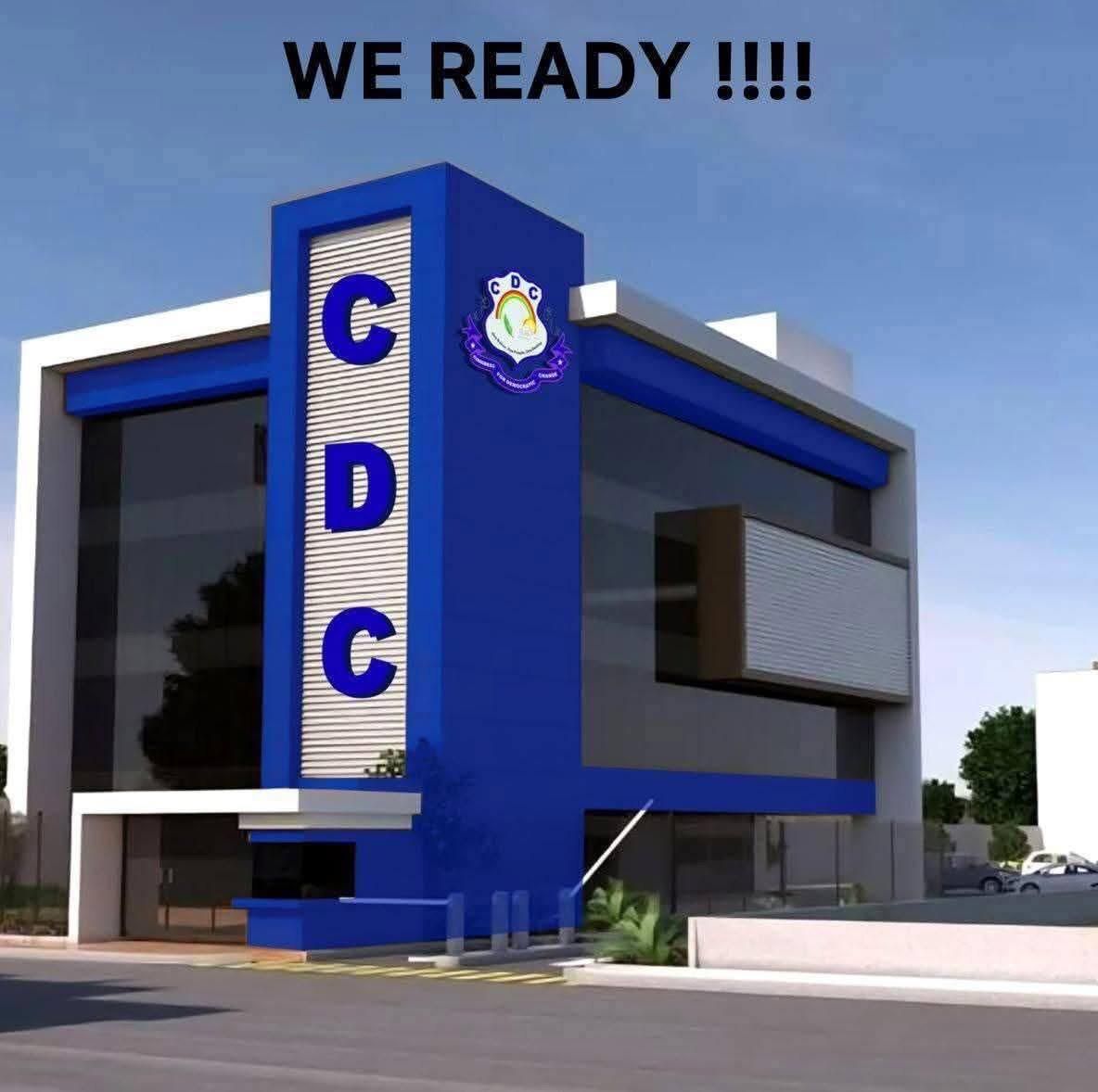
MONROVIA – Minutes after a Monrovia court ordered the eviction of the Congress for Democratic Change (CDC) from its national headquarters in Congo Town, the party’s political leader and former Liberian President George M. Weah broke his silence from the Ivory Coast, releasing a bold blueprint for a new party headquarters.
In a social media post, the form President urged CDC partisans to remain focused and avoid being provoked by political opponents or misinterpretations of statements.
“We have more danger to deal with than correcting speeches. Let us all agree together to show to the Liberian people that the CDC belongs to them,” Weah wrote, emphasizing unity and resilience.
The former President declared that despite the eviction, the CDC remains “mighty, loyal, and faithful to the people’s struggle,” promising that “by the grace of God, no one will ever break up this people’s powerful party.”
Weah framed the current setback as part of a broader national struggle, asserting that “nothing will separate us” and that the party will “continue to fight no matter what.” Using the liberation chant “Amandla! Awethu!” he reaffirmed CDC’s resolve to stand as a grassroots-driven political movement.
The CDC leader revealed that the party is now focused on securing a permanent home, stating, “We have to build our own home. We will, and we must! We will never be defeated. Remember, the CDC makes leaders—leaders never make the CDC.”
Accompanying his remarks, Weah posted on his WhatsApp story an architectural design for what he described as “The mighty Coalition for Democratic Change’s new building.” He framed the blueprint as a statement of political endurance, noting, “We are ready to prove our might.”
Political Analysis: CDC’s Eviction Echoes Unity Party’s 2013 Setback
The CDC’s current eviction from its headquarters draws striking parallels to the political turbulence the Unity Party (UP) faced over a decade ago. In 2013, while in opposition, the UP was also forced to vacate its party headquarters amid a protracted property dispute. At the time, CDC figures—then in opposition—were quick to frame the incident as evidence of UP’s organizational weakness and poor internal management.
Now, twelve years later, the tables have turned. The CDC, fresh from losing the presidency in the 2023 election, is contending with the same symbolism of displacement that once haunted its rival. In both cases, the evictions occurred at moments when the parties were recalibrating their political identity in opposition after losing state power.
For the Unity Party, the 2013 loss of its headquarters was a blow to morale but also a moment of reorganization. The party leaned on its established political network, rebuilt its base, and focused on winning the 2017 elections—an effort that fell short but kept it politically relevant.
For the CDC, the challenge is twofold: the eviction comes just months after electoral defeat, and it coincides with internal questions about leadership succession and party strategy. However, unlike UP in 2013, CDC under Weah still maintains a strong grassroots mobilization capacity, a loyal urban youth base, and an image as the champion of the “ordinary people.”
Weah’s decision to immediately unveil a blueprint for a new headquarters is both a symbolic and strategic move. Symbolically, it sends a message of defiance and forward momentum, suggesting that the party will not dwell on the humiliation of eviction. Strategically, it reframes the narrative from loss to renewal, positioning CDC as an organization capable of self-reliance rather than dependent on rented space.
Yet, the political risks are clear. Without a rapid follow-through on construction, the blueprint could be dismissed by critics as a publicity stunt. Additionally, as the CDC transitions into full opposition mode, it will face the test of maintaining cohesion without the advantages of incumbency—a challenge that fractured the UP during its own opposition years.
Ultimately, the CDC’s ability to turn this crisis into a rallying point may determine whether the party can replicate, or even surpass, the resilience that kept the Unity Party in contention for over a decade after losing its headquarters. Weah’s call for unity and his insistence that “leaders never make the CDC” may be the rallying cry his supporters need—but delivering on the promise of a new home will be the real test of the party’s staying power.


