


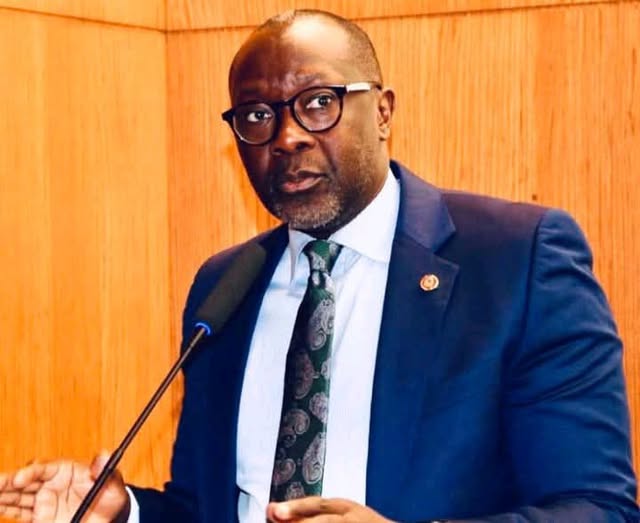
Monrovia, Liberia — Senator Amara M. Konneh has announced his conditional support for the Third Amendment to the ArcelorMittal Liberia (AML) Mineral Development Agreement, describing it as an improvement over past concessions but one that requires firm enforcement and disciplined implementation to truly benefit ordinary Liberians.
After an independent and detailed review, Senator Konneh acknowledged that the agreement is not flawless and that Liberia could have negotiated stronger provisions in certain areas. Nonetheless, he believes the amendment represents meaningful progress and presents real opportunities for employment, local business growth, and national value creation—if its commitments are taken seriously.
Progress Without Illusions
Senator Konneh noted that Liberians are justified in demanding stronger social contributions, improved community infrastructure, and greater investment in education, particularly in technical and scientific disciplines. He stressed that Liberians must eventually lead the sector, not merely serve as labor. While communities expect tangible improvements—such as better roads, healthcare facilities, and housing—the ultimate measure of success will be the conversion of promises into measurable outcomes.
Local Content: The True Economic Engine
According to the Senator, the most transformative aspect of the amendment lies in its local content provisions. He emphasized that Liberian participation in supplying goods and services to AML holds the greatest potential for broad-based prosperity. The agreement mandates that, within six months, the government and AML establish a joint framework and committee to advance local content initiatives—a provision Konneh described as the “real substance” of the deal.
If implemented rigorously, he said, this framework could drive wealth creation by empowering Liberian-owned small and medium-sized enterprises (SMEs) across sectors such as security, logistics, fuel distribution, catering, construction support, maintenance, accommodation, and other value-chain services—provided the process is transparent, inclusive, and capacity-driven.
Six Months Must Deliver Results
Senator Konneh warned that the six-month timeline must not become a procedural delay. He proposed the establishment of a high-level Local Content and SME Steering Committee, chaired at a senior national level—potentially under the Vice President—to ensure authority, coordination, and accountability. A technically competent Business Development and Local Enterprise Team, he said, should operate under this body with a clear mandate to deliver results, not symbolism.
He outlined key priorities, including identifying immediate procurement opportunities for Liberian SMEs, setting enforceable participation targets for genuinely Liberian-owned businesses, creating fair supplier qualification systems, and publishing regular progress reports for public and legislative oversight.
A Firm Warning Against Fronting
Senator Konneh cautioned against fronting, describing it as a serious threat to the integrity of local content provisions. He warned that using Liberians as nominal owners while control and profits remain in foreign hands undermines national development and robs future generations. True local content, he stressed, must mean genuine ownership, real value retention, and deliberate capacity building.
Financing the Opportunity
Acknowledging that access to finance remains the greatest obstacle for Liberian SMEs, the Senator noted that while financing mechanisms are not fully detailed in the amendment, the cooperation framework provides space for action. He urged the government and AML to engage development partners and financial institutions to create credit facilities, guarantees, and supplier-development financing to enable Liberian businesses to scale and compete effectively.
Beyond Jobs: Building Leadership
Senator Konneh emphasized that the amendment must go beyond employment numbers to foster Liberian leadership. He welcomed provisions that commit to placing Liberians in senior management roles, including representation at the highest leadership levels within one year. He described this as a nation-building imperative that requires structured training pipelines, transparency, and annual public reporting.
Communities Must Benefit Now
He concluded by stressing that host communities in Nimba, Bong, and Grand Bassa must experience immediate and visible benefits. Their youth need jobs, women require fair access to opportunities, and local economies must see real-time gains—not deferred promises.
While reiterating that the agreement is not perfect, Senator Konneh maintained that it equips Liberia with stronger enforcement tools, clearer leverage, and a defined pathway for local enterprise development. For these reasons, and with a firm call for disciplined execution and urgent action on local content within the six-month window, he announced his support for the ratification of the Third Amendment.


