


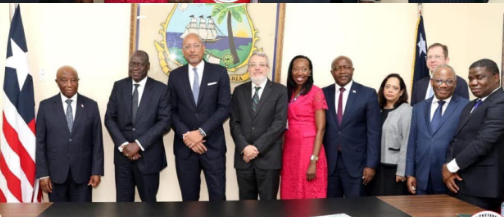
President Joseph Nyuma Boakai, Sr. has reiterated his administration’s resolve to place Liberia’s energy sector at the center of the country’s development agenda, describing it as a fundamental driver of sustainable growth and national transformation. He made the remarks during a courtesy visit by a high-level World Bank delegation at the Executive Mansion.
Addressing the delegation, President Boakai stressed that no country can achieve lasting development without a dependable and efficient energy system. He emphasized that access to reliable power is essential for economic expansion, social inclusion, and improved living standards for Liberians.
The President assured the delegation that his government is committed to working closely with international partners to introduce reforms aimed at upgrading and expanding the nation’s energy infrastructure. According to him, such reforms are critical to delivering long-term benefits and securing a better future for coming generations.
President Boakai also expressed gratitude to the World Bank for its sustained support, noting that the institution has played a key role in helping Liberia address longstanding development challenges. He described the partnership as vital to the country’s quest for stability, prosperity, and inclusive growth, and pledged to strengthen collaboration to ensure energy sector reforms align with Liberia’s broader development priorities.
For their part, the World Bank delegation reaffirmed its strong backing for Liberia’s development efforts. The team was led by Mr. Ousmane Diagana, Vice President for Western and Central Africa, alongside Mr. Ethiopis Tafara, Regional Vice President of the Multilateral Investment Guarantee Agency (MIGA). They disclosed plans to roll out a new National Development Country Partnership Framework designed to deepen engagement with Liberia, promote private sector participation, and support sustainable development.
Mr. Diagana explained that World Bank programs in Liberia will be guided by the Agriculture, Roads, Rule of Law, Education, Sanitation, and Tourism (ARREST) Agenda. This framework aims to close critical infrastructure gaps, strengthen governance systems, and empower key sectors to stimulate economic growth. He noted that energy remains a central pillar of the agenda, given its importance in creating jobs, improving livelihoods, and enhancing national resilience.
The delegation further highlighted the longstanding relationship between the World Bank and Liberia, pledging continued assistance to President Boakai’s administration in advancing reforms and initiatives that directly improve the lives of citizens.
Several senior Liberian government officials were present during the meeting, including Minister of Finance and Development Planning Augustine K. Ngafuan; Minister of State for Presidential Affairs Sylvester M. Grigsby; Presidential Economic Advisors Sahr Johnny and Morley Kamara; and Deputy Minister of Finance for Economic Management Dehpue Zuoh.
Concluding the engagement, President Boakai again underscored the strategic importance of the energy sector, noting that affordable and reliable electricity is critical to progress in education, healthcare, agriculture, and industry. He stressed that the government’s energy vision goes beyond power generation, focusing instead on empowering Liberians and positioning the country to compete effectively in the global economy.
The meeting represents another milestone in Liberia’s development journey, reinforcing the administration’s commitment to transformative reforms and a more prosperous future for all citizens.


