


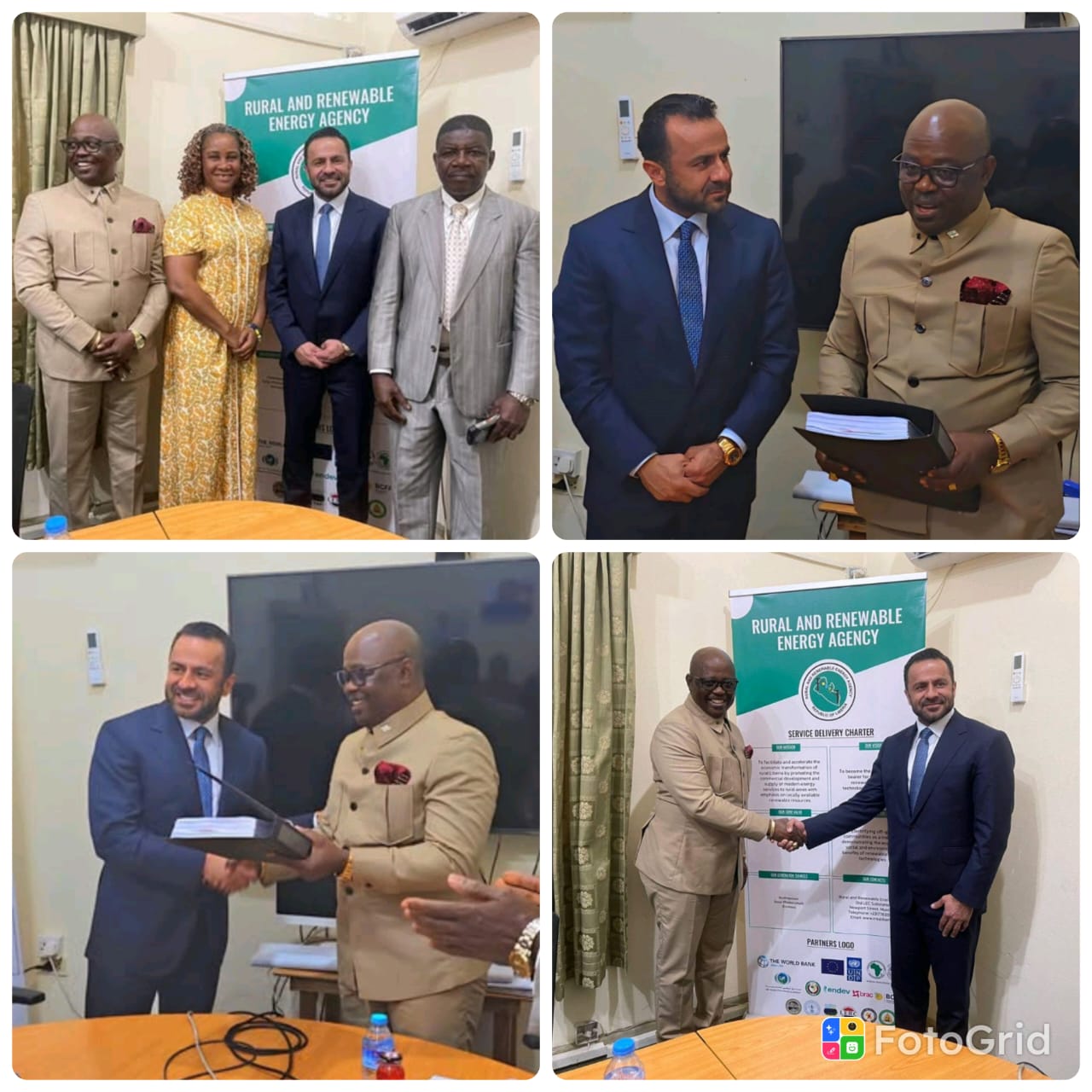
Government and World Bank Partner on $10.6M Hybrid Energy System for Over 50,000 Residents
In a significant leap toward closing the rural energy gap, the Government of Liberia has officially launched a $10.67 million hybrid solar energy project in Lofa County — one of the most ambitious renewable energy undertakings in the nation’s history. The initiative aims to bring reliable electricity to over 50,000 people across more than 20 communities in the northern region.
The project, unveiled on July 21, involves the construction of a 4.0 megawatt-peak (MWp) Solar Photovoltaic (PV) Plant paired with a 9.4 megawatt-hour (MWh) Battery Energy Storage System (BESS). The energy system will serve as the foundation for a hybrid power network in Bakuma Town, Lofa County — integrating solar, battery, and diesel-powered sources to deliver consistent electricity across the region.
The energy package is being implemented under the Liberia Renewable Energy Access Project (LIRENAP) with funding and technical support from the World Bank. The contract was awarded to International Consolidated Contractors Offshore, with completion expected within 12 months.
According to Theophilus A.T. Kambo, World Bank Project Coordinator at the Rural and Renewable Energy Agency (RREA), the project represents more than an infrastructure upgrade — it’s a game-changer for communities long left in the dark.
“This project is a transformative milestone for Liberia’s rural energy agenda,” said Kambo. “It reflects the government’s strong commitment to renewable energy, community development, and sustainable electrification.”
Part of Liberia’s “Mission 300“
The Lofa County energy initiative falls under “Mission 300,” the government’s strategic plan to ensure universal electricity access by 2030. Currently, only 28% of Liberia’s population has access to electricity, and in rural areas, that figure drops dramatically to around 7%, according to data from the Liberia Electricity Corporation and the World Bank (2024).
The Bakuma-based hybrid facility is designed to serve six key towns — Voinjama, Foya, Kolahun, Bolahun, Massabolahun — along with 20 surrounding communities. Once operational, it will provide: 126.4 kilometers of medium-voltage and 211.4 kilometers of low-voltage distribution lines 10,317 household connections via 112 transformers A reach of approximately 50,000 people
The technical highlights include: A 4.0 MWp fixed-tilt solar array 9.4 MWh lithium-ion battery system with 95% Depth of Discharge (DoD) 3.0 MWac PV inverters and 1.5 MVA battery inverters A SCADA-based mini-grid controller to optimize dispatch and load balance With an expected annual energy output of at least 3.7 gigawatt-hours (GWh), the system will operate in a synchronized parallel mode that blends diesel and solar inputs, providing maximum reliability in both sunny and cloudy conditions.
A Greener, More Resilient Solution
Initially, plans had been made to construct a 2.3 MW hydroelectric plant in the same area. However, unforeseen geotechnical issues and cost overruns rendered the hydro option unviable. The government and its partners pivoted to a hybrid solar-diesel model that is now deemed more resilient, cost-effective, and environmentally sustainable.
“This hybrid solution is not only greener but more resilient and economically viable,” Kambo noted. “It’s a direct response to the real challenges facing infrastructure in our rural communities.”
The project also includes the installation of a 1.8 MW diesel generator and an underground 250,000-liter diesel storage facility to ensure uninterrupted service during peak demand or extended cloudy periods.
Local and National Impact
For many residents of Lofa County, where power outages or complete lack of electricity have long hampered education, healthcare, and local business, this project promises a dramatic improvement in quality of life.
“Access to electricity means clinics can refrigerate vaccines, students can study at night, and small businesses can operate more efficiently,” said Hon. Sarah Dukuly, a lawmaker representing Lofa District. “This is more than infrastructure — it’s empowerment.”
Officials say the hybrid system’s scalable design will allow for future expansion as demand grows and additional funding becomes available.
A Model for Future Clean Energy Projects
With backing from the World Bank and Liberia’s Rural and Renewable Energy Agency, this energy initiative is setting the benchmark for how donor-funded renewable energy can be implemented in underserved regions. As the government pushes toward the 2030 universal access goal, similar hybrid systems may be replicated in other counties.
“We’re not just powering homes — we’re powering development,” Kambo emphasized.
As construction begins in the coming weeks, residents and stakeholders alike hope that the Lofa solar hybrid project becomes a symbol of progress, inclusion, and the dawn of clean energy in Liberia’s rural heartlands.


