


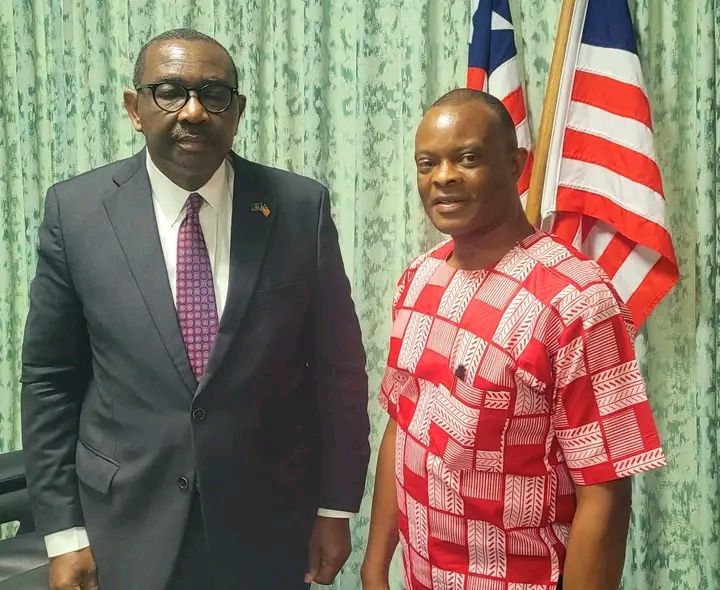
A leading humanitarian advocate is calling for a shift from punishment to rehabilitation in the case of popular religious commentator “Prophet Key,” arguing that Liberia has an opportunity to model a more restorative form of justice.
Ambassador Maxson Kpakio, Executive Director of HOPE Restored Foundation International, has appealed to Liberia’s Solicitor General and Minister of Justice, Hon. Natu Oswald Tweh, to intervene in the six‑month prison sentence recently imposed on Prophet Key by the full bench of the Supreme Court of Liberia.
While explicitly respecting the authority and decision of the Court, Ambassador Kpakio believes the length and nature of the punishment are disproportionate and could be transformed into something more constructive. He is urging the Justice Ministry to consider reducing the sentence and converting it into between 300 and 400 hours of community service.
According to Ambassador Kpakio, placing Prophet Key in direct service to the public would still hold him accountable, but in a way that benefits the very communities affected by harmful conduct. He argues that community service would send a powerful message that justice in Liberia is not only about confinement, but also about correction, responsibility, and reconciliation.
“Assigning Prophet Key to 300 to 400 hours of community service, rather than keeping him behind bars, would send a stronger signal to the public,” Kpakio maintained. He emphasized that such an approach would demonstrate that the justice system can be both firm and compassionate—insisting on consequences while still believing in the possibility of change.
He further noted that community service is widely used around the world as an alternative form of punishment, particularly in non‑violent cases, and could allow the religious figure to “pay his debt in the community” by engaging in meaningful, visible work that improves society rather than isolating him from it.
As of now, the Ministry of Justice has not issued any public response to Ambassador Kpakio’s appeal, leaving many observers watching closely to see whether the government will embrace a more restorative model of justice in this high‑profile case.


