


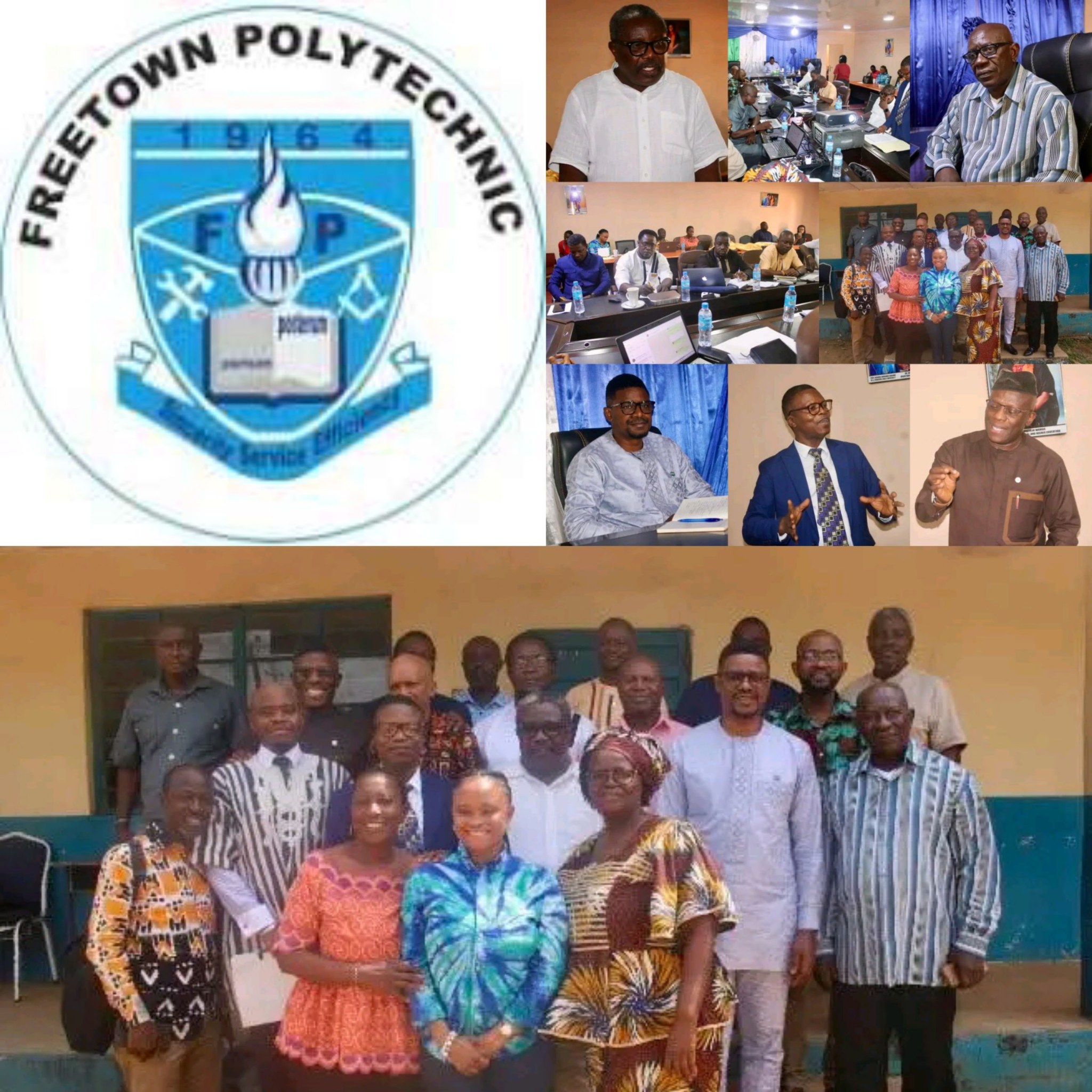
Freetown, Sierra Leone February 17,2026;– A quiet policy meeting at Freetown Polytechnic’s Jui Campus has turned into a clear warning to universities across the country: raise your standards, clean up your data, or face consequences.
At a high‑level engagement on institutional management and quality assurance, the Ministry of Technical and Higher Education (MTHE) brought together vice chancellors, registrars, quality assurance officers, regulators, and senior government officials to confront the growing crisis of overcrowded classes, weak assessment systems, and unaccredited programs.
Deputy Minister Sarjoh Aziz‑Kamara used the platform to send an unmistakable message. He insisted that quality assurance is now at the heart of government reforms—not a box‑ticking exercise. Public universities have been ordered to submit complete enrollment and program data going back to 2018, with sanctions promised for any institution that fails to comply. He also pressed universities to digitize their management systems and align with global standards under new laws such as the 2025 Tertiary Education Commission Act, the National TVET Act, the Dual Apprenticeship Policy, and the ongoing review of the 2021 Education Act.
Chief Technical and Higher Education Officer, Dr. Josephus Brimah, warned that Sierra Leone cannot talk about national development while running fragmented, outdated qualification systems. He announced work toward a unified national qualifications framework for higher and technical education, including policies for credit transfer and recognition of prior learning, so students can move more easily between institutions and pathways. He urged universities to improve data systems, go digital, and take professionalism and continuous training of lecturers seriously if they want to be trusted at home and abroad.
Freetown Polytechnic Principal, Dr. Samba Moriba, shifted the focus to what happens inside lecture rooms. He stressed that quality assurance must touch curriculum relevance, staff performance, student welfare, and administrative efficiency—not just paperwork for accreditation visits. Internal monitoring, he argued, must be matched by tough external scrutiny to truly lift academic standards.
In a hard‑hitting presentation on legal compliance, MTHE Director of Higher Education, Emmanuel J. Momoh, cautioned institutions against running unaccredited programs and operating outside the Universities Act 2021 and national quality benchmarks. He listed serious challenges: a shortage of PhD‑qualified staff, an over‑reliance on part‑time teaching, overcrowded halls, weak exam systems, and poor mechanisms to tackle plagiarism and research ethics. Momoh urged universities to scrap or reform “irrelevant” or under‑resourced programs and tie their offerings more directly to national priorities like agriculture, mining, governance, health, science, maritime studies, and the digital economy.
Civil Service Training College Principal, Dr. Victor Massaquoi, reminded participants that quality assurance starts at the top. Without strong leadership, clear accountability, and dedicated budgets for quality systems, no institution can deliver credible teaching or maintain accreditation. He insisted that no academic program should operate without clearance from the Tertiary Education Commission.
By the end of the engagement, one message stood out: the era of lax oversight is ending. The Ministry is pushing universities toward a culture where data is accurate, programs are accredited, lecturers are qualified, and students receive an education that truly matches both national needs and international standards. For thousands of young Sierra Leoneans investing in degrees, these reforms could be the difference between a certificate that opens doors—and one that is quietly ignored.


