


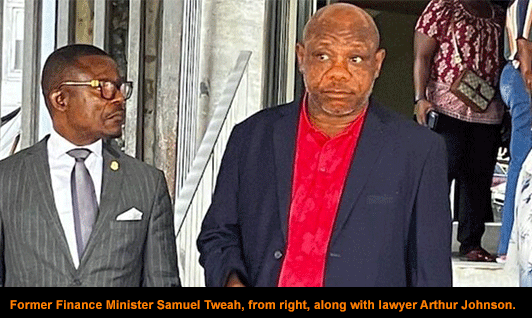
In a decision with far-reaching constitutional implications, the Supreme Court of Liberia has reaffirmed that former Finance Minister Samuel D. Tweah and four other ex-officials are not protected by presidential immunity and must face prosecution in an ongoing criminal case.
The ruling, delivered on February 12, 2026, denies a petition for re-argument filed by Tweah and his co-petitioners, effectively reinforcing the Court’s December 18, 2025 opinion. That earlier judgment had rejected their request for a writ of prohibition aimed at halting criminal proceedings against them.
The Core Legal Question: Can Presidential Immunity Be Extended?
The former officials argued that their roles as members of the National Security Council (NSC), operating under the Office of the President, entitled them to the same constitutional immunity granted to the President under Article 61 of the Liberian Constitution.
Alongside Tweah, the petitioners include: Cllr. Nyenati Tuan, former Acting Minister of Justice Stanley S. Ford, former Director of the Financial Intelligence Agency D. Moses P. Cooper, former FIA Comptroller, and Jefferson Karmoh, former National Security Advisor
They face multiple charges, including economic sabotage, theft of property, money laundering, criminal facilitation, and criminal conspiracy.
However, the Supreme Court drew a clear constitutional boundary: presidential immunity is personal to the President and does not extend to advisors, council members, or officials operating within the Executive Branch.
Justice Boakai N. Kanneh, delivering the opinion, emphasized that immunity “springs from the Constitution” and is not transferable. The Court held that merely functioning within the Office of the President does not create derivative immunity.
A Technical Error, But No Substantive Impact
In seeking re-argument, the petitioners contended that the Court relied on an incorrect statutory citation in its earlier ruling, referencing Section 2(g) instead of Section 3(b) of the National Security Reform and Intelligence Act of 2011.
The Court acknowledged the miscitation but deemed it legally harmless. The Justices reasoned that even under the correct statutory provision, no law confers immunity on NSC members. The correction, therefore, had no bearing on the outcome.
The ruling reinforces a central principle of statutory interpretation: courts may not add to or subtract from legislation where the language is clear.
Re-Argument Is Not a Second Appeal
Significantly, the Court clarified the procedural limits of a petition for re-argument. Such petitions are granted only when the Court has overlooked or misapprehended a material point of fact or law. They are not vehicles for re-litigating issues merely because a party disagrees with the Court’s reasoning.
The petitioners, the Court concluded, failed to meet this threshold.
Separation of Powers and Accountability
The decision carries broader constitutional weight. By rejecting derivative immunity claims, the Court reinforced the doctrine of accountability within the Executive Branch. While national security functions may require discretion, they do not exempt officials from scrutiny where criminal conduct is alleged.
The Court has instructed its Clerk to issue a mandate directing the lower court to resume jurisdiction and proceed with trial in the First Judicial Circuit Court, Criminal Assizes “C,” Montserrado County.
Chief Justice Yamie Quiqui Gbeisay, Sr., along with Associate Justices Yussif D. Kaba and Boakai N. Kanneh, signed the judgment. Associate Justices Jamesetta Howard Wolokolie and Ceaineh D. Clinton-Johnson recused themselves.
A Constitutional Line Drawn
The ruling signals a firm judicial stance: executive proximity does not equal constitutional protection. Immunity, where granted, must be explicit—not implied.
With the path cleared for prosecution, the legal battle now shifts from constitutional shielding to evidentiary scrutiny in open court. The broader message is unmistakable—public office does not confer permanent insulation from the rule of law.


