


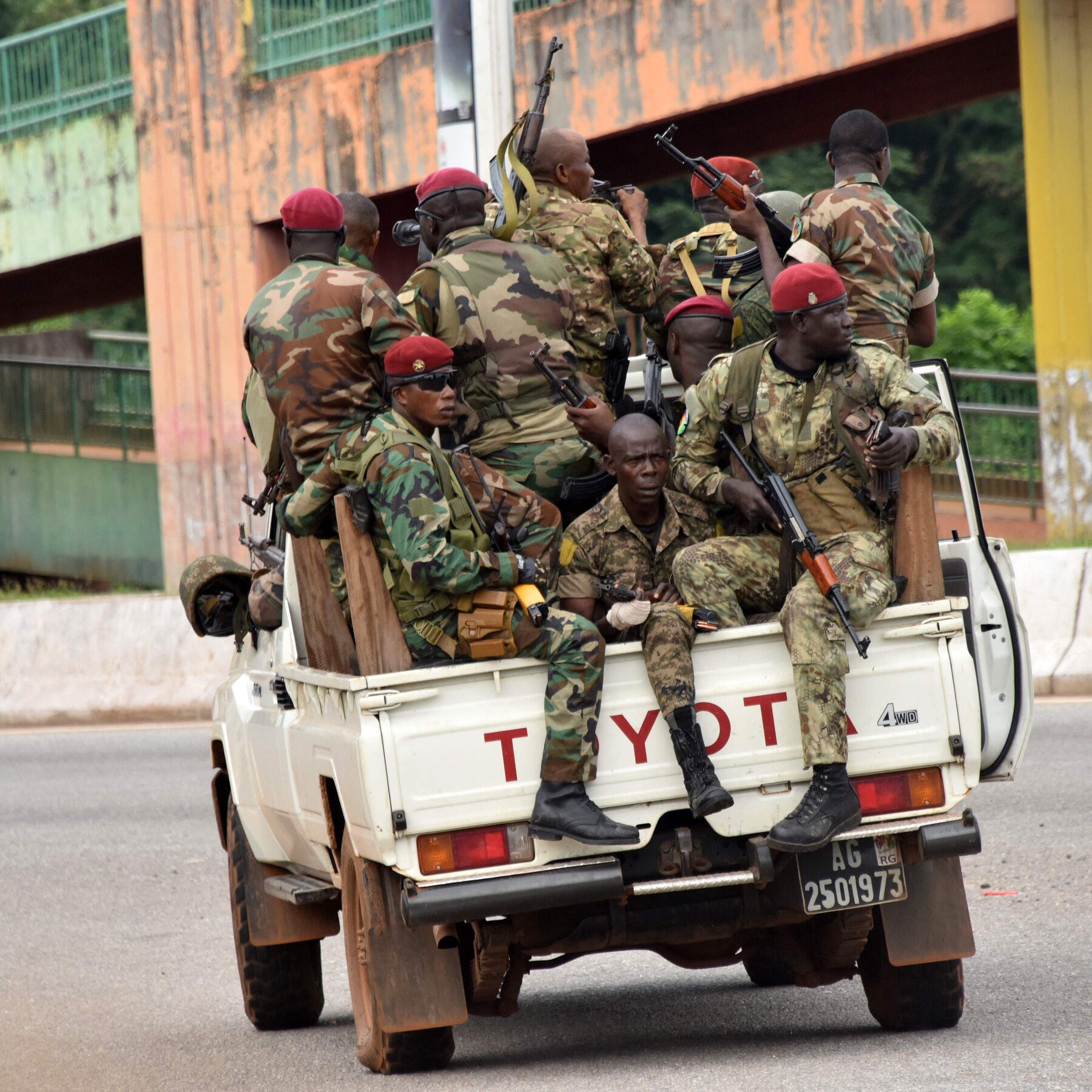
A recent military deployment ordered by Mamady Doumbouya, President of Guinea, to the frontier with Liberia is raising broader questions about the evolving security dynamics along the two countries’ shared border and the potential implications for stability in the Mano River basin.
Reports indicate that the Guinean government has dispatched a sizable military contingent to the border area, including armored vehicles, artillery units, and a helicopter, accompanied by a ceremonial presentation of the national flag to the troops. While such deployments can be framed as routine measures to reinforce territorial protection, the scale and symbolism of the operation suggest a deliberate message—both domestically and regionally—about Guinea’s posture in the ongoing border dispute.
The troops are being positioned near the Sorlumba area in Lofa County, a location that has recently become a focal point of tension between local communities and authorities on both sides of the frontier. Analysts note that disputes in this zone are rooted in historical ambiguities over boundary demarcation, which periodically resurface when competing claims or security incidents arise.
Addressing the soldiers prior to their deployment, President Doumbouya framed the mission as part of a broader national responsibility to defend Guinea’s territorial integrity. He portrayed the troops as guardians of national unity and resilience, emphasizing that the protection of inherited territory remains a fundamental obligation of the state.
“You, soldiers of Guinea, represent the unity, strength, and resilience of our nation,” Doumbouya told the troops. “At a time when our homeland faces challenges, your commitment and dedication are more important than ever.”
The symbolic handing over of the Guinean flag to the soldiers carried an additional layer of political messaging. In military tradition, such gestures often reinforce not only the legitimacy of the mission but also the expectation that troops will defend national territory without compromise. Doumbouya underscored this point by declaring that no land inherited from Guinea’s ancestors would be surrendered.
Beyond the rhetoric, the deployment appears to reflect a calculated effort by the Guinean leadership to project resolve in a sensitive border region. Security observers argue that while the move may be intended as a deterrent or a demonstration of sovereignty, it also risks increasing anxiety among border communities who depend on cross-border trade and interaction for their livelihoods.
The situation also highlights a familiar challenge in West Africa, where colonial-era boundary lines often left unresolved demarcation issues. When combined with local land disputes and weak border management structures, these ambiguities can easily escalate into diplomatic friction or localized confrontations.
For Liberia, the development places renewed pressure on authorities to carefully manage relations with its northern neighbor while reassuring residents in Lofa County that the situation will not deteriorate into a broader security crisis.
Ultimately, the current standoff illustrates how territorial disputes, even in relatively remote areas, can quickly evolve into matters of national pride and regional security. Whether the deployment serves as a temporary show of force or signals a deeper geopolitical tension will likely depend on the willingness of both governments to pursue diplomatic engagement alongside their security measures.


